
$3.2 MILLION FOR NOTHING.
HOW MALPRACTICE INSURANCE QUIETLY TRANSFERS PHYSICIAN WEALTH.

$100,000 a year. For 32 years. That’s $3.2 million.
That is what a neurosurgeon pays in malpractice premiums over a career.
At retirement, that physician receives exactly nothing in return.
No residual asset.
No balance sheet entry.
No participation in the investment income generated by their own premiums.
The carrier kept the float.
The carrier invested it.
The carrier retained the underwriting profit.
The physician paid the bill.
In Today’s Article
How malpractice insurers turn mandatory premiums into long-term investment portfolios
The 548,000 physicians who directly fund this system
Why 75% of hospitals abandoned commercial malpractice decades ago
The math that converts $3.2 million in career premiums into ~$12.5 million in terminal value
A glossary at the end for reference
The Market Nobody Talks About
The U.S. medical malpractice insurance market generates approximately $12.5 billion in annual premiums and insures roughly 1 million physicians.
Estimates vary by source, but the directional structure of the market is stable:
548,000 physicians purchase their own malpractice coverage
349,000 physicians are covered under employer or hospital policies
52,500 physicians practice without insurance entirely
The 548,000 physicians who purchase their own coverage represent approximately $6.9 billion in annual premiums.
These physicians have direct control over their insurance decisions.
They are also unknowingly building someone else’s balance sheet.
What Your Premium Actually Does
Every malpractice premium performs three functions:
It pays claims when they occur
It covers the insurer’s operating costs
It becomes invested capital
In a traditional commercial policy, the physician benefits only from the first function.
The third function, the investment of capital over decades, belongs entirely to the carrier.
You are renting protection.
They are accumulating wealth.
Who Controls the Market
The top five carriers control approximately 44% of the malpractice insurance market:
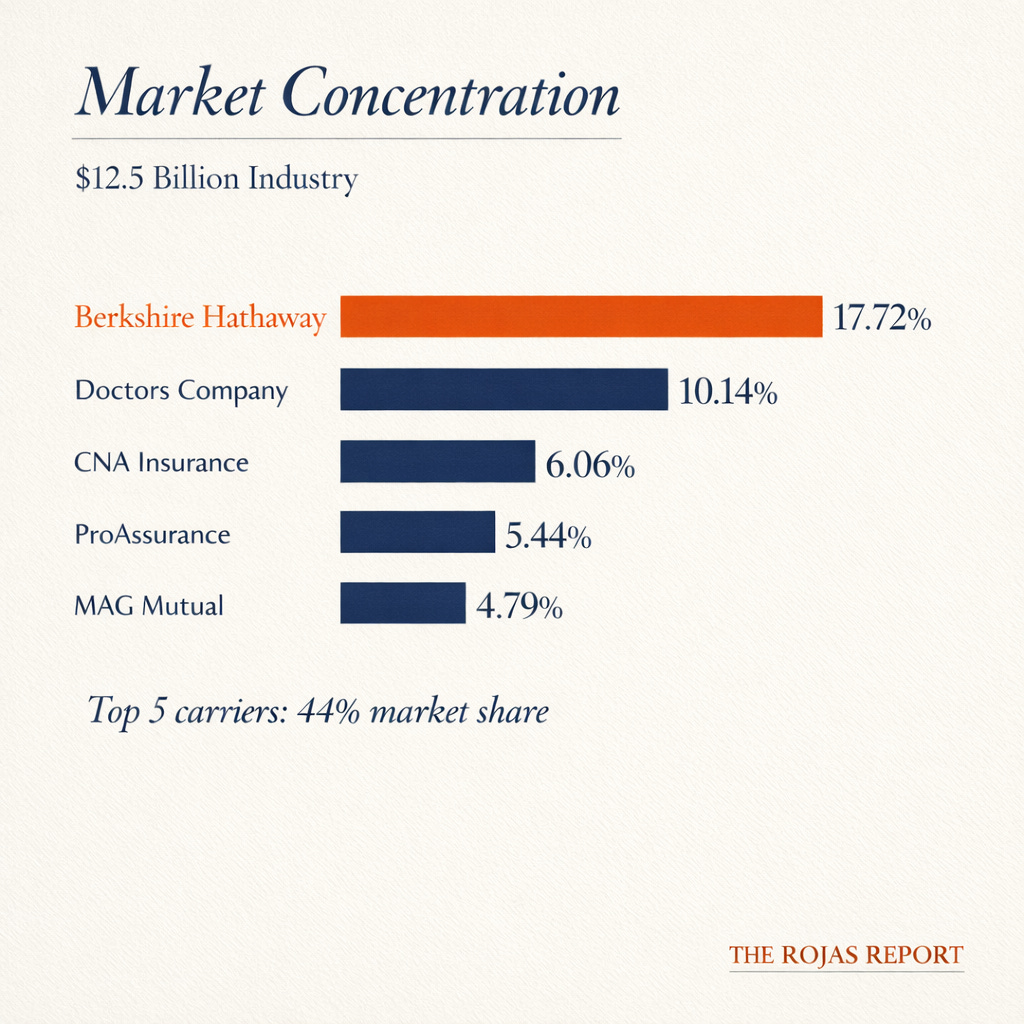
Physician-owned mutuals control roughly 25% of the market.
Commercial carriers control the remaining 75%.
Here is the number that matters more than all of that:
Healthcare REITs, Commercial property owners, Manufacturers, and health systems already use alternative risk structures, including captive insurance.
These structures are fully regulated, widely used, and well-established across multiple industries.
Large healthcare organizations identified this structural advantage decades ago. Independent physicians, meanwhile, continue writing checks to Berkshire Hathaway.
