
340B Wasn’t Stolen From Rural Hospitals. It Was Built On Their Graves.
The program Congress designed to save safety-net communities became the financing engine for the systems that replaced them.

206 rural hospitals have closed since 2010.
340B grew to $81 billion in the same period.
The program designed to save them was funding the machine that replaced them.
IN TODAY’S ARTICLE:
340B grew to $81 billion while 206 rural hospitals closed. The program’s own data indicts the program’s defense.
Where the $66.4 billion spread actually went: five publicly traded chains and PBMs, not safety-net communities.
The dual-classification loophole: how urban hospitals reclassified as rural and captured benefits Congress wrote for critical access facilities.
The receipts: named systems, named executives, named compensation figures, sourced from IRS Form 990 filings.
Glossary at the bottom of today’s article.
THE SCOREBOARD NOBODY READS
A small hospital in Waverly, Tennessee. Humphreys County. Rural. Struggling. Participating in the 340B program, Congress designed to stretch scarce resources for communities exactly like this one.
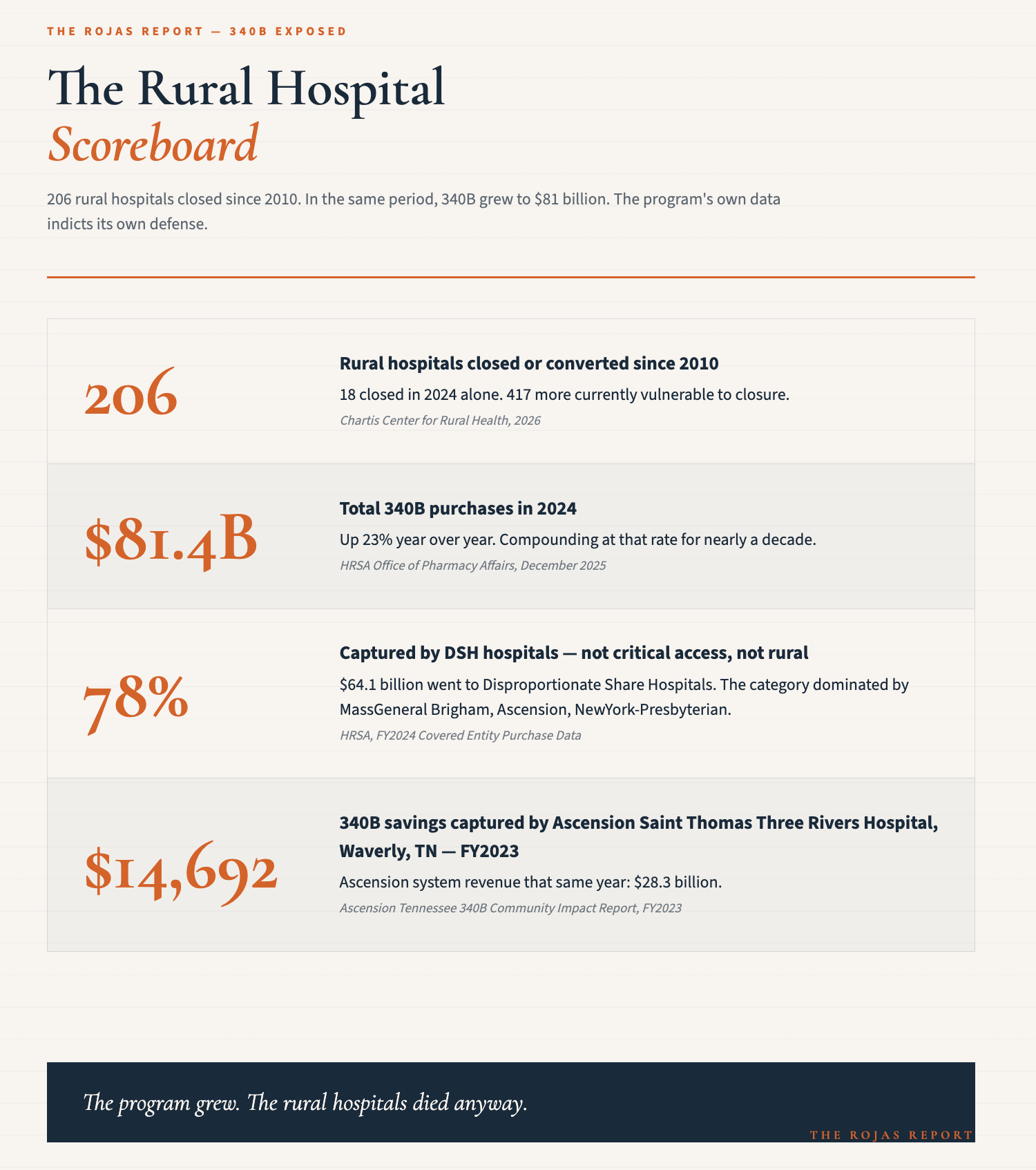
In fiscal year 2023, Ascension Saint Thomas Three Rivers Hospital captured $14,692 in 340B savings.
Ascension, the system that owns it, reported $28.3 billion in total operating revenue that year.
That is the 340B program. Not the press release. The program.
The American Hospital Association has one remaining argument for 340B: rural hospitals need it to survive. Take it away, and rural communities lose access to care. People get hurt. You are the villain.
The data runs the other way.
The Chartis Center for Rural Health tracks every rural hospital closure in America. Their February 2026 report counts 206 rural hospitals that have closed or converted to models that exclude inpatient care since 2010. That number includes the 18 that closed or converted in 2024 alone. It includes the accelerating pace of closures in Tennessee, Texas, Kansas, Mississippi, and Oklahoma.
206 rural hospitals are gone. 417 more are currently vulnerable to closure. 46% of all rural hospitals were operating at a negative margin in 2025.
340B grew every single year during this period. The program hit $81.4 billion in purchases in 2024, up 23% year over year. It has compounded at roughly that rate for the better part of a decade.
The program grew.
The rural hospitals died anyway.
The system isn’t broken.
It’s working exactly as designed.
$100M lobbying contrast → anger has a use → $49.99/$300 tiers → series tease → subscribe button.
