
$441 Million. $1.3 Billion. $2.3 Billion. The Going Rate for Everything Physicians Built.
Physicians built their own insurance companies in 1975. What they did next explains everything they do not own today.

Rojas Actual,
Physicians spent fifty years complaining about insurance companies.
Strange complaint.
They built their own once. 1975. It worked.
Then peace broke out.
And they sold.
IN TODAY’S ARTICLE:
3 weeks ago, the last two physician-built malpractice giants became one company. The Doctors Company closed its $1.3 billion purchase of ProAssurance on June 26. Fifty years of physician-built insurance finished consolidating.
The 1975 crisis proved physicians can own the insurance layer. Alabama physicians capitalized their own carrier at $1,000 apiece. Northern California physicians built NORCAL. The infrastructure worked.
The same refusal repeats across every layer: lobbying, direct contracts, employer clinics, ASCs, billing, brokers. Physicians declined to own each one. Someone else collects the rent now.
The pattern has a name. Build in crisis. Sell in peace. Rent back what you built. And there is one structure that finishes what 1975 started.
Glossary at the bottom of today’s article.
THE CRISIS BUILD
Go back to 1975.
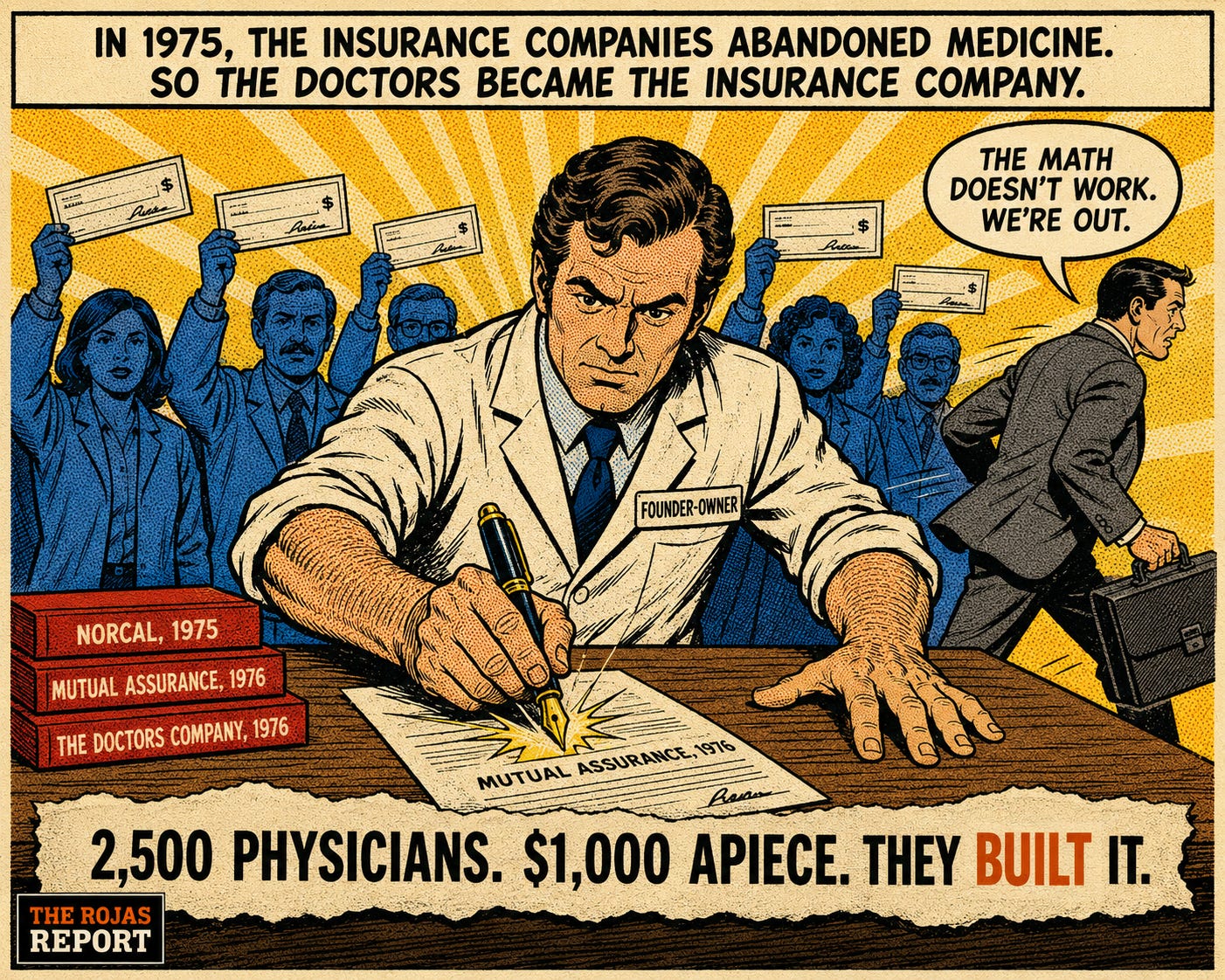
The commercial carriers abandoned medicine. Claims frequency exploded. Jury awards exploded. The companies that insured physicians looked at the math and walked. In Alabama, the carrier that brokered nearly 90 percent of physician coverage exited the market around 1973. Physicians searched locally for replacement coverage. Nothing. They went to Europe. Nothing.
So they built their own.
Roughly 2,500 Alabama physicians put up $1,000 apiece and formed Mutual Assurance.
It wrote its first policy on April 1, 1977.
The founding physicians gave the company two mandates: stay financially sound, and stop settling meritless cases for nuisance value.
Fight them instead.
The same year, Northern California physicians built NORCAL Mutual. California passed MICRA in 1975 because the crisis was existential there too. The Doctors Company followed in 1976, physician-founded, physician-governed, built in Napa while the commercial market burned.
Understand what this proves.
Physicians did not need permission to own the insurance layer. They did not need a carrier, a hospital system, or a private equity sponsor. They needed a crisis sharp enough to force the decision. When survival demanded ownership, physicians wrote checks, capitalized companies, and ran them.
The infrastructure worked. Mutual Assurance became one of the first policyholder-founded companies rated by AM Best. NORCAL became one of the leading medical professional liability writers in the country. Physician-owned. Physician-directed. Surplus accumulating year after year inside companies the policyholders controlled.
That was the peak of physician ownership in America.
Then the crisis passed.
The malpractice company is simply the easiest layer to see.
Every other layer follows the same script.
THE PEACETIME SALE
Here is what physicians did with the companies they built.
Mutual Assurance demutualized in 1991. First physician-founded insurance company to convert to a publicly traded stock company. The policyholder-owners became shareholders, then became sellers. Through a series of mergers, it became Medical Assurance, then ProAssurance in 2001. The physician mutual became a NYSE ticker.
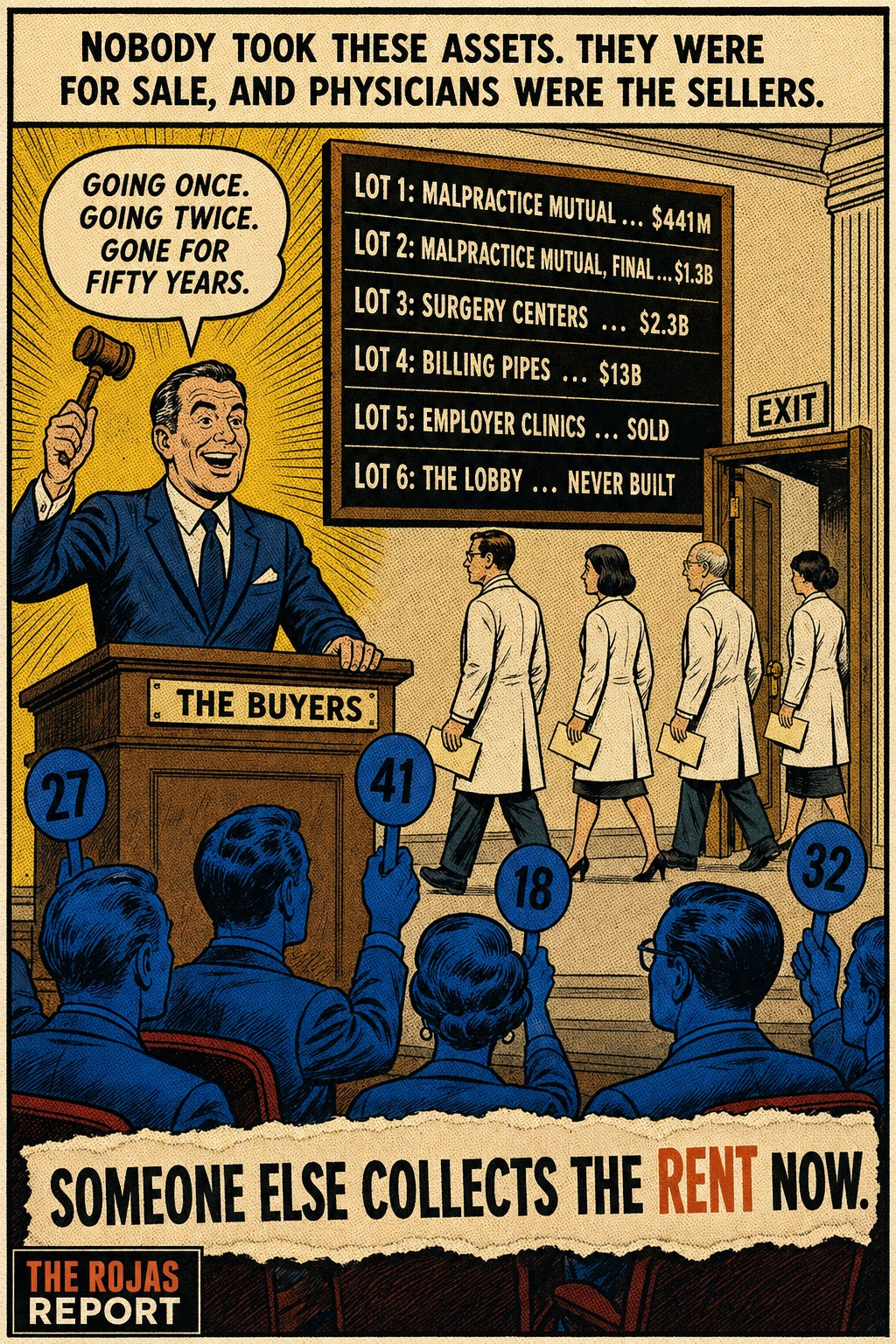
NORCAL held out longer. Forty-six years. Then in 2021, its members voted to demutualize. On May 5, 2021, ProAssurance completed the acquisition. Base consideration at closing: $441 million.
Read the fine print on that transaction, because the fine print is the indictment.
ProAssurance funded the deal with $248 million in cash. A large slice of the remaining consideration came as contribution certificates, $191 million in principal with a fair value of $175 million, which are IOUs issued to NORCAL’s own policyholders and owed by NORCAL’s own successor company. The physicians who owned the company financed the sale of their own company to its buyer.
And one more line from ProAssurance’s 10-K. The company recognized a $74.4 million gain on bargain purchase the day the deal closed.
A gain on bargain purchase means the buyer’s accountants concluded they paid less than the fair value of what they bought. ProAssurance booked a $74.4 million profit from the purchase of NORCAL. The physicians sold half a century of accumulated surplus at a price so favorable to the buyer that GAAP required the buyer to record the discount as income.
Five years later, the consolidation finished. On June 26, 2026, The Doctors Company completed its acquisition of ProAssurance for $25 per share in cash. Total value: approximately $1.3 billion. The combined company holds $12 billion in assets and covers more than 200,000 healthcare professionals.
Fifty years of physician-built malpractice insurance now sits inside one surviving company.
The Doctors Company remains physician-owned, and that matters. But look at how the surviving structure treats the surplus. The Tribute Plan, created in 2007, contributes surplus dollars back to member physicians. It has distributed more than $175 million to roughly 14,000 members. The largest single payment on record: $264,808. Physicians collect it at retirement.
A discretionary award at the end of a career is a gold watch. It is not a structural right to your own underwriting profit, paid annually, while you practice. No malpractice company in America returns the annual underwriting profit to the physicians who generate it. The surplus sits in the company. It always sits in the company.
The physicians of 1975 built companies to survive. Their successors sold the companies and kept the premium invoices.
Physicians sold the insurance layer one closing at a time.
Then they paid retail to rent it back.Learn how to build your independence.
Join the 100,000 readers of The Rojas Report.Join them.
THE PATTERN EVERYWHERE ELSE
The malpractice arc is not an isolated story.
It is the master pattern.
Walk the other layers.
The lobby they never built. Hospitals fund the American Hospital Association and a constellation of state associations that shape reimbursement policy every session. Physicians fund organizations that license billing codes and sell them back to the profession. There is no physician-funded lobbying infrastructure with the budget, the discipline, or the permanence of the hospital lobby. The people whose payment rates get set in committee rooms never bought a seat at the door.
The contract they redlined to death. I have watched this one across two decades of building direct contracting companies. An employer offers a physician group a direct agreement: full payment, fast terms, no carrier in the middle. The group sends it to a lawyer. The lawyer returns forty redlines. Then the physician asks the question that explains everything.
“Will United cancel me if they find out?”
That is not a business question. That is a hostage asking the kidnapper for permission. The physicians who refused direct contracts were not protecting their practices. They were protecting their captivity.
The clinics they handed away. Employers wanted onsite and near-site clinics. Musculoskeletal groups were positioned better than anyone to build them: the conditions that drive employer health spending run straight through orthopedics. The groups declined. Non-physician operators built the employer clinic industry instead, and now those operators sit between physicians and the employers who buy their care.
The surgery centers they were locked out of. From the late 1990s through roughly 2012, securing buy-in from young surgeons for an ASC was a financing disaster. Senior partners hoarded the equity. The profession never built a financing vehicle for its own facility ownership.
Watch who bought the centers instead. In 2015, Tenet paid $425 million for control of United Surgical Partners International and held 95 percent by 2018. In January 2017, UnitedHealth’s Optum bought Surgical Care Affiliates for roughly $2.3 billion, acquiring 205 surgical facilities and roughly 3,000 physician partnerships in a single transaction.
The physicians in those centers kept operating.
The equity went to Dallas and Minnetonka.
The billing layer they routed through the adversary. Optum closed its $13 billion acquisition of Change Healthcare in October 2022 after beating a challenge from the Department of Justice. A massive share of physician claims, remittances, and payment data now flows through infrastructure owned by the largest carrier’s parent. Physicians watched the pipes get bought and kept pumping their revenue through them.
The broker layer they never touched. Employers decide benefits through brokers and TPAs. Those intermediaries decide which networks live, which direct deals die, and which physicians get steered to. Physicians never built a competing broker channel. They wait at the end of a distribution system someone else owns.
And the structure hospitals kept for themselves. While physicians were selling their mutuals, hospital systems were quietly running the exact structure physicians abandoned. The Cayman Islands Monetary Authority’s public licensee register lists captive insurance companies owned by Ascension, Rush, Baystate, Dignity Health, Christiana Care, and Saint Luke’s. Hospital systems have retained their own underwriting profit offshore for decades. The majority of Maryland hospitals hold offshore captives, per Maryland Hospital Association testimony.
Hospitals never sold their insurance layer.
They domiciled it in the Cayman Islands and kept the surplus.
THE VERDICT
The pattern holds across fifty years and every layer of the industry.
Physicians build in crisis. Physicians sell in peace. Then physicians rent back what they built at retail to buyers who booked a bargain-purchase gain on the way in.
Nobody took these assets. No law forced the NORCAL sale. No regulator ordered MSK groups out of the employer clinic business. No statute barred a physician-owned broker channel or a physician-owned claims clearinghouse. Each layer was available. Each layer was declined.
The system is working exactly as designed. The design just assumed physicians would keep refusing to take ownership of anything. So far, the assumption has paid.
Here is my disclosure, because I am not writing this from the bleachers. I build captives for physician organizations. Most recently, I partnered with an experienced team of physicians to build a new medical malpractice company that structures the underwriting profit to benefit the physicians who generate it, every year, not as a gold watch at retirement.
Owning your own insurance company is not a new idea. They first captives were formalized in the 15th century. The physicians of the crisis era got the first half right: own the insurance company. The second half is the part their successors fumbled: never sell it, and take your surplus home every year.
Fifty years of receipts say physicians only build when the building is on fire.
The building is on fire.
Time to build.
-Rojas out.

GLOSSARY
Mutual insurance company: An insurance company owned by its policyholders rather than shareholders. Underwriting profit belongs to the member-owners.
Demutualization: The conversion of a policyholder-owned mutual into a stock company. Ownership shifts from policyholders to shareholders, and the accumulated surplus becomes sellable equity.
MICRA: The Medical Injury Compensation Reform Act, passed by California in 1975 during the malpractice crisis that triggered the physician mutual movement.
Contribution certificates: Debt-like instruments issued to NORCAL policyholders in the demutualization, owed by NORCAL’s successor company. Principal amount $191 million, fair value $175 million at closing.
Gain on bargain purchase: An accounting gain a buyer records when the price paid is below the fair value of the net assets acquired. ProAssurance recognized $74.4 million on the NORCAL acquisition.
Tribute Plan: The Doctors Company’s program, created in 2007, that contributes surplus dollars to member physicians, collected at retirement. Discretionary, not a structural annual right to underwriting profit.
Direct contract: An agreement between a physician group and an employer or its plan for medical services at negotiated rates, bypassing the carrier network.
ASC: Ambulatory surgery center. An outpatient surgical facility, historically physician-owned, now consolidated heavily under Tenet’s USPI and Optum’s SCA Health.
Captive insurance company: An insurance company owned by the entity it insures, used to retain underwriting profit and investment income that would otherwise accrue to a commercial carrier.
SOURCES
ProAssurance Corporation. Form 8-K, May 5, 2021. “ProAssurance Completes NORCAL Transaction.” (Base consideration $441 million at closing; member approval April 26, 2021.) https://www.sec.gov/Archives/edgar/data/1127703/000177734321000023/pra-20210505xnorcal_closex.htm
ProAssurance Corporation. Form 10-K, fiscal year 2021. (Total consideration $448.8 million; $248 million cash; contribution certificates $191 million principal, $175 million fair value; contingent consideration up to $84 million; $74.4 million gain on bargain purchase.) https://www.sec.gov/Archives/edgar/data/1127703/000187524622000003/pra-20211231.htm
The Doctors Company. Press release, June 26, 2026. “The Doctors Company Completes Acquisition of ProAssurance Corporation.” ($25.00 per share; approximately $1.3 billion; 200,000+ professionals; $12 billion combined assets.) https://www.thedoctors.com/about-the-doctors-company/newsroom/press-releases/2026/the-doctors-companycompletes-acquisitionofproassurance-corporation
ProAssurance Group corporate history. (Mutual Assurance formed 1976 by Alabama physicians; NORCAL Mutual founded 1975 by Northern California physicians; Mutual Assurance among first policyholder-founded companies rated by AM Best.) https://proassurancegroup.com/company-history
Business Alabama, 2025. “ProAssurance being acquired by The Doctors Company.” (Mutual Assurance formed 1976 by Alabama physicians after the medical association-endorsed carrier abandoned the market; first physician-founded company to demutualize, 1991.) https://businessalabama.com/proassurance-being-acquired-by-the-doctors-company/
Birmingham Medical News, 2025. “The Doctors Company Buys ProAssurance.” (Approximately 2,500 Alabama physicians at $1,000 apiece; first policy April 1, 1977; founding mandates; Tribute Plan created 2007, more than $175 million distributed to almost 14,000 members, largest payment $264,808.) https://www.birminghammedicalnews.com/article/9189/the-doctors-company-buys-proassurance
Optum / Surgical Care Affiliates. Joint press release via SEC Form 425, January 9, 2017. ($57.00 per share; approximately $2.3 billion; 205 surgical facilities; approximately 3,000 physicians; TPG affiliates approximately 30 percent.) https://www.sec.gov/Archives/edgar/data/0001411574/000119312517005204/d505217dex991.htm
Tenet Healthcare Corporation. Press release, March 23, 2015. ($425 million cash for 50.1 percent of USPI joint venture; approximately $1.5 billion USPI debt; put/call path to full ownership.) https://investor.tenethealth.com/press-releases/press-release-details/2015/Tenet-United-Surgical-Partners-International-and-Welsh-Carson-to-Create-the-Nations-Largest-Ambulatory-Surgery-Platform/default.aspx
Tenet Healthcare Corporation. Press release, April 26, 2018. “Tenet Completes Purchase of USPI from WCAS.” ($630 million for the remaining WCAS 15 percent; ownership increased to 95 percent.) https://investor.tenethealth.com/press-releases/press-release-details/2018/Tenet-Completes-Purchase-of-USPI-from-WCAS/default.aspx
Optum. Press release, October 3, 2022. “Optum and Change Healthcare Complete Combination.” https://www.unitedhealthgroup.com/newsroom/2022/2022-10-3-optum-change-healthcare-combination.html
Forbes, October 3, 2022. “UnitedHealth Group’s Optum Closes $13 Billion Change Healthcare Deal.” (Deal completed after defeating the Department of Justice challenge.) https://www.forbes.com/sites/brucejapsen/2022/10/03/unitedhealth-closes-optums-13-billion-change-healthcare-deal/
Cayman Islands Monetary Authority. Entity search and licensee registers. (Captive licensees owned by hospital systems including Ascension, Rush, Baystate, Dignity Health, Christiana Care, and Saint Luke’s.) https://www.cima.ky/search-entities-cima
The Baltimore Banner, April 6, 2026. “How the Cayman Islands helped Maryland hospitals avoid taxes.” https://www.thebanner.com/politics-power/state-government/maryland-hospitals-cayman-islands-tax-JDUND7G5XJCJZOSTU2MNZI6KOI/
The Baltimore Banner, April 8, 2026. “Lawmakers question pause on Maryland hospitals’ insurance tax collections.” (Whistleblower testimony: at least 10 nonprofit hospitals, at least $1.8 billion offshore; SB 890 tax pause and study.) https://www.thebanner.com/politics-power/state-government/maryland-hospital-insurance-tax-pause-J5O35RY7FFF6VNPWHGTRAQFMGU/