
$71.8 Million. That's How Much the Middleman Took From Your Practice Over 30 Years.
One practice. One career. $480,000 per year bled to insurance carriers for the crime of staying independent. Compounded over 30 years, 80% of the destruction is interest you never earned.

They didn’t sell because they wanted to.
They sold because their malpractice tripled. Their benefits cost 50% more than the hospital across town. Their Medicare reimbursement has declined by 33% in real dollars since 2001.
They sold because no one built what independent practices actually needed.
Then I met with groups of physicians across the country who were passionate about the independent practice of medicine.
IN TODAY’S ARTICLE:
The structural tax on independence that extracts $480,000 per year from every 50-employee practice. Dutch talks about it incessantly.
The Avalere data that proves independent physicians deliver the lowest-cost care in Medicare, and why the system punishes them for it
The infrastructure that gives independent physicians hospital-system economics without surrendering a single share of equity
Why I built it, who owns it, and what comes next
Glossary at the bottom of today’s article.
THE NUMBER THAT STARTED EVERYTHING
12%.
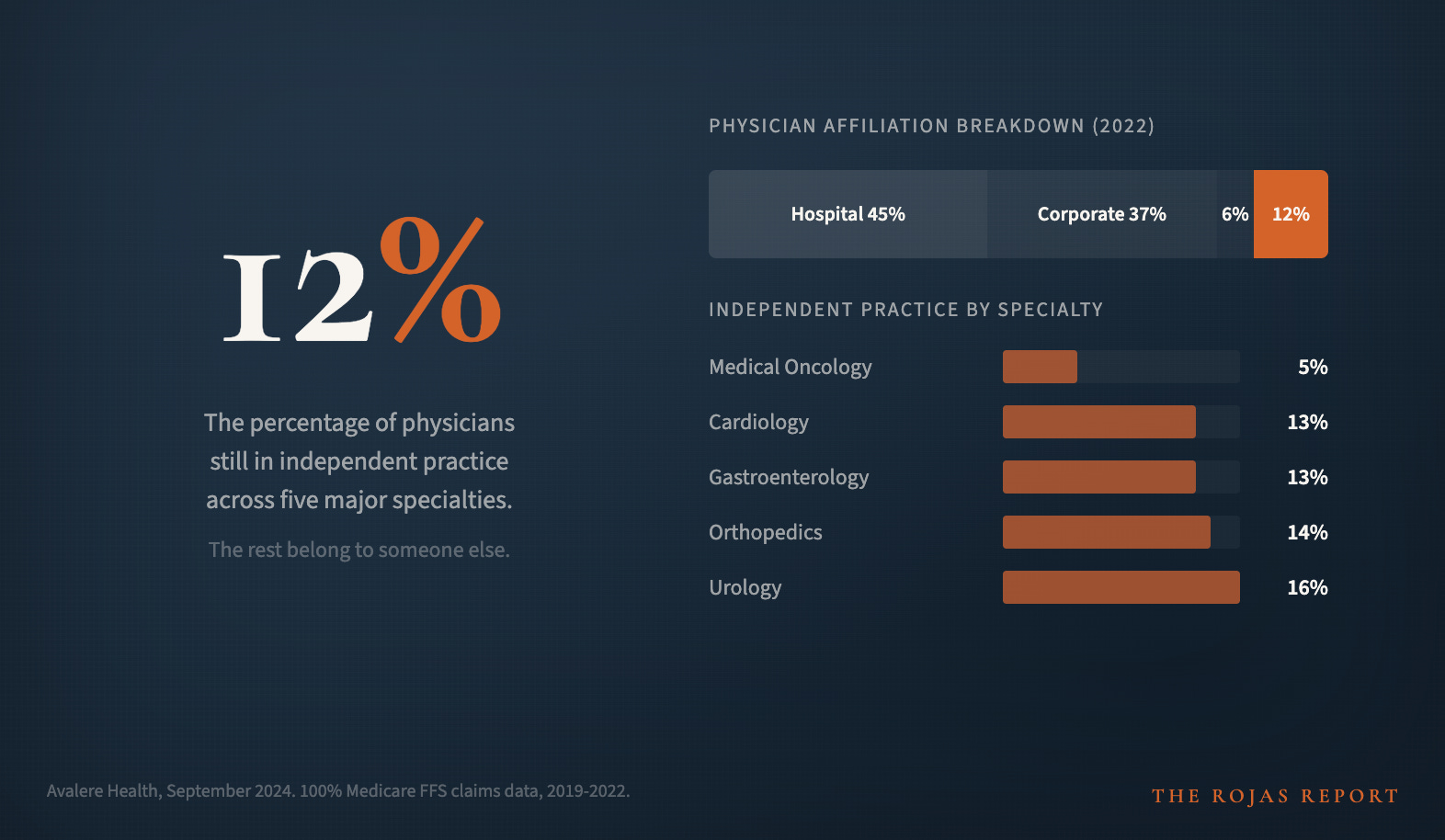
That is the percentage of physicians still in unaffiliated private practice across five of the highest-volume, highest-revenue specialties in American medicine: cardiology, gastroenterology, medical oncology, orthopedics, and urology.
Avalere Health analyzed 100% Medicare fee-for-service claims data from 2019 through 2022 across these five specialties. They tracked every physician. Every affiliation change. Every dollar. In medical oncology, 5% of physicians remain independent. In cardiology, 13%. Forty-five percent are now hospital-affiliated. Thirty-seven percent are corporate. Six percent are PE-backed.
Physician ownership dropped from 53.2% to 35.4% over the last 12 years. Hospital employment climbed from 23.4% to 34.5%. Private equity now controls 6.5% of all physicians and over 30% in gastroenterology, dermatology, and ophthalmology.
The narrative from every industry conference, every consulting firm, every health system CEO is the same: consolidation is inevitable. Independent practice is dying. Get on the bus or get left behind.
They are half right. The trend is real. The conclusion is wrong.
Independent practice is not dying because physicians are bad at business. It is not dying because patients prefer hospital systems. It is not dying because the clinical model is broken.
It is dying because the economic infrastructure that supports it does not exist.
Until now.
THE $480,000 QUESTION
Take a 50-employee independent practice.
A physician-owned hospital.
A surgery center with a small staff.
Every one of them buys insurance. Employee health benefits. Malpractice. Property and casualty. Workers comp. Cyber liability. D&O coverage. All of it.
They buy it alone.
Practice by practice.
Facility by facility.
Retail pricing.
Small-group rates.
The health system across town buys the exact same coverage. Same carriers. Same products. Same claims process.
They pay 25% to 50% less.
Not because they negotiate better. Not because they have smarter administrators. Because they purchase as a single entity across thousands of employees. Insurance carriers price based on volume. Larger groups pay less. Smaller groups pay the independence tax.
Run the numbers on a single 50-employee facility. These are modeled estimates based on industry-standard rate differentials between small-group and large-group purchasing:
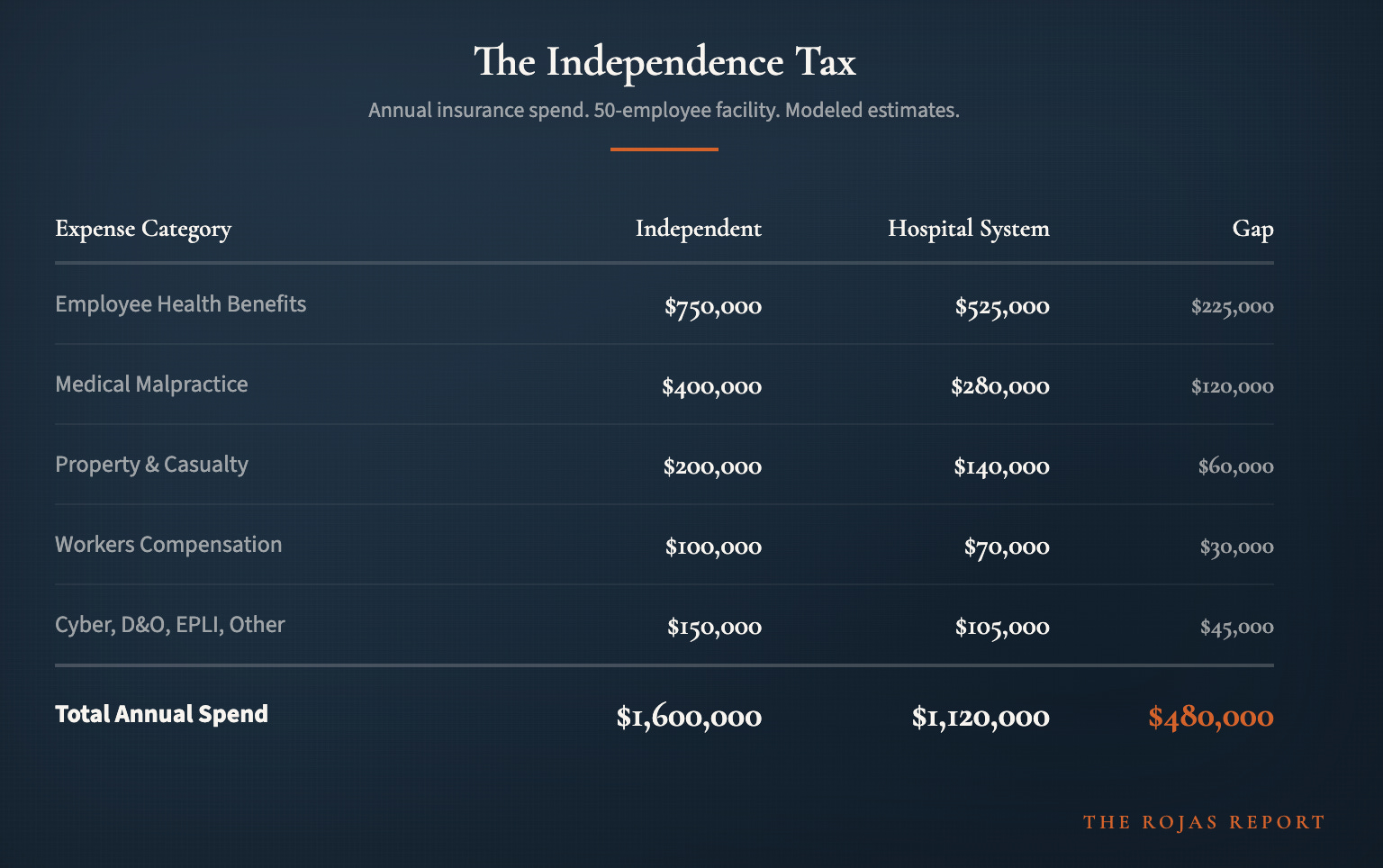
$480,000 per year.
Every year.
Not a one-time hit.
A permanent bleed.
I asked this question during an in-person visit, which included more than 100 practices. What would that money do if you kept it?
The S&P 500 has returned 9.5% annually in real terms over its history. That is the baseline for what capital does when it is not being lit on fire to subsidize your own extinction.
$480,000 per year, invested at 9.5%:
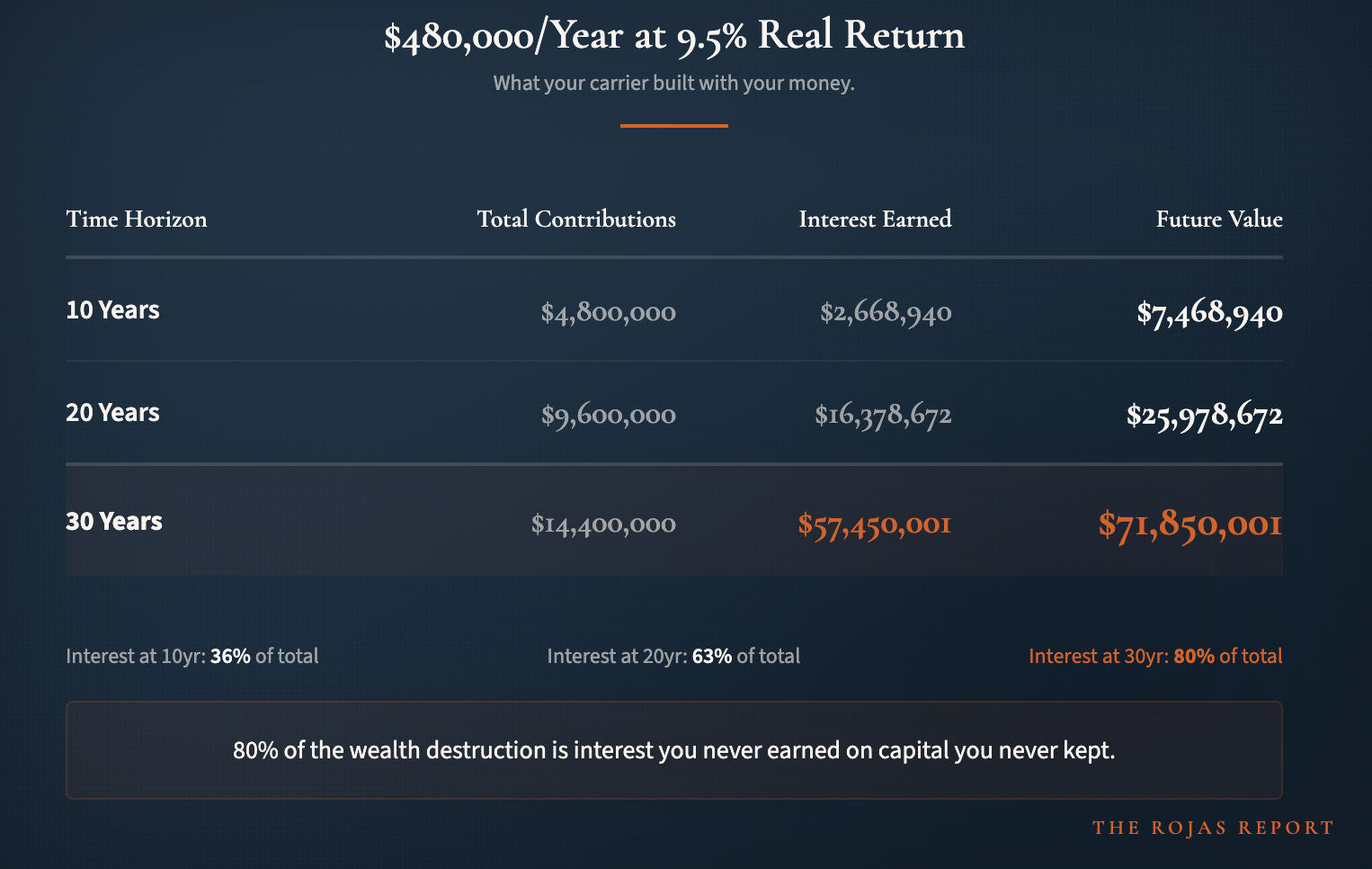
$57.4 million in compounding you did not see.
That number only surprises people who weren’t paying attention.
60,000+ physicians were. Subscribe.
