
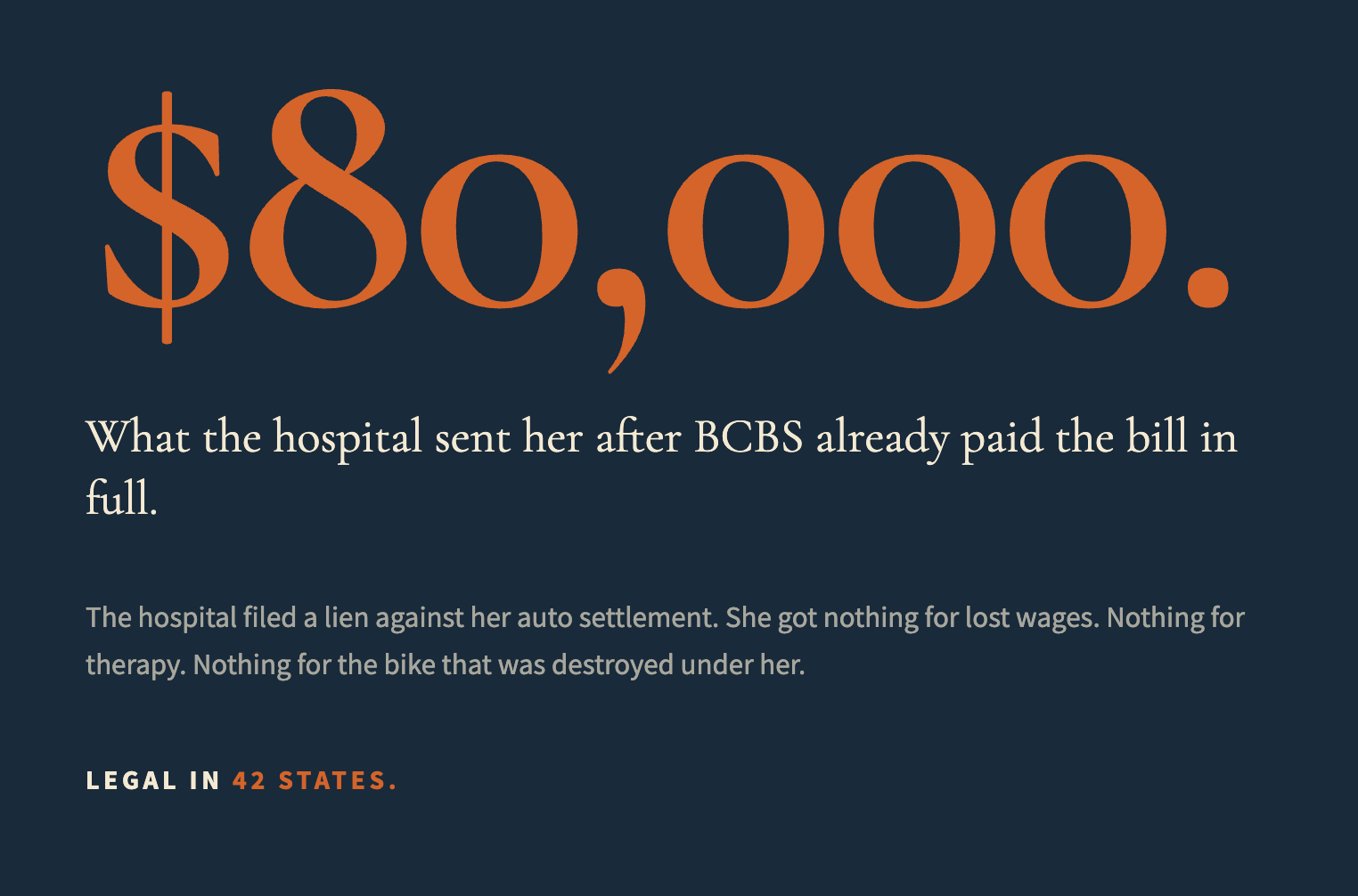
$80,000. That's What The Hospital Wanted After BCBS Already Paid The Bill In Full.
The hospital collects from the insurer, files a lien for the chargemaster on the auto settlement, and books the difference as charity care. One patient. Three revenue events.

Nancy was riding her bike to work when a car made an illegal turn and hit her. She was transported by ambulance to the hospital, where she stayed inpatient for a few days. Her BCBS plan paid the hospital its full contracted rate.
Two weeks later, a law firm representing the hospital sent Nancy a letter demanding $80,000 more, the chargemaster bill. BCBS had already paid the hospital in full, but the state lien statute let them collect twice. Nancy’s $50,000 auto settlement went to the hospital, leaving her with nothing for lost wages, pain, or her destroyed bike.
A 2020 Florida State University Law Review article documented the mechanism in writing. A Louisiana appellate court called the same practice disingenuous and somewhat deplorable. Forty-two states still permit it. The trade associations defend it in every Ways and Means hearing as community benefit.
IN TODAY’S ARTICLE:
Nonprofit hospitals use two lien mechanisms against insured accident victims. Both are recognized in court and legal in most states. Both typically result in the patient’s auto settlement being claimed by the hospital.
Pattern A. The hospital bills the insurer, accepts the contracted rate, and files a lien for the chargemaster spread against the auto settlement. The patient may pay twice. Nancy’s case illustrates this pattern.
Pattern B. The hospital does not bill the auto insurance company (the insurer) at all. Instead, the hospital files a lien, a legal claim, against the auto settlement for the full list price of services (called the chargemaster). The hospital then attempts to record the unbilled amount that could have been charged to insurance as a community benefit on the IRS Form 990, Schedule H. The St. Luke’s Kansas City class action lawsuit revealed this pattern.
Part 2 names the five channels of consideration hospitals receive for the “burden” they describe to lawmakers, and the September 2025 Ways and Means hearing that did not ask about any of them.
Glossary at the bottom of today’s article.
THE TWO PATTERNS
Hospital lien practice against insured accident victims runs through two distinct mechanisms. The trade associations describe both as community benefit. The revenue cycle vendors describe both as a collections strategy. Courts have ruled on both, sometimes in favor of the hospital, sometimes against. The state statutes accommodate both.
The patient outcome is identical. The auto settlement disappears. The accounting story the hospital tells about the BCBS portion is the only thing that changes.
Pattern A. The hospital bills the patient’s commercial insurance. The hospital accepts the contracted rate as payment (the discounted price negotiated with the insurer). The hospital then files a lien (a legal claim) against the auto settlement for the chargemaster spread (the difference between the amount paid by insurance and the hospital’s full listed price). The patient’s settlement goes to the hospital for the difference between what the insurer paid and what the hospital wishes it had collected.
Pattern B. The hospital does not bill the patient’s commercial insurance. The hospital files a lien against the auto settlement for the full chargemaster rate. The hospital then books the foregone insurance billing as uncompensated care on Schedule H of the Form 990.
Both patterns are common enough that revenue cycle attorneys teach them as a national playbook. Both patterns are common enough that state legislatures have enacted specific statutes targeting each. Both patterns are common enough that a 2020 Florida State University Law Review article footnoted them in plain English. Some hospitals do this in lieu of billing the insurance. Others bill the insurance, receive payment, and then use the lien to cover the chargemaster spread.
The federal regulators have not stopped either pattern. The trade associations have not addressed either pattern in congressional testimony. The Form 990 reporting structure does not separate them.
PATTERN A: BALANCE-BILL VIA LIEN
The hospital has a contract with BCBS. The hospital agreed to accept a negotiated rate for trauma services. Call it $4,800. The hospital bills BCBS. BCBS pays. The contract extinguishes the patient’s debt to the hospital.
The hospital then files a lien against the patient’s auto settlement for the difference between the negotiated rate and the hospital’s chargemaster. Call the chargemaster $38,000. The lien is for the $33,200 spread.
Two revenue events for one patient. The contract rate from the insurer. The chargemaster spread from the auto settlement.
The hospital cannot book the BCBS portion as charity care. The BCBS payment was received. Schedule H community benefit reporting treats contractual write-downs differently from foregone billing. The hospital collected from BCBS. The hospital cannot claim the BCBS amount as “uncompensated care.”
The lien is what reaches the patient.
Andrews v. Samaritan Health Systems (Arizona, 2001). Nine auto accident patients sued the hospital system after this exact sequence. The hospitals had collected the BCBS contract rate. The hospitals then filed liens against the tort recoveries for the chargemaster difference. The Arizona Court of Appeals ruled in favor of the hospital. The hospital was permitted to collect the spread.
West v. Shelby County Healthcare Corporation (Tennessee, 2014). Same fact pattern. The Tennessee Supreme Court ruled the other way. Once the insurer paid the negotiated rate, the payment extinguished the patient’s debt. With no debt, no lien. The hospital could not file a charge under the chargemaster against the settlement.
Rabun v. St. Francis Medical Center (Louisiana, 2016). Same fact pattern. The Louisiana appellate court used the phrase that now appears in every law review article on the subject. The court called the hospital’s attempt to bypass the insurance rate and collect charges against the patient’s settlement disingenuous and somewhat deplorable.
Parnell v. Adventist Health System/West (California, 2005). The California Supreme Court held that a hospital cannot assert a lien against a patient when it has already accepted the insurer’s payment as full payment.
Ansley v. Banner Health Network (Arizona, 2018). Banner Health ran Pattern A against Medicaid patients. The Arizona Court of Appeals held that federal Medicaid regulations preempt the state lien statute. The federal payment-in-full rule applies to Medicaid. Banner cannot collect the spread from Medicaid patients in Arizona. Commercial insurance lacks the same federal protection. Pattern A continues against commercially insured patients in Arizona today.
Nancy’s case is Pattern A. BCBS paid the hospital in full. Two weeks later, the hospital’s law firm sent her an $80,000 letter. The auto settlement went to the hospital for the spread. Nancy received zero. The mechanism is documented. The case law varies by state. The patient outcome does not change.
Forty-two states wrote the lien statute.
The trade associations defend it as community benefit. 100,000+ physicians, lawmakers, and operators read The Rojas Report because they recognize which side wrote the story. Subscribe.
