
A Government Contractor Let That Hospital Into Medicare. Then a Patient Died.
Every safeguard that was supposed to catch West Texas Hospital had already failed.

Rojas Actual.
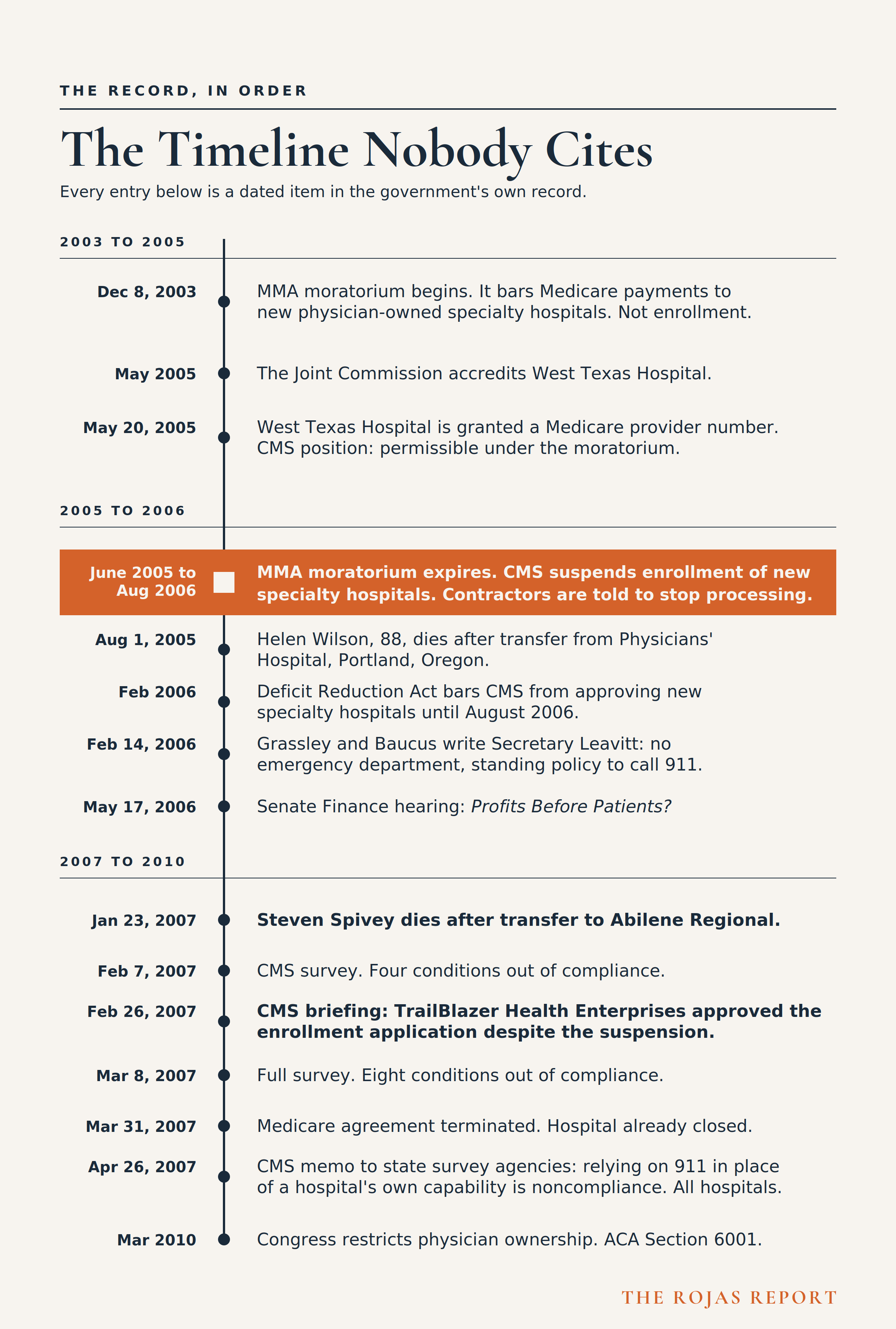
Steven Spivey died on January 23, 2007, after spinal surgery at a physician-owned hospital in Abilene, Texas.
A federal contractor approved that hospital’s Medicare enrollment against written instructions from CMS.
CMS learned of it in February 2007. A patient was already dead.
Medicare had paid the hospital $4,193,702.
Then a man died, and Congress went looking for a law to change.
IN TODAY’S ARTICLE:
What the record establishes about the death in Abilene, and what nineteen years of citation has never established
The Medicare contractor that enrolled the hospital against CMS instructions, and the $4,193,702 that followed
The eight conditions of participation the hospital failed, and which three actually closed it
Why a second identical case in Oregon matters more than the one everybody quotes
Glossary at the bottom of today’s article.
WHAT HAPPENED IN ABILENE
Steven Spivey of Gorman, Texas, went into West Texas Hospital in Abilene for spinal surgery after a truck accident. He was 44 and had three children. The facility held fourteen beds. The surgery went as expected. That night he began to choke.
His wife Tracy was in the room. She told CNN in 2007 that staff read it as a panic attack, that his last words were that he was in trouble, and that she performed CPR herself for roughly fifteen minutes while asking someone to get a doctor. She said she checked three places for a pulse and found none.
By her account, the surgeon arrived about two hours after the choking started and called for 911. Paramedics transported Spivey to Abilene Regional Medical Center, a full-service community hospital. He was pronounced dead there.
West Texas Hospital had no dedicated emergency department. It remained bound by the Emergency Services condition of participation at 42 CFR 482.55, which applies to every Medicare hospital, whether or not it operates an emergency department.
The date was January 23, 2007.
Almost every retelling of this story since has moved through Christopher Lee’s Washington Post piece of January 10, 2008, which ran the day the Inspector General released its report and referred to the case in the past tense. That publication date is what puts 2008 in readers’ minds. Reed Abelson had already reported the case for the New York Times on April 2, 2007, roughly ten weeks after it happened.
The death was January 23, 2007, and what happened around it that year is the part that never gets told.
WHAT THE RECORD ESTABLISHES
Set down clearly what is proven and what is not.
Proven: a patient went into respiratory arrest hours after elective spinal surgery, the hospital called 911, and the patient was transferred to a community hospital and died there. Senators Baucus and Grassley and Representative Stark put those facts in writing to CMS on February 8, 2007.
Not proven: that the delay caused the death. No agency finding says it. No court judgment says it. The family retained attorney Darrell Keith and told CNN in June 2007 that they would file the following week. Local reporting confirms a wrongful death suit was filed. No docket number or disposition is accessible through open sources, so nothing about that case belongs in this argument. Wendell Primus wrote in July 2026 that the delay may have cost Spivey his life, and the qualifier is doing real work.
The vivid details, the fifteen minutes of CPR and the two-hour gap, come from one televised interview with the widow, given while she prepared litigation. That is not a criticism of Tracy Spivey. It is what the evidentiary record is, and a federal statute has rested on it for sixteen years.
THE CONTRACTOR WAS TOLD TO STOP
In December 2003, Congress imposed an eighteen-month moratorium on Medicare payments to new physician-owned specialty hospitals. The statute reached payment. Enrollment was left alone.
West Texas Hospital was granted its Medicare provider number on May 20, 2005, nineteen days before that moratorium expired. Baucus, Grassley and Stark flagged the date on February 8, 2007, and in the same letter recorded the agency’s answer: it was CMS’s position that granting a provider number during the moratorium was acceptable. What CMS said was subject to review and possible recovery was any payment made inside that window. The three members asked CMS to identify which payments those were.
The statutory moratorium expired June 8, 2005. CMS then began an administrative suspension on enrollment of new facilities that ran through August 2006, and Congress reinforced it in the Deficit Reduction Act of 2005, barring CMS from approving new specialty hospitals until the agency delivered its Strategic and Implementing Plan.
On February 26, 2007, CMS staff briefed committee staff. TrailBlazer Health Enterprises, the fiscal intermediary for Texas, had approved West Texas Hospital’s Medicare enrollment application despite CMS instructions to suspend processing applications from hospitals meeting the federal definition of a physician-owned specialty hospital. A provider agreement was issued despite the suspension. Medicare paid the facility $4,193,702.
Baucus, Grassley and Stark wrote to CMS Acting Administrator Leslie Norwalk on March 6, 2007, demanding to know what CMS had done about the contractor, whether TrailBlazer had been sanctioned, and how CMS oversees contractors generally. They framed it as a question about delegation, noting that CMS relies on contractors to enroll hospitals and to process and pay over $300 billion in claims annually, and that the scale of that authority makes accountability reasonable to expect when instructions go unfollowed. On the sanctions question they wrote that the briefing had left them unable to tell.
Four weeks separate the two letters. On February 8 the violation is a provider number issued during a statutory payment moratorium. On March 6 it is an enrollment approved against an administrative suspension. Same three signatures, same hospital.
A federal contractor put that hospital inside the Medicare program in violation of the government’s own instruction. Nineteen years later, the hospital is the argument for restricting who may own one.
IT CARRIED A SEAL OF APPROVAL
The Joint Commission accredited West Texas Hospital in May 2005.
Under the Social Security Act, Joint Commission accreditation can give a hospital deemed status under Medicare’s conditions of participation, so it ordinarily does not undergo the same initial state agency certification survey. CMS retains validation, complaint, and enforcement authority. The Inspector General noted in January 2008 that 42 percent of physician-owned specialty hospitals held that kind of accreditation.
On March 6, 2007, the same three members of Congress wrote to Joint Commission president Dennis O’Leary. They asked how the accreditation was granted, what reviews followed, how the Commission learned of the January 23 death, and what the accreditation status was now. Stark, in the accompanying statement, named the Joint Commission as partly responsible for the breakdown and for the death, and pointed to its accreditation of Redding Medical Center.
Grassley asked why a hospital that far out of compliance had been given a seal of approval less than two years earlier.
Hold that question. It comes back at the end of this series.
The Senate Finance record on this hospital sat in public view for nineteen years. Nobody reads it. Paid subscribers get the primary documents, the statutory analysis, and every article in this ten-part investigation.
