
America’s Largest Physician Platform Barely Employs Physicians
Optum built its platform on affiliated physicians. After the 2025 loss, it blamed them and began cutting them loose.

Rojas Actual.
$7.77 billion in earnings from operations in 2024.
A $278 million loss from operations in 2025.
An $8 billion swing in twelve months.
Optum’s answer: employ them, bind them tighter, or remove them.
IN TODAY’S ARTICLE:
The 90,000-physician number Wall Street repeats never appears in UnitedHealth’s own investor book. The company provides no employment breakdown for it.
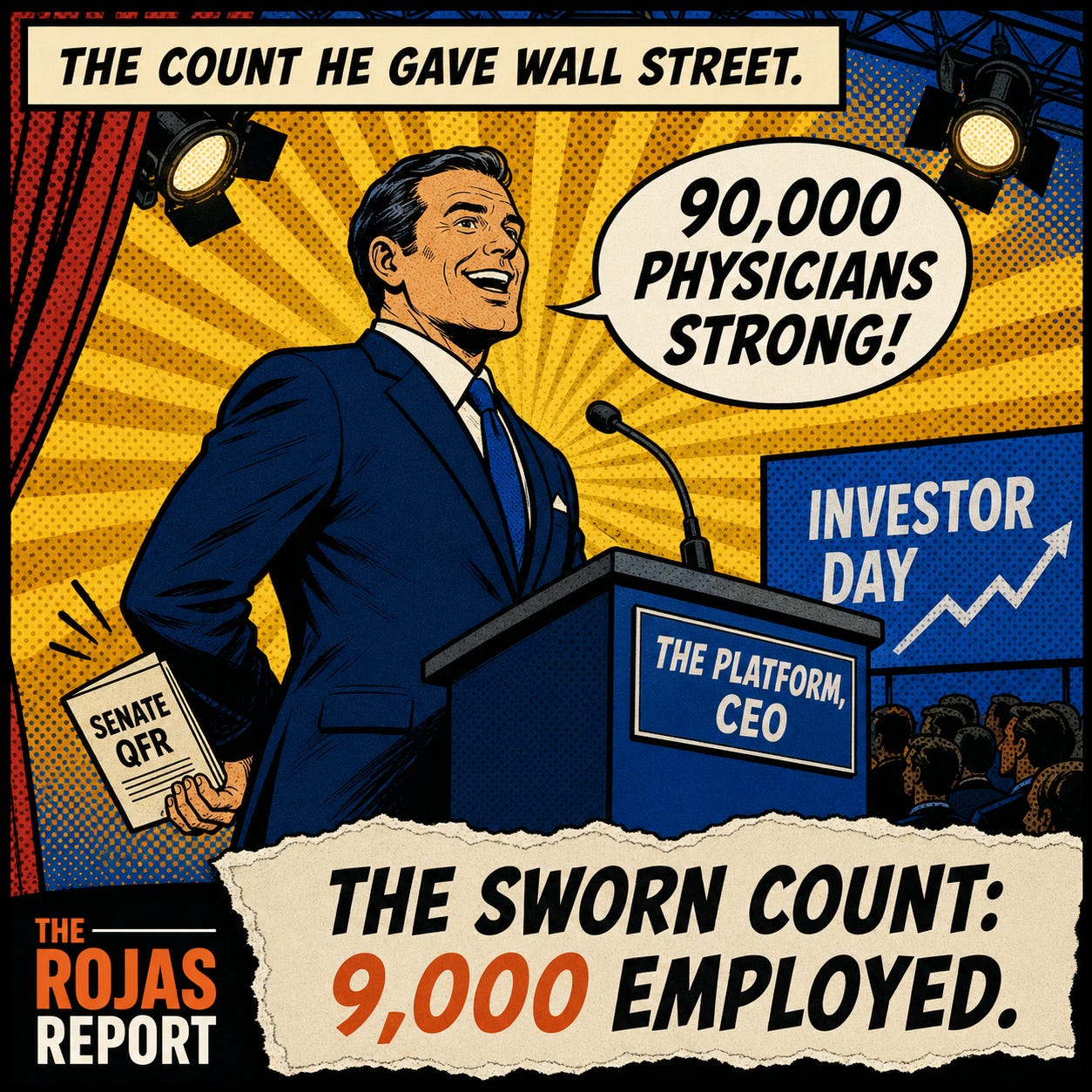
The sworn count, from Andrew Witty’s written answers to the Senate Finance Committee: roughly 9,000 employed. The other 80,000-plus are independent physicians in risk contracts.
Optum Health missed 2025 expectations by $6.6 billion. Its CEO blamed the affiliated physicians on the record.
“Employed or contractually dedicated wherever possible” is the 2026 plan. The 80,000 affiliated physicians are the adjustable line.
Glossary at the bottom of today’s article.
THE NUMBER EVERYONE REPEATS
The claim runs in every headline. UnitedHealth employs 90,000 physicians. About one in ten American doctors, by the Senate’s own count. The largest physician employer in the country.
Becker’s ran it. Medscape ran it. Health Affairs cited it. Consultants built slide decks on it.
The number entered the world on November 29, 2023, at UnitedHealth Group’s investor conference. Amar Desai, then CEO of Optum Health, told Wall Street the platform had nearly 90,000 employed or affiliated physicians.
Employed or affiliated. Four words. The first one made the headlines. The middle two did the work.
Now open the official investor book UnitedHealth published for the same conference. Search it. The 90,000 figure appears nowhere. The book combines physicians and advanced practice clinicians into a single total of approximately 130,000. No split. No employment count. No definitions.
America’s most repeated physician count lives in a stage presentation.
THE SWORN COUNT
May 2024. Andrew Witty sits before the Senate Finance Committee to answer for the Change Healthcare cyberattack. Senators use the occasion to ask about the 90,000.
His written answer, submitted to the committee and repeated twice in identical language:
“Optum employs roughly 9,000 physicians. Optum does not employ any contracted or affiliated physicians. These affiliated physicians contract with Optum’s risk-bearing, independent practice association entities, who in turn contract with health plans under a value-based risk contract. These affiliated physicians are independent of Optum.”
Roughly 9,000.
One tenth of the number in the headlines.
The distinction is not cosmetic. An employee sits inside the enterprise. An affiliated physician sits inside a contract. The company can count both when describing scale. Only one has an employment relationship when the economics collapse.
The other 80,000-plus are independent physicians whose practices hold network participation agreements with Optum’s risk-bearing IPA entities. Those entities contract with health plans. The physicians carry the risk terms downstream. UnitedHealth also told the Senate that the network agreements contain no non-competes. No employment. No ownership. No non-compete. Either side could leave. Only one side controlled the network.
UnitedHealth told the Senate it holds no ownership or investment interest in those independent practices. Fewer than 3 percent receive management support from an Optum MSO.
The committee described the discrepancy directly: “You clarified in your testimony that UHG only directly employs roughly 10,000 out of those 90,000 doctors; you have never disclosed how exactly the other 80,000 doctors are classified.”
That fragment sits in the congressional record, dated June 2024. UnitedHealth has published no newer physician employment split since. The fiscal 2025 10-K, filed February 2026, reports nearly 165,000 clinical professionals among more than 390,000 employees and never isolates a physician employment total.
They counted 90,000 for Wall Street. They counted 9,000 for Congress. Both numbers came from the same company describing the same doctors.
Congress regulates ownership, employment, referral relationships, and market concentration. Optum’s model sits between those categories. It can aggregate tens of thousands of physicians for investors while describing those same physicians as independent when Congress asks who it owns.
THE DEFINITION DOES THE WORK
February 2025. UnitedHealth publishes a brief arguing Optum primary care outperforms hospital-based practices. The methodology fine print defines an “Optum Health practice” as one where the physicians are employees of “an Optum-affiliated physician-owned practice or an Optum-owned entity, exclusively managed and supported by Optum.”
That definition includes physicians legally employed by physician-owned professional entities while an Optum-owned MSO manages the infrastructure beneath them.
In states such as Massachusetts, corporate-practice restrictions help produce this structure: a physician-owned professional entity paired with a corporate-owned MSO. Optum owns the MSOs that supply the full scope of administrative, management, and support services to Atrius Health and Reliant Medical Group.
The physician’s name remains on the clinical entity. Optum owns and manages the machinery around it.
One more receipt from that same brief, buried in their own chart: physician-owned practices beat hospital-based practices on cost by 2.1 percent. UnitedHealth’s chart gives hospital-based practices a 1.6 percent quality edge and still shows them costing more. UnitedHealth’s own study, run on UnitedHealth’s own claims, confirms what independent physicians have said for decades.
Wall Street counted 90,000.
Congress got 9,000.Supporters get what happened when the economics turned against the other 80,000.
