An Island Is Not Independence
What every American institution used to know, and forgot.


A non-denominational church on the south side of a metro you have driven through. Five thousand members. A main campus with a 1,200-seat sanctuary, a children’s wing, a coffee shop, a parking deck. Two satellite campuses. A worship band that streams to YouTube every Sunday morning at nine and eleven.
The church spends four million dollars a year on insurance. Property on three campuses. General liability. Workers compensation. Health benefits for the staff. Auto on the vans. Cyber. And even SAM coverage.
Four million dollars.
Every year.
Out of the offering plate.
The pastor preaches a sermon series on stewardship in the fall. He calls his congregation to tithe. He calls them to give faithfully, sacrificially, joyfully. He means every word of it. He does not mean for the offering to flow from the pew to the pulpit to the insurance broker. That is exactly where a great deal of it is going.
The congregation tithes to the church.
The church tithes to the carriers.
Forty minutes down the road, another non-denominational church is doing the same thing. Five thousand members of its own. Same suburban demographic. Same insurance broker network. Same coverage stack. Same multi-million dollar line item. Two separate accounts. Two separate invoices. Two separate Sunday morning prayers asking God to provide.
The two pastors know each other. They have shared pulpits. Their wives are friends. Their children attend the same youth retreats. They have never once sat down and asked whether one shared benefits broker, one pooled property tower, one consolidated cyber policy might free up a million dollars between them. A million dollars that could fund the youth ministers, the missionaries, the food pantry, the addiction recovery program that both churches keep meaning to launch.
It would not require a merger.
It would not require theological agreement on every fine point.
It would not require sacrificing a single minute of either pastor’s calling.
It would require a phone call.
The phone call does not get made.
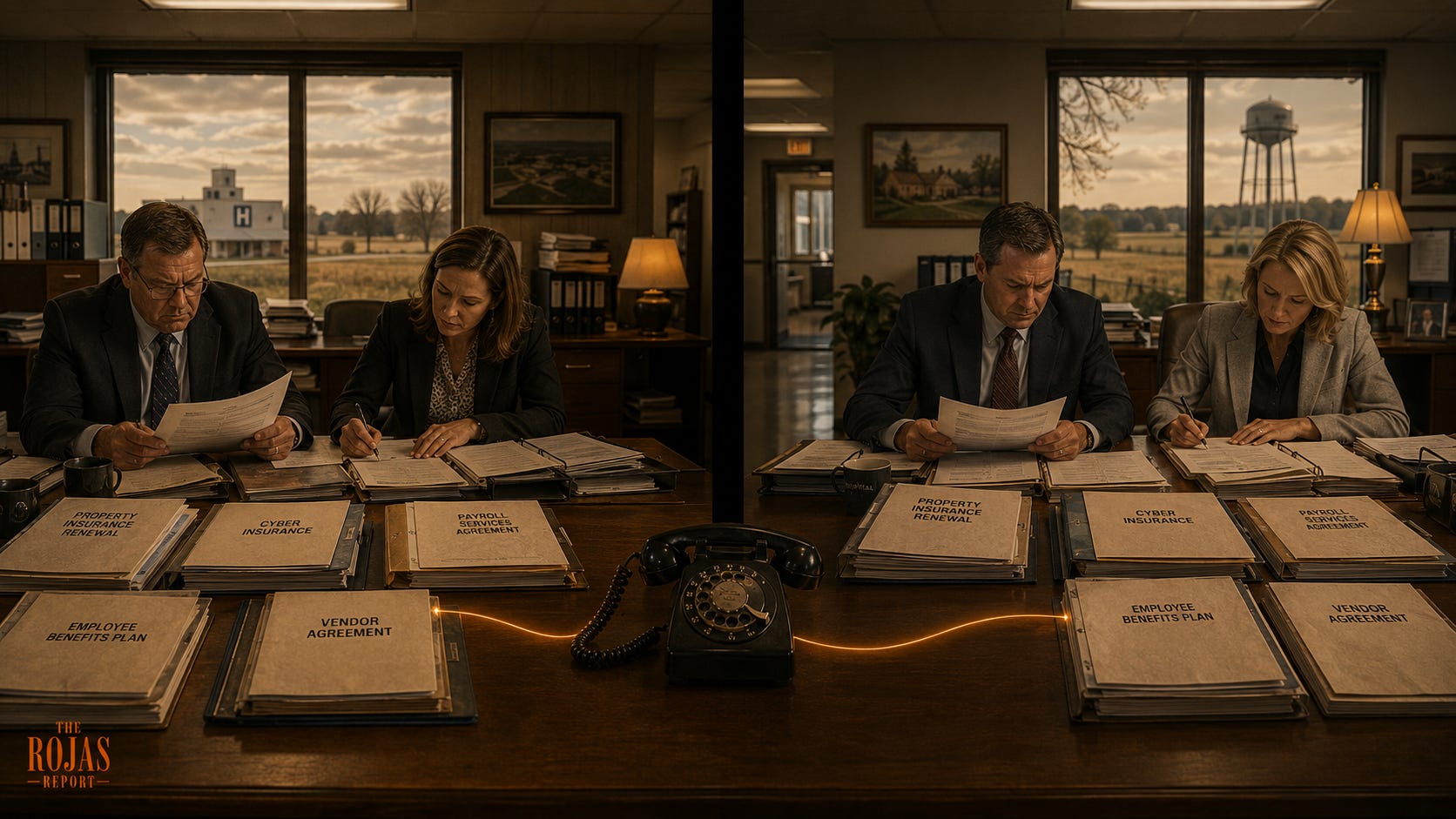
Independence and living on an island are two different things.
That sentence is the entire thesis.
Read it twice if it did not land.
Independence is a virtue. It is the soul of the American experiment, the soul of the Reformation, the soul of the small business, the soul of the family farm.
Living on an island is not a virtue. It is a vulnerability dressed up in the costume of a virtue. It is what happens when an institution forgets that the calling that made it independent in the first place was always meant to be lived alongside its neighbors.
I have spent the better part of the last year sitting across the table from rural hospital CEOs. Sixty of them. Maybe a few more. They tell me the same story in different accents.
The hospital is bleeding cash. The case mix is shifting toward older, sicker Medicare patients whose care costs more and pays less. The commercial mix has collapsed because the only large employer in town moved its headquarters to a metro. The supplemental payments from the state are a year behind. The malpractice premium just renewed at a number the board could not believe. The cyber insurance carrier is demanding new attestations the IT director does not know how to answer. The local nurse pool has been bought up by a national staffing agency that now charges twice what the hospital paid two years ago.
And then they tell me what they are going to do about it.
They are going to call their senator.
That is the plan. The entire plan. They believe that the senator from their state is, to borrow from a movie they probably have not watched in thirty years, their only hope. They believe it the way the orphan believed it. They have made it their theology.
Forty miles away there is another rural hospital. Same Medicare mix. Same staffing crisis. Same property insurance carrier. Same payroll vendor. Same EHR. Same cyber attestation paperwork sitting on the same kind of desk in front of the same kind of CFO, paid the same kind of salary to do the same kind of work twice.
The two CEOs know each other. They sit on the same state hospital association board. They have spoken at the same conferences. They have shaken hands at the same political fundraisers where the senator who is their only hope thanked them both for their support.
They have never once picked up the phone and asked whether they could share a single back-office function. Not one. Not insurance. Not benefits. Not purchasing. Not legal. Not compliance. Not even the contract review that both of their CFOs are doing this week on the same vendor agreement.
The cooperation that would lower their cost structure dramatically does not require a merger. It does not require legislative permission. It does not require a 501 (c) (3) reformation. It does not require a consultant. It requires a phone call.
The phone call does not get made.
This is not a hospital problem.
This is the American small enterprise problem in microcosm.
Manufacturing. I have sat with the second- and third-generation owners of foundries, machine shops, plastic injection operations, and food processors. Each one is running a back office that looks like it was assembled by a different person in a different decade with a different theory of ERP. Each one has a benefits broker who has been with the family since the founder’s funeral. Each one is buying the same steel, the same resin, the same packaging from the same regional suppliers, alone, at a price the supplier sets because no single buyer is large enough to push back.
Commercial real estate. Operators with eight buildings, twelve, twenty. Each one carries property insurance separately. Each one buys cleaning, landscaping, security, energy separately. Each one negotiates with the same regional contractors who have figured out exactly what each operator will tolerate paying. The operators know each other. They sit on the same chamber boards. They will not pool a single line item.
State chartered banks. Community banks with a hundred million in assets, two hundred million, five hundred million, each one running its own compliance shop, its own fraud detection, its own core processing renewal, its own regulatory examination prep. Each one losing market share to a credit union down the street that is, almost by definition, a cooperative. The credit union figured out a hundred years ago what the community bank refuses to consider this morning.
Restaurants. I sat with more than sixty independent restaurant owners at an association meeting last month. Most of them in the same metro. Paying retail to the same food distributors. Same uniform service. Same payroll processor. Same point-of-sale vendor. Same insurance broker. Not a single one of them had ever considered pooling their property insurance with the others in the room.
These are not unintelligent people.
They run businesses on margins that a hospital CFO would call impossible.
They negotiate every line item daily.
They survive seasons that would crush most enterprises in a quarter.
They are not dumb. They have never been asked the question in a way that demanded an answer, so the answer never came.
The chains they compete with do not pay retail for any of it. The chains buy at scale and crush them on cost of goods. The independent restaurateurs blame the delivery apps, blame inflation, blame the rent, blame the customer who will not tip. They do not call each other.
Independent medical practices. Same story. Six-person orthopedic group with its own HR. Three-person ophthalmology practice with its own benefits broker. Five-person internal medicine group with its own malpractice carrier. The hospital across the street that just bought their largest competitor pools all of it. That is part of why the hospital was able to write the check.
Physician-owned hospitals are the strangest case of all. The owners are co-investors with each other across multiple facilities. They already share an investment thesis. They already share a tax ID structure on dozens of joint ventures. They are in the same conference rooms three times a year. They sit on the same boards. They sign the same operating agreements. They distribute the same K-1s. And then they go home and renew their property insurance, their malpractice, their commercial contracts, their benefits stack, separately: each facility, alone. Most of them have never even heard of the cooperative ownership structures American farmers and credit union members have used for a hundred years to do exactly this together.
I have interviewed nearly a thousand business owners over the last sixty months.
The pattern does not change.
When I ask them why they do not cooperate, the answer is almost always the same.
It is not philosophical.
It is not ideological.
It is not even strategic.
It is, “this is the way we do it.”
That is the diagnosis. They do not refuse to cooperate. They have never thought about it. The question has never been put to them in a way that demanded an answer. The inheritance was independence in isolation, and they confused the inheritance with the calling.
Here is what makes the diagnosis painful: America used to know.
The farmer who got electricity in 1937 did not get it from a utility. He got it from a cooperative he and his neighbors capitalized themselves because no investor would run a line out to a farm that was twelve miles from the nearest town. The rural electric cooperative is one of the most successful private institutions in American history, and almost nobody under fifty knows what it is or how it was built.
The credit union exists because workers, often immigrant workers, often Catholic workers, often workers a commercial bank would not serve, pooled their savings and lent to each other. The credit union is a cooperative. It is older than many of the banks it now competes with. It is winning.
Mutual insurance companies exist because policyholders, not shareholders, own the risk pool. State Farm. Nationwide. Northwestern Mutual. Liberty Mutual in its origins. They were built on the same logic. The people who carry the risk should own the rails. They built some of the largest insurance companies in the country by refusing to surrender ownership to outside capital.
And it happened in modern memory.
In 1975, the commercial carriers walked out of medical malpractice in Alabama. The state’s largest carrier exited. Physicians searched the country for a replacement, then searched Europe. Nothing. So roughly 2,500 Alabama physicians each put up a thousand dollars, capitalized Mutual Assurance, and wrote their first policy in 1977. Northern California physicians did the same thing the same year and built NORCAL. The Doctors Company followed in 1976 out of Napa. The physicians did not need permission. They did not need a bailout. They needed a phone call to be made and, under the pressure of a crisis, they finally made it.
Agricultural cooperatives fed this country and still do. Land O’Lakes. Ocean Spray. Sunkist. Cabot Creamery. Each one is a federation of independent farmers who figured out that they could compete on the field and cooperate on everything else, and that this combination, not isolation, was the actual content of their independence. Their families still own their farms. They still make their own decisions. They are still independent. They are not on an island.
This is not a foreign concept to American business. It is the foundation of American business. We just stopped teaching it.
Somewhere in the last fifty years, the mythology shifted. The lone founder became the only acceptable archetype. The cooperative was reframed as a relic, or worse, as something vaguely socialist, which is a slander against an institutional form that was almost always built by deeply religious, deeply self-reliant, deeply independent people who happened to be smart enough to know that they could not buy electricity, lend money, or insure a barn alone.
The institutions that figured out cooperation built the country we inherited. The institutions that forgot are the ones now begging the senator for help, or asking the congregation to give a little more so the carrier can be paid.
What did cooperation produce for the institutions that figured it out?
It produced ownership that did not get sold. The farmer who joined the rural electric cooperative in 1937 did not just get electricity. He got equity in the rails his grandchildren still depend on. The worker who joined a credit union in 1925 did not just get a loan. He got a share in an institution that now has assets larger than the bank that refused him service. The members of Land O’Lakes did not just sell butter together. They built a brand the grocery chains have to negotiate with on the farmers’ terms, not their own.
It produced capital that stayed in the calling. Money that stopped leaving for the carrier and the broker and the vendor stayed in the building. The youth minister got hired. The labor and delivery unit stayed open. The food pantry opened. The credit got extended to the small business that no national lender would touch.
It produced decision rights that stayed local. The farmer still made his own decisions on his own land. The worker still chose his own loan officer. The pastor still preached his own sermon. The physician still set foot in his own operating room. Cooperation on the unglamorous things preserved authority on the sacred ones.
The independents who never figured it out got something else.
They got billed.
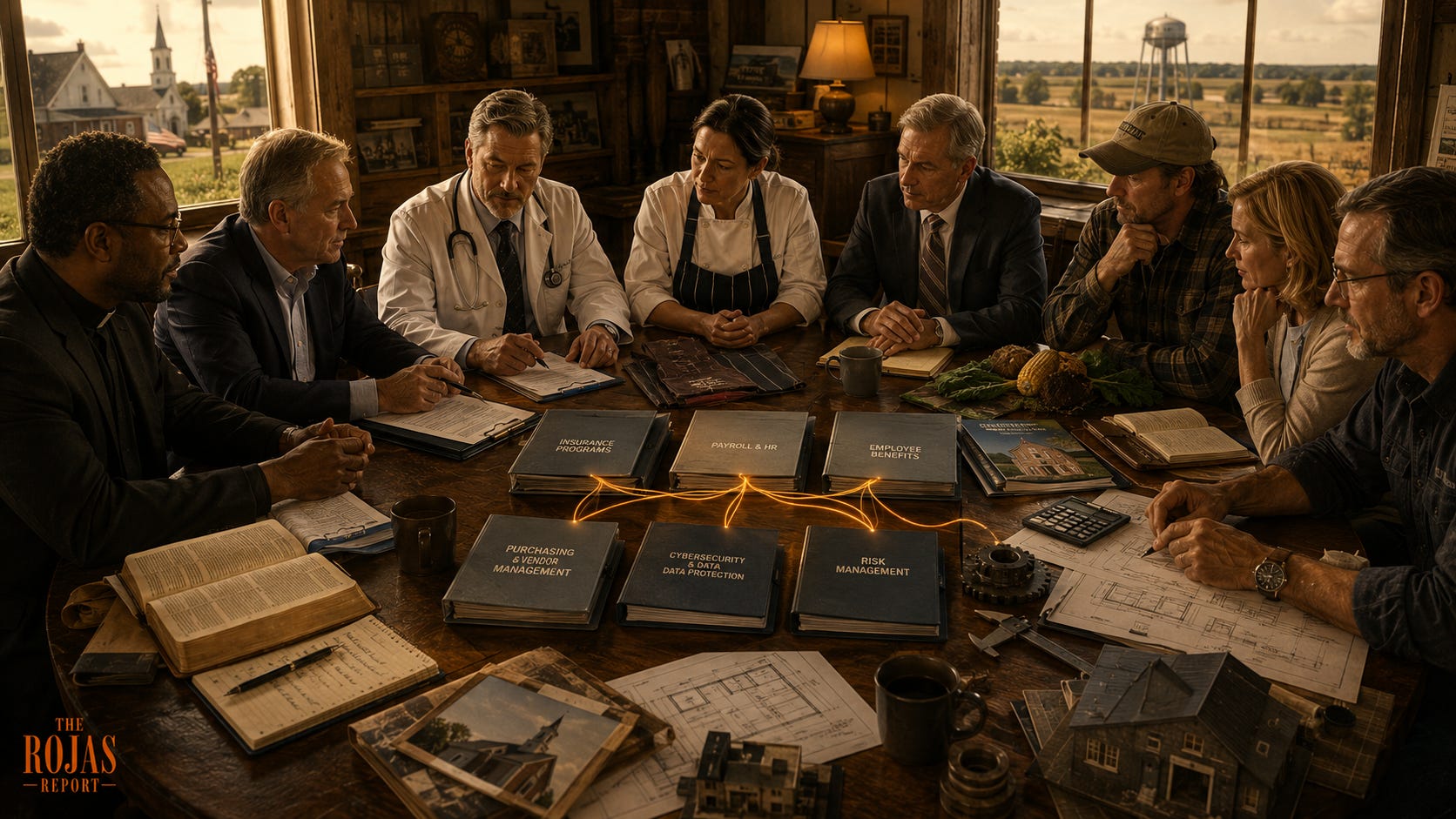
Independence is a calling. The calling is real.
The pastor is called to preach.
The CEO is called to keep the labor and delivery unit open.
The physician is called to operate.
The restaurateur is called to feed her neighbors.
The banker is called to extend credit to the small business in his town that no national lender will touch. The manufacturer is called to make the part.
These callings are sacred, in their way.
None of them are diminished by cooperation.
All of them are preserved by it.
Isolation is what happens when you forget the calling requires neighbors.
There is a grain elevator still standing in a small town in the upper Midwest. It has been standing for almost a hundred years. The farmers who built it are long dead. Their grandchildren still own it. The elevator is not the largest grain handling operation in the county. It is not the most modern. It does not move the most volume. It is still standing because the farmers who built it understood something that the institutions begging the senator for help today have forgotten.
Institutions do not disappear all at once.
They disappear one unnecessary invoice at a time.
One premium. One vendor.
One renewal. One phone call nobody made.
America became prosperous because independent people learned what could be shared without giving away what mattered.
That lesson built the country.
It can rebuild it.
-Rojas out.