Atrium Health Is Not a Hospital. It Is a Unit of The Local Government.
This is how healthcare has been hijacked by "non-profit" health systems.

The Charlotte-Mecklenburg Hospital Authority operates as a “unit of local government” under North Carolina law.
This means it has powers similar to those of local governments, including the legal right of eminent domain, the power to acquire private property for public use, automatic property tax exemption ,exclusion from paying local property taxes, and immunity from certain antitrust laws, as recognized by the Fourth Circuit.
On Monday, May 4, that structure asks Wake County for permission to absorb its third major North Carolina hospital system in six years.
Remember: North Carolina is a Certificate of Need State.
Every hospital merger announcement uses the same words.
Strategic combination.
Stronger together.
Better serve the community.
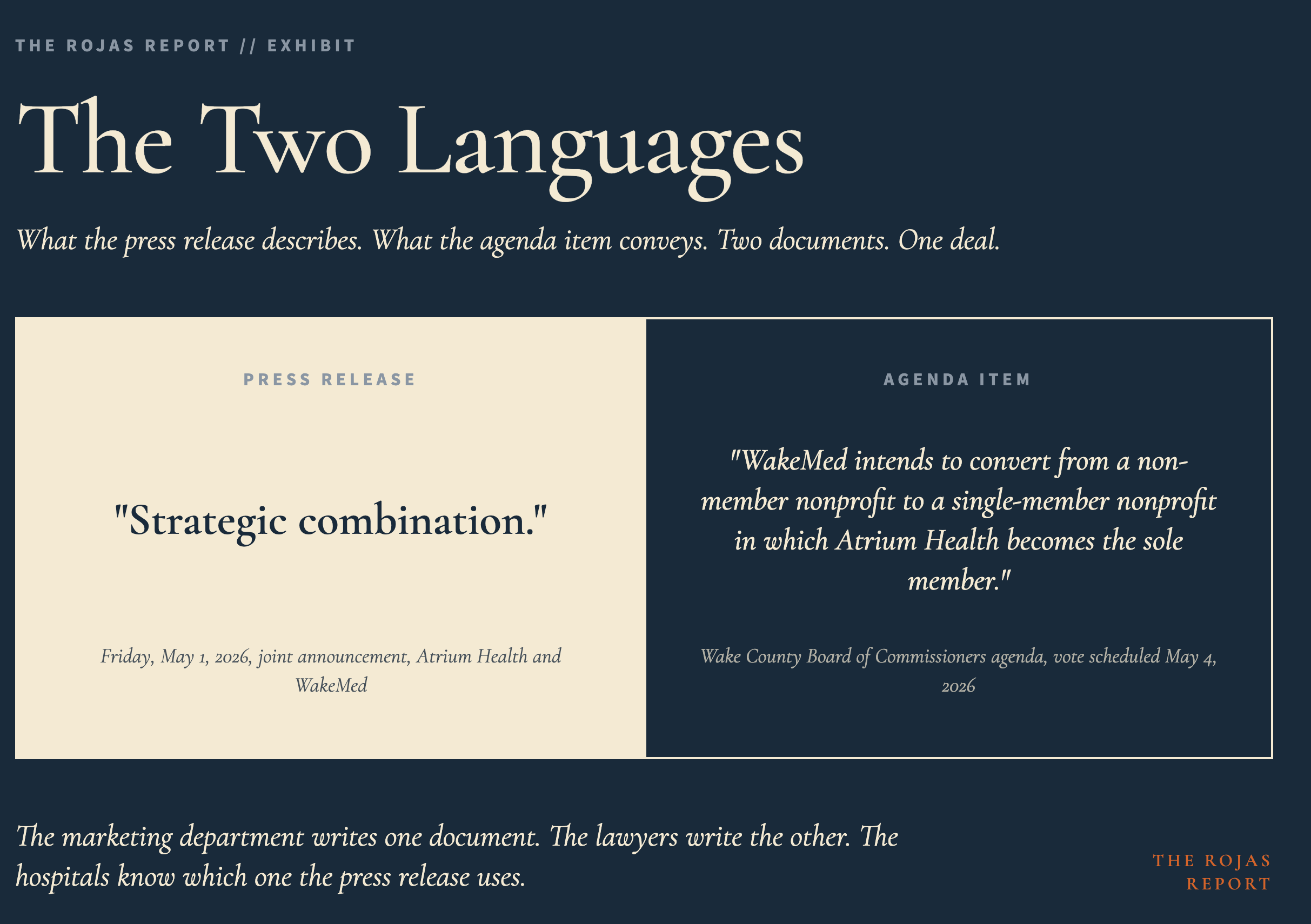
The Atrium-WakeMed press release uses all of them. The Wake County agenda item, written by lawyers and not for the press, uses different words.
“WakeMed intends to convert from a non-member non-profit, a non-profit without an outside controlling party, to a single-member non-profit, where Atrium Health becomes the sole corporate member, the only organization with legal control over WakeMed, ensuring unified governance, consistent oversight, and alignment with system objectives.”
That is the deal.
The community is not the customer.
The community is the asset being conveyed.
IN TODAY’S ARTICLE:
The press release language versus the agenda item language, and why both are technically true
What “sole corporate member” of a non-profit actually means in practice
Why Atrium does this through ‘combinations’—a term for integrating organizations without an asset purchase—instead of acquisitions, and how this structure avoided the same antitrust scrutiny that blocked its 2018 UNC deal.
Why Treasurer Brad Briner went on record opposing the combination on the same day Atrium and WakeMed announced it
Glossary at the bottom of today’s article.
THE TWO LANGUAGES
There is the language of the press release. And there is the language of the agenda item.
The press release was issued on Friday, May 1. It says Atrium Health and Raleigh-based WakeMed have entered into a “strategic combination.” It says the combination will create $2 billion in capital investment in Wake County over ten years, more than 3,300 new healthcare jobs, and the state’s largest non-profit mental health network.
Donald Gintzig, the CEO of WakeMed, called it a “significant next step in building upon this legacy, expanding our impact and ensuring a thriving nonprofit health care future for all we serve.”
That is the language community hospitals use when they get acquired.
The Wake County agenda item, written by the Board of Commissioners’ lawyers, uses different language. It says: “WakeMed intends to convert from a non-member nonprofit, which has no defined owner or member, to a single-member nonprofit, a structure where Atrium Health becomes the sole member.”
This change ensures unified governance, consistent oversight, and alignment with system objectives. That is the actual deal.
The press release describes a partnership for the public; the agenda item is a conveyance for those holding the gavel on Monday.
The community is not the customer.
The community is the asset being conveyed.
The deals get made before the press release.
This is where you find out first.
WHAT “SOLE CORPORATE MEMBER” ACTUALLY MEANS
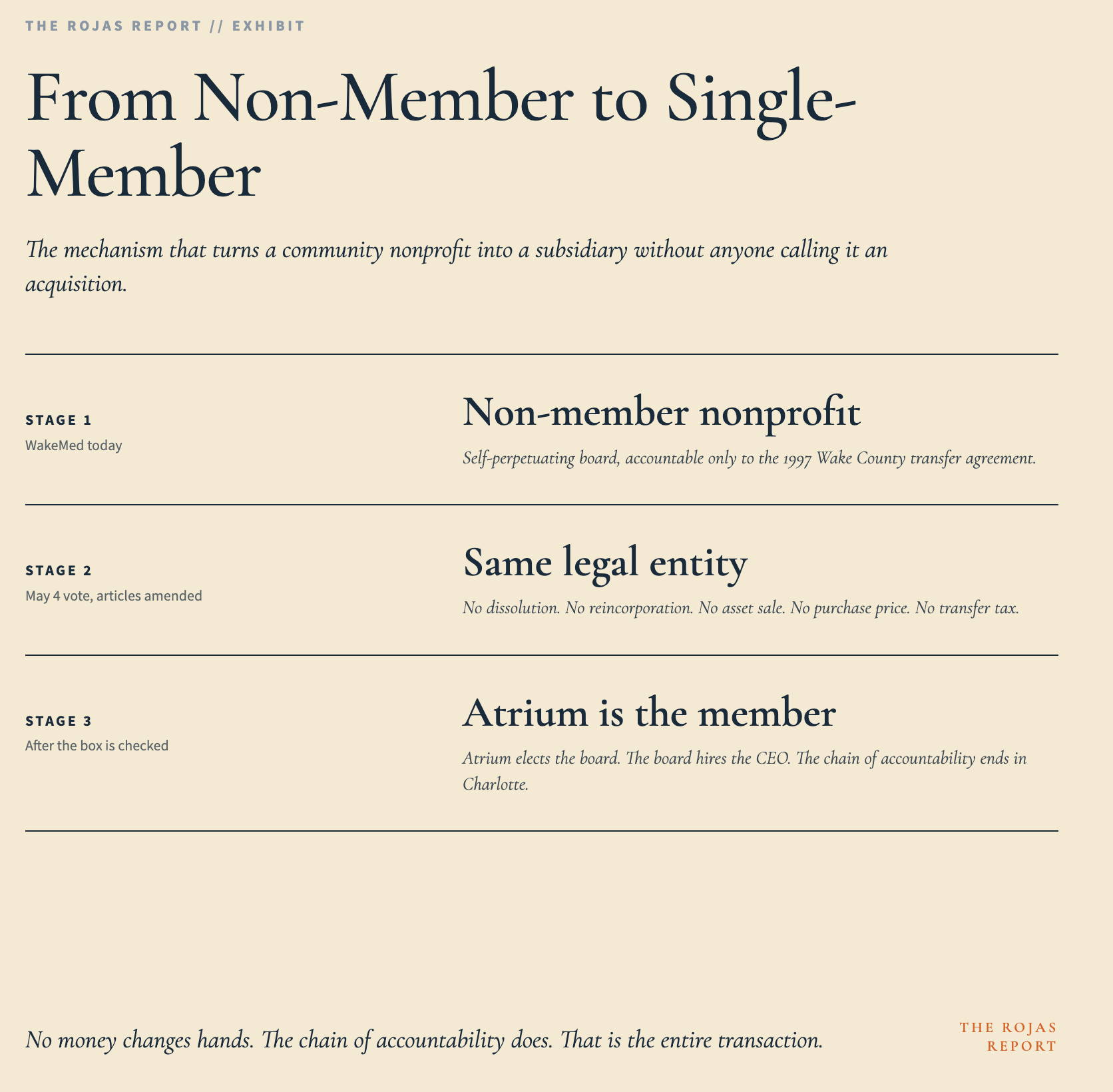
A non-profit hospital has members. The members elect the board. The board hires the CEO. The CEO runs the institution. That chain of accountability is the core legal structure for every charitable hospital corporation in North Carolina.
WakeMed today is a “non-member” non-profit, meaning it is not owned by members or shareholders. No outside party controls the chain. The board governs itself and is accountable to the 1997 Wake County transfer agreement that created it.
Under the deal, Atrium Health becomes the sole corporate member. According to the agenda item, WakeMed “continues as the same legal entity without dissolving or reincorporating.” The hospital and legal entity remain, with no asset sale, purchase price, or transfer tax.
The chain of accountability changes.
That is all.
Atrium does not buy WakeMed. Instead, Atrium replaces the existing chain of accountability by becoming the sole corporate member, gaining full legal control.
That is why this is a ‘combination’, meaning a legal and governance integration, rather than a traditional merger. A merger triggers Hart-Scott-Rodino premerger antitrust review at the federal level. A merger triggers asset transfer analysis at the state level.
A merger requires the buyer to assume all of the target’s liabilities at closing.
None of that happens here.
What happens here is a paperwork conversion: WakeMed’s articles of incorporation get amended, its official corporate documents are changed. The single-member box gets checked, indicating Atrium as the single entity with legal control. Atrium is the name in the box.
That is the entire transaction.