
Capital Is Not Greed. It Is the Only Thing That Sets a Physician Free.
You understand your wage and have surrendered your assets. That gap is your dependency.

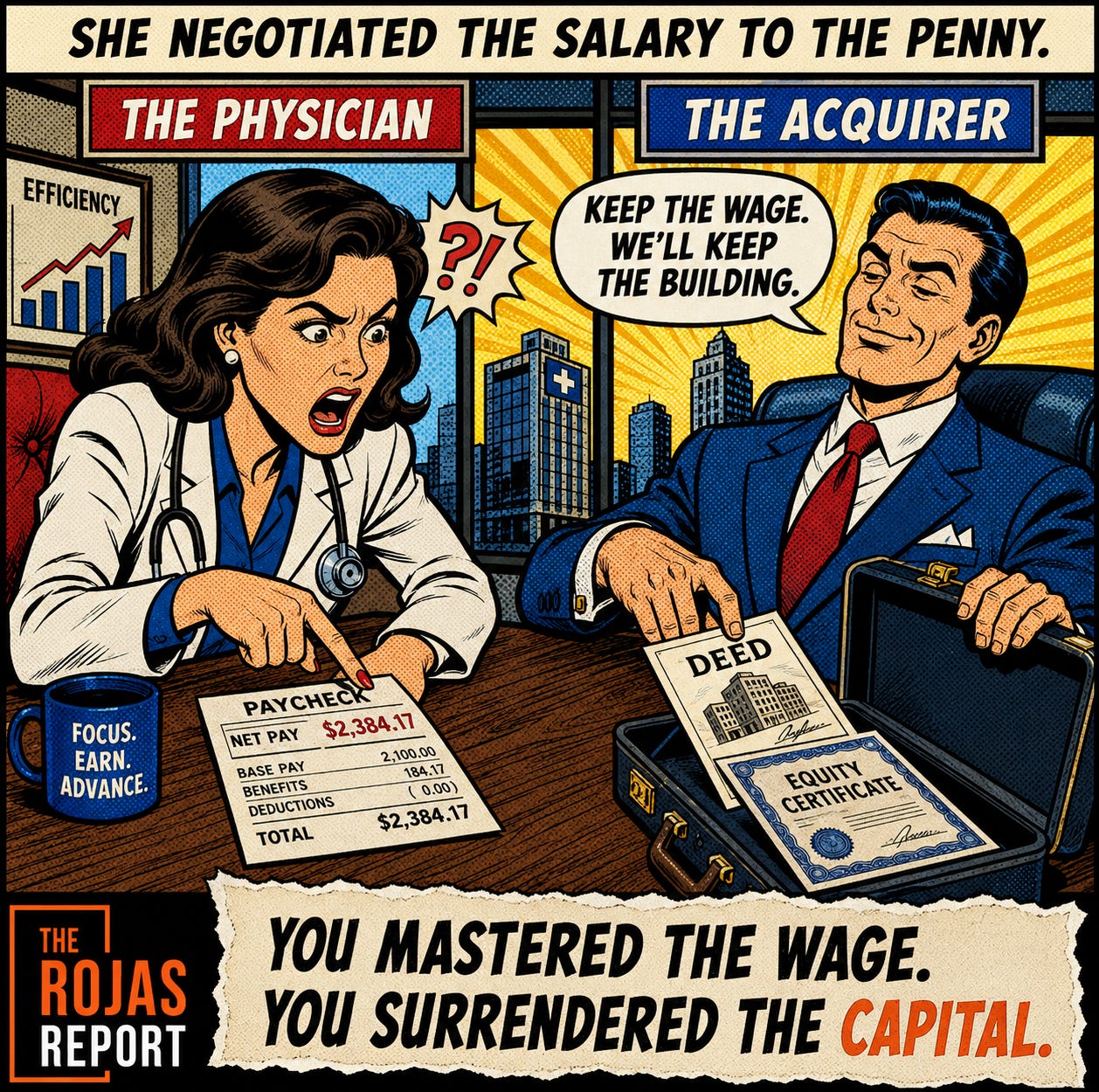
Watch a physician negotiate a salary, then watch the same physician flinch at the word equity.
She will fight to the third decimal on an RVU rate, then hand the entire asset to the people across the table without a fight.
She understands her wage.
She does not understand her capital.And that gap is the whole reason she depends on everyone above her.
IN TODAY’S ARTICLE
The reflex installed in training that turned capital into contamination
Why prestige was sold to physicians as a substitute for ownership
What capital actually is, once you stop confusing it with greed
The four dependencies, and the asset that cuts each one
Glossary at the bottom of today’s article.
THE REFLEX THEY INSTALLED
From the first week of training, two columns get drawn for you. The clinical, which is sacred. The commercial, which is contaminated. The good doctor stays on the clean side of the table and lets the administrators handle the money, so the medicine stays pure.
By the end of residency, you do not think money is dirty. You feel it. The aversion sits below argument, in the same place as the reflex to scrub in.
That reflex does not make the medicine cleaner.
It decides who ends up owning it.
You were not taught to distrust capital by accident.
You were taught it by the people who planned to keep yours.
THE PEDIGREE TELL
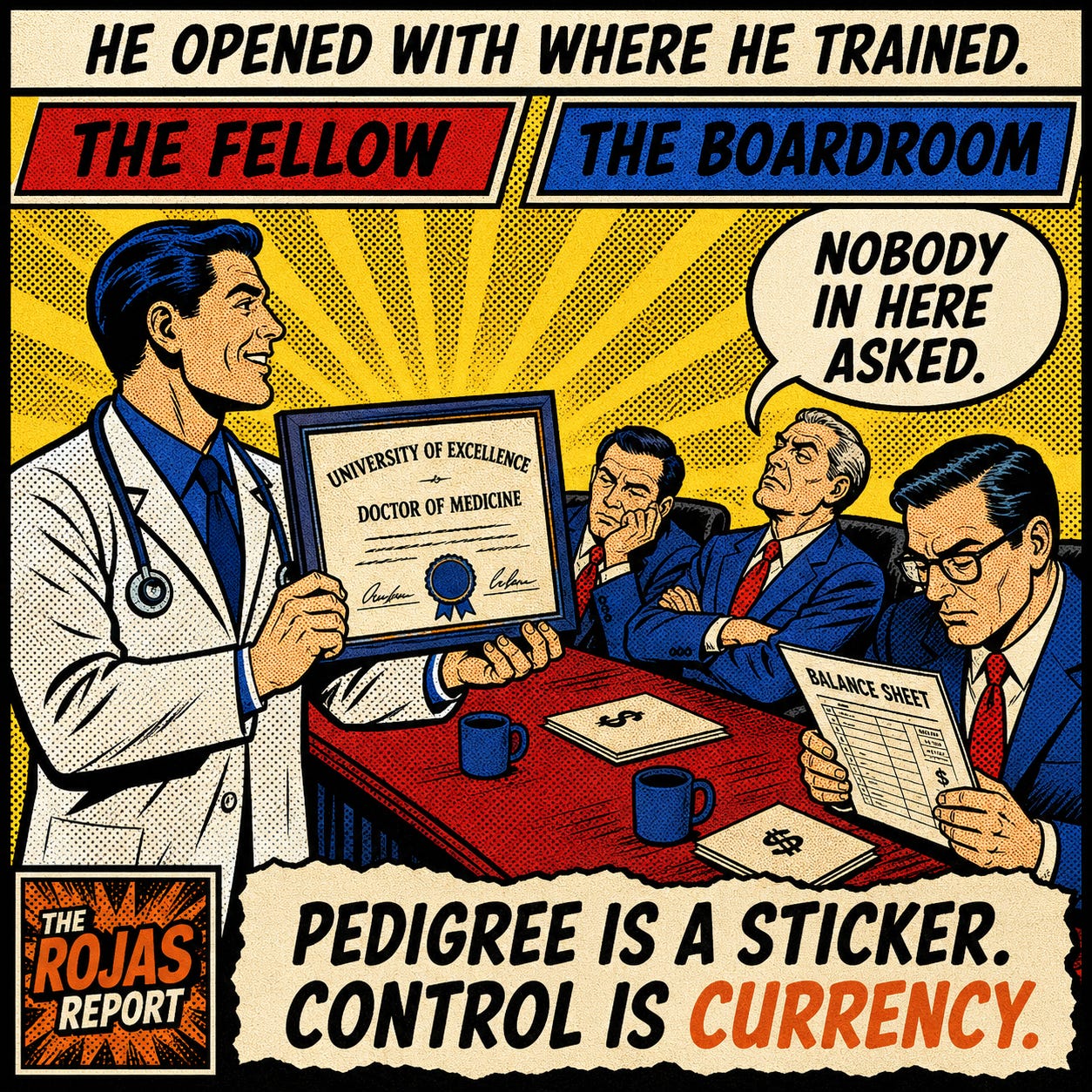
Listen to how a physician introduces herself to another physician.
It starts with the training. The fellowship. The program. The named institution, dropped early, so the room knows the rank before the conversation starts. The whole exchange is a status sort, run in the first ten seconds, on credentials.
Now listen to how a founder introduces himself. He does not. Nobody who builds things leads with where he went to school, because in the room where things are built, nobody cares. The pedigree buys nothing there. It is not currency. It is a sticker.
I check out the moment you tell me where you trained. Not because the training is fake. Because it is the wrong question. I want the result. Tell me you built the thing.
Tell me you found the method that makes it cheaper and better. Tell me you figured out how to cover a thousand work comp patients at a price the carrier cannot touch. Now I am leaning in, and you did not need a single line of your CV to get there.
Here is what they did to you.
They granted physicians prestige in place of ownership.
The fellowship instead of the equity.
The title instead of the asset.
The wall of diplomas instead of the cap table.You were taught to compete for rank within the guild, while people outside the guild competed for the thing that actually pays. Control.
WHAT CAPITAL ACTUALLY IS
The misunderstanding sits right at the center. Physicians hear the word capital and picture greed. A pile of money. Something a person hoards instead of heals.
That is not what capital is. Capital is control. It is the authority to decide how the work gets done, who does it, and on what terms. In this system, that authority is denominated in dollars, and nothing else is legal tender.
A physician with no capital does not set the staffing. Does not protect the patient from the spreadsheet. Does not fund the thing she believes in. She asks permission. Every day for 30 years, she asks the people who own the thing her work built for permission.
That is the cost of the flinch.
Not a smaller bank account.
A smaller life, lived entirely at the discretion of others.
And it compounds, because you will never build something you secretly despise. You will start the captive and stall on the funding. You will join the ownership group and never read the operating agreement.
Consciously you want the asset. Unconsciously you are ashamed of it. The two cancel out, and a physician running at net zero on the most consequential decision of her career is the most profitable thing the rest of the system has ever met.
THE NUMBER
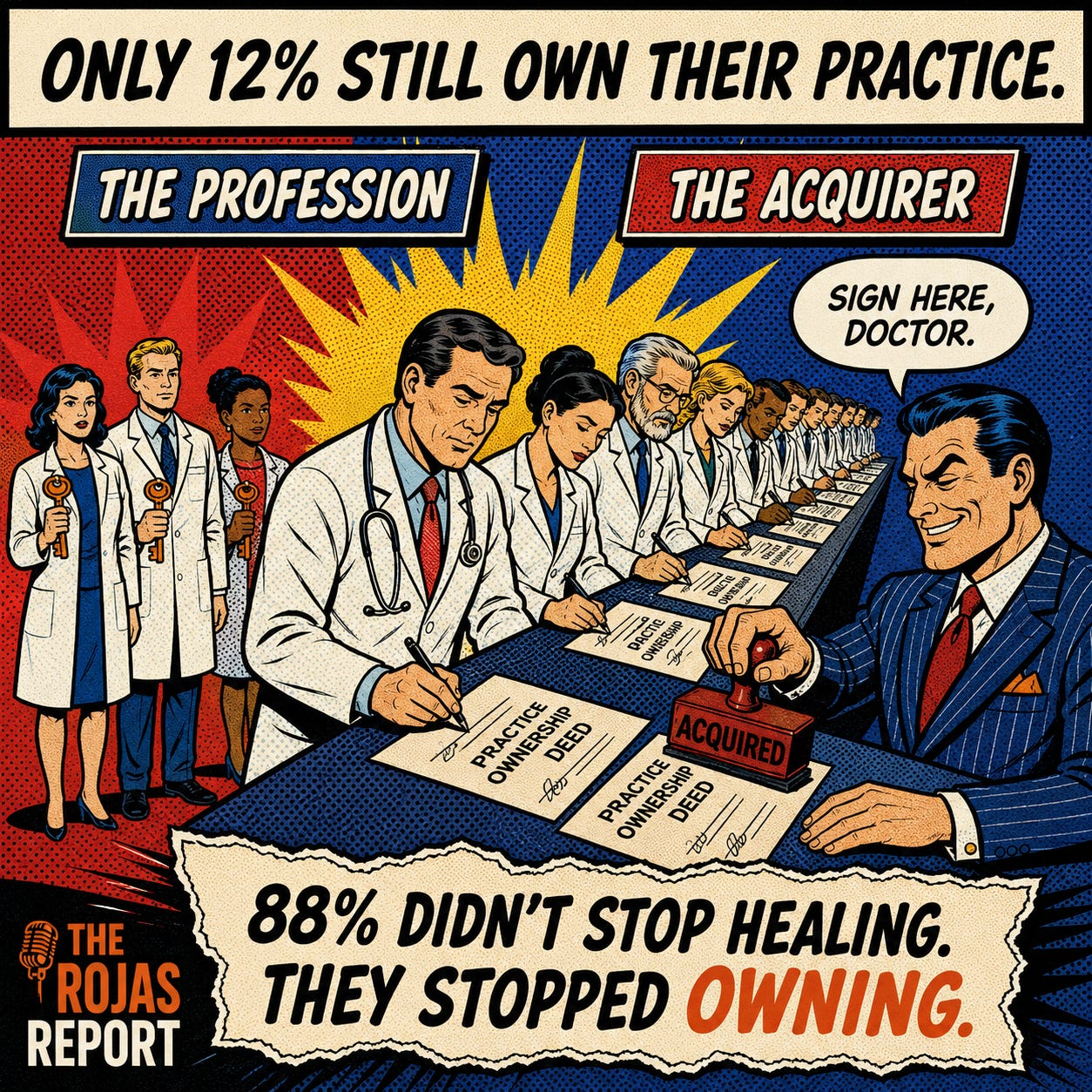
Put a figure on it. Avalere studied the five specialties that built independent medicine, cardiology, gastroenterology, medical oncology, orthopedics, and urology, and counted how many physicians still practice unaffiliated, owning their own shop. The answer for 2022 is 12%. The range runs from 5% in medical oncology to 16% in urology.
That is not a profession that lost a fair fight.
That is a profession that got acquired.By 2022, 45% were affiliated with a hospital, 37% with a corporate entity, 6% with private equity.
The other 88% did not stop being good doctors.
They stopped being owners.
Avalere ran those numbers in September 2024. The same study priced what the affiliation costs, and we will reach that figure, because it is the receipt that explains the entire acquisition.
THE POOR MAN’S WISDOM
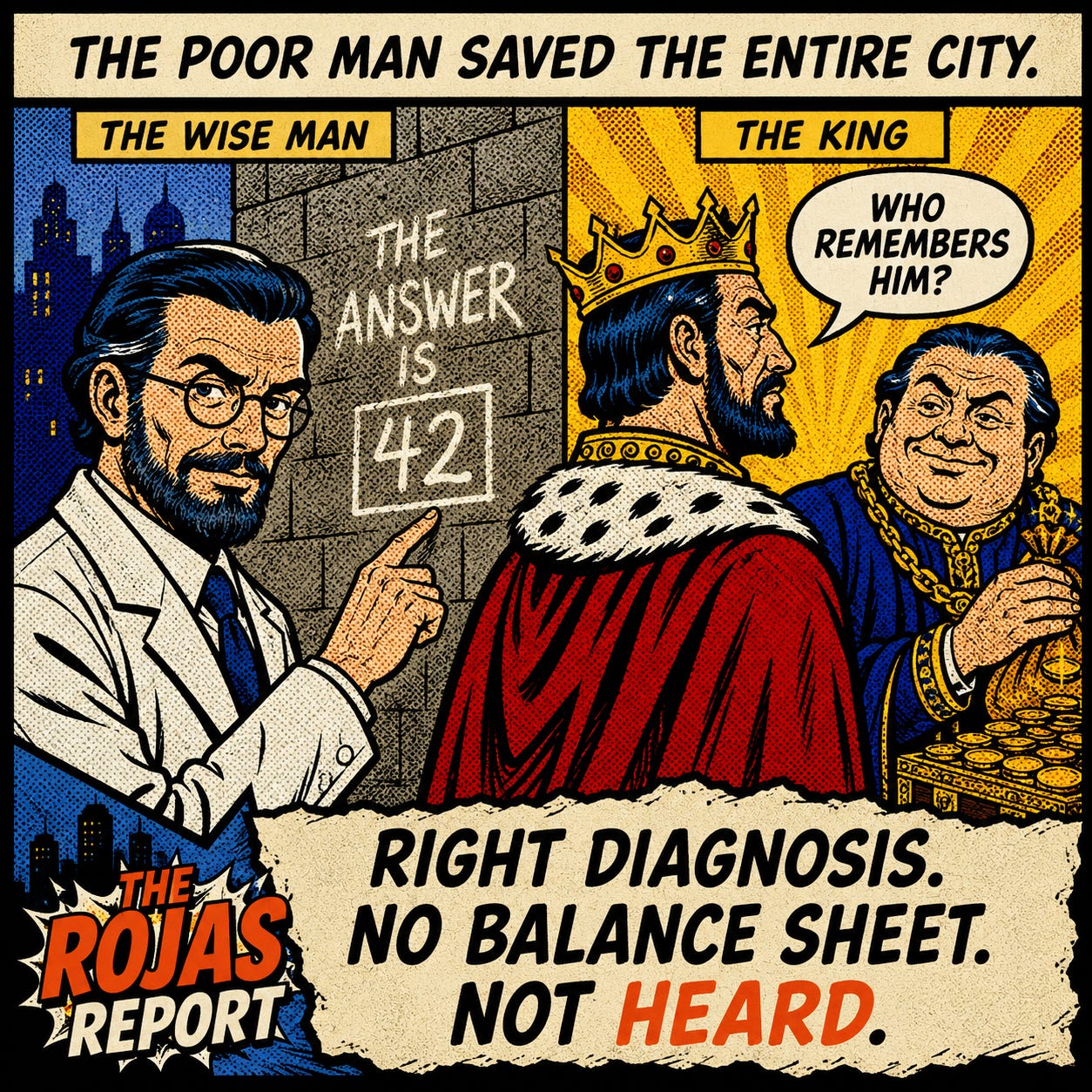
There is a sentence about this, roughly 2,500 years old.
A small city, few people in it. A great king besieges it and builds his works around it. Inside the walls lives one poor wise man, and by his wisdom he delivers the entire city. He is right. He saves everyone.
Then the line: no man remembered that same poor man. And the verdict, worth carving into the inside of every white coat. The poor man’s wisdom is despised, and his words are not heard.
Consider who wrote it. Tradition gives the book to the wisest man who ever lived. A king with every resource, every result a person could accumulate, writing near the end of a life that left nothing untried. He was not poor. He had no reason to flatter the poor. The line he chose to leave behind was that the poor man’s wisdom gets discarded anyway, not because it is wrong, but because of the status of the person holding it.
You are the poor wise man. You have correctly diagnosed a broken system. You are the only one in the building with the wisdom to deliver the city. And your words are not heard, because you arrived with a credential and no capital, and the room runs on capital.
That is the real shape of your dependency. Not only that you answer to the hospital. That you cannot even be heard until someone with a balance sheet repeats what you already knew.
The four walls of your dependency, and the exact asset that takes each one down, sit on the other side of this line.
One hundred thousand readers a month move through The Rojas Report: physicians, healthcare executives, and lawmakers, who read it because the people taking your capital read it first. The deals get made before the press release, and you find out before, not after.
