CASH PAY: THE HIDDEN ARBITRAGE
Insurance Doesn’t Save You Money. It Hides the Real Price.

The “discount” for cash isn’t a discount.
It’s the actual cost of care without the administrative tariff.
A few weeks ago, we presented a group of rural hospitals with a direct contract.
Same offer we make to all facilities in our network.
100% payment. Upfront. Guaranteed.
The lawyer redlined 75% of the agreement.
Her reason: “We get paid in 20 days with insurance.”
She was wrong. Not maliciously. She just didn’t know.
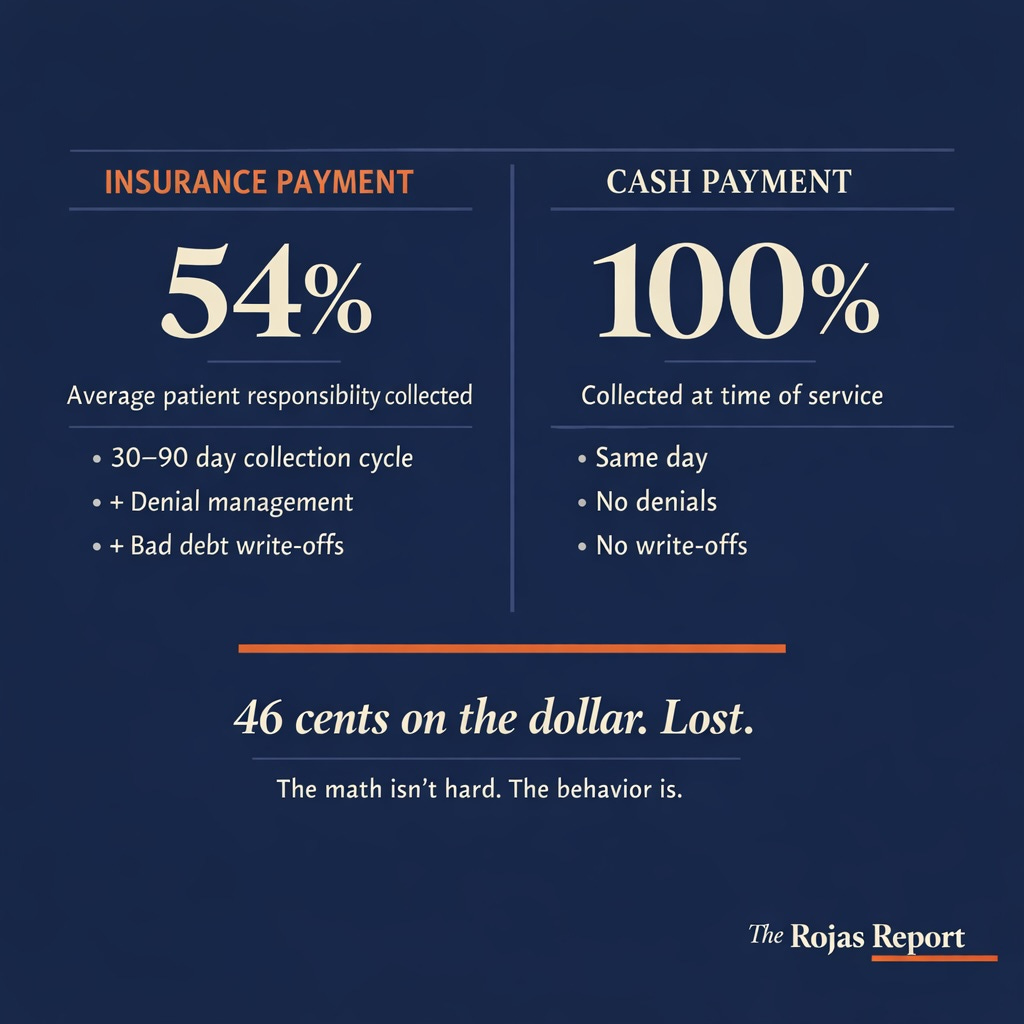
The average collection cycle is 30 to 90 days.
And that’s before you account for the 46% that’s never collected.
This is the math physicians refuse to do.
IN TODAY’S ARTICLE:
Why a rural health system chose uncertain insurance payment over guaranteed cash
The administrative tariff is hidden inside every insurance transaction
$50 billion in bad debt, 87% from insured patients
The math that makes cash the obvious choice
Glossary at the bottom of today’s article.
THE MATH PHYSICIANS REFUSE TO DO
The lawyer said 20 days, and the reality is 30 to 90. That’s the average collection cycle for insurance claims. But “average” hides the variance.
Prior authorizations take weeks to process before the service happens. Denials add months after. Appeals add quarters. And when the insurer finally pays its portion, the physicians must still collect from the patient.
That’s where the math falls apart.
Rurals collect 54% of the patient's responsibility after coverage kicks in. That number has been falling. Before the pandemic, it was higher. Now it’s declining year over year.
Cash is 100%.
At the time of service.
The spread is 46 cents on the dollar.
And the rurals chose the 54%.
Not ultimately, I did step in, but they did try…
This is the behavioral failure killing independent medicine.
THE $50 BILLION LIE
Hospitals wrote off more than $50 billion in bad debt last year.
The assumption is that bad debt comes from uninsured patients. People who show up to the ER with nothing. Charity cases.
That assumption is wrong.
Self-pay after insurance accounted for 58% of bad debt in 2021. In 2018, it was 11%. The share of bad debt from insured patients has more than quintupled over the past 3 years.
Cleveland Clinic’s CFO said it plainly: 87% of their bad debt in 2024 came from insured patients who didn’t pay their out-of-pocket share.
Not the uninsured.
The insured.
The people with coverage.
With cards in their wallets. With premiums deducted from their paychecks.
They’re not paying.
And hospitals are writing it off.
This is the “guaranteed” payment that physicians prefer to cash.