
Congress Banned Physician Ownership. Then the Payer Bought the Operating Rooms.
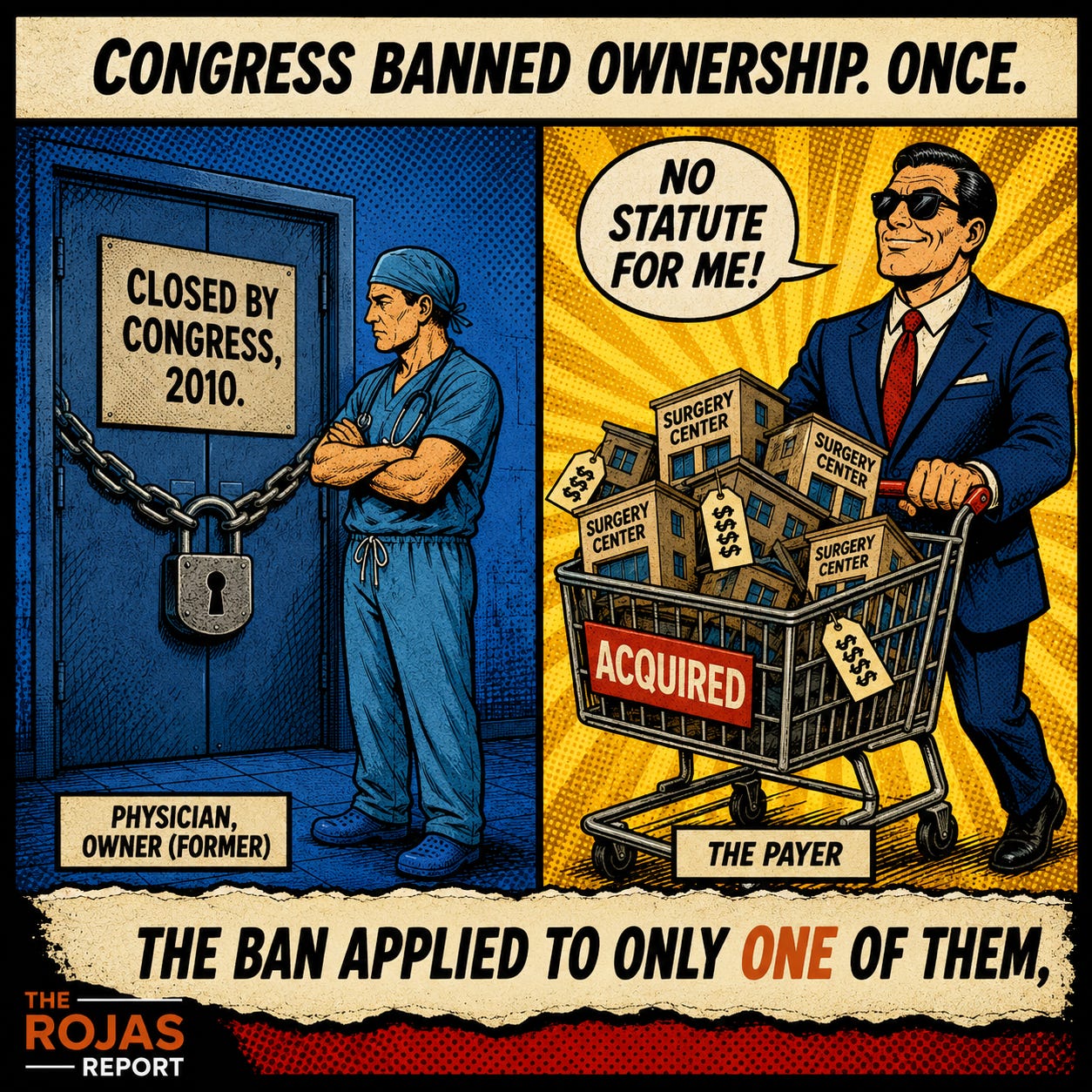
Physicians cannot own hospitals. UnitedHealth owns hundreds of surgery centers. Only one was ever called a conflict.

Rojas Actual.
In 2010, Congress decided physician ownership was a conflict of interest.
Seven years later, UnitedHealth paid $2.3 billion for Surgical Care Affiliates.
The payer that decides what surgery costs now owns where surgery happens.
Nobody in Washington called that a conflict.
IN TODAY’S ARTICLE:
Section 6001 closed the whole-hospital exception in 2010. No new physician-owned hospitals could enter Medicare. The existing ones froze in place.
Seven years later, Optum bought Surgical Care Affiliates, one of the largest surgery-center chains in the country, for $2.3 billion.
In 2024 alone, UnitedHealth took full or partial stakes in more than 100 surgery centers. Almost none of it was announced.
Health Affairs put the words “pricing power” on it in February. The physician ban never moved.
Glossary at the bottom of today’s article.
THE CONFLICT CONGRESS COULD SEE
March 2010. Section 6001 of the Affordable Care Act closes the whole-hospital exception to the Stark law. After December 31 of that year, no new physician-owned hospital can enroll in Medicare. The hospitals that already exist freeze in place: no new beds, no new operating rooms, no new ownership beyond hard caps.
The stated rationale: conflict of interest. A physician who profits from a facility might refer patients to that facility. Congress accepted the argument that this incentive was too dangerous to permit.
The argument had an author. The Federation of American Hospitals, the investor-owned hospital lobby, negotiated Section 6001 into the ACA, thereby closing the physician-ownership pathway while leaving every corporate route open. The Rojas Report archive covers its defense letters in detail.
The principle, as enacted: ownership plus referral power is a conflict too dangerous to permit. Washington permitted everything that follows.
THE SEVEN-YEAR TURNAROUND
January 2017.
Optum announces it will acquire Surgical Care Affiliates for approximately $2.3 billion. SCA operated one of the largest surgery-center chains in the country, spanning more than 30 states. Health Affairs Scholar researchers later documented that this single deal drove the growth of UnitedHealth’s ASC ownership.
The buying never stopped.
It just stopped being announced.
STAT reviewed UnitedHealth’s financial filings and found more than 35 surgery centers and physician practices acquired in 2023, nearly all without announcement. In 2024, the pace accelerated: full or partial stakes in more than 100 surgery centers, inside a year in which UnitedHealth acquired or created more than 250 subsidiaries. The targets concentrated in the most profitable procedural lines: cardiac cath labs, orthopedics, ophthalmology, gastroenterology. More than a dozen came through a joint venture with Texas Health Resources, a nonprofit hospital system in the Dallas-Fort Worth area.
The Private Equity Stakeholder Project traced the pattern further in October 2025: Optum absorbing entire private-equity-assembled platforms, including PE GI Solutions, OrthoAlliance, and U.S. Digestive Health, and surfacing as a reported bidder for Surgery Partners, the third-largest ASC operator in the country.
A physician who wanted to open a surgical hospital in 2017 was barred by federal statute. The largest health insurer in the country faced no such statute, and it bought at scale, quietly, for eight consecutive years.
THE FOUR HATS
Count the roles UnitedHealth holds in a single outpatient surgery.
It sets the reimbursement rate as the payer. It decides whether the claim gets paid. It owns the facility that collects the payment. And through Optum, it counts the operating physician as part of its platform, employed or affiliated, as covered here Tuesday.
Its insurance arm ended 2025 with 8.4 million Medicare Advantage members whose networks it designs. STAT’s 2024 review found the surgery centers concentrated in geographies where UnitedHealth is already the largest Medicare Advantage player. The map of what it bought follows the map of who it insures.
A physician with an ownership stake and a referral pen was a conflict. A conglomerate holding the rate, the claim, the facility, and the physician network is a business model.
Physicians got a statute.
UnitedHealth got a shopping list.
Supporters receive the mechanism that keeps the list off the regulators’ desks.
