

Rojas Actual.
Take a cardiologist in private practice.
Follow his Medicare patients for one year.
Then watch him join a hospital.
Same physician.
Same specialty.
Medicare spending associated with his patients rises by $1,327 per beneficiary.
The physician changed employers.
The financial incentive changed balance sheets.
IN TODAY’S ARTICLE:
What Medicare spends on the same physician’s patients before and after he joins a hospital
The 82 percent, and the eight-year run that produced it
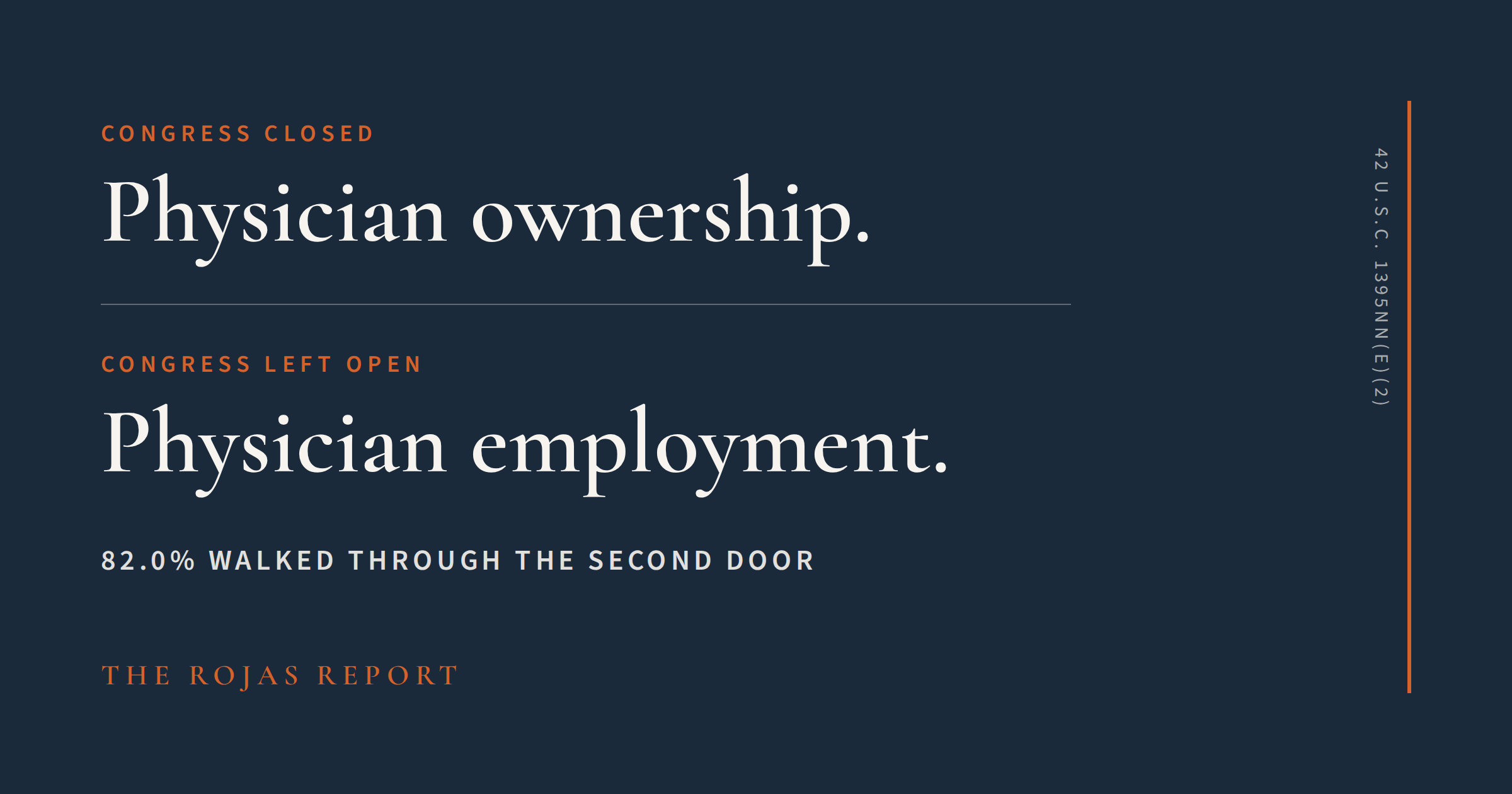
The Stark provision that bars ownership-based referral and permits employment-based productivity pay
What the government’s own referral study found before any of this
Glossary at the bottom of today’s article.
THE PREMISE
The Stark law rests on a concern about financial relationships. A physician with a financial interest in an entity may have an economic reason to send patients there. The statute reaches two kinds of interest, ownership and compensation, and it treats them differently.
Section 6001 applied that concern to physician ownership of hospitals. After December 31, 2010, a physician could no longer hold an ownership interest in a new hospital and refer Medicare patients to it.
Sixteen years have passed. This article asks a single question with the data now available.
Did the financial incentive disappear, or did it move?
THE NUMBER
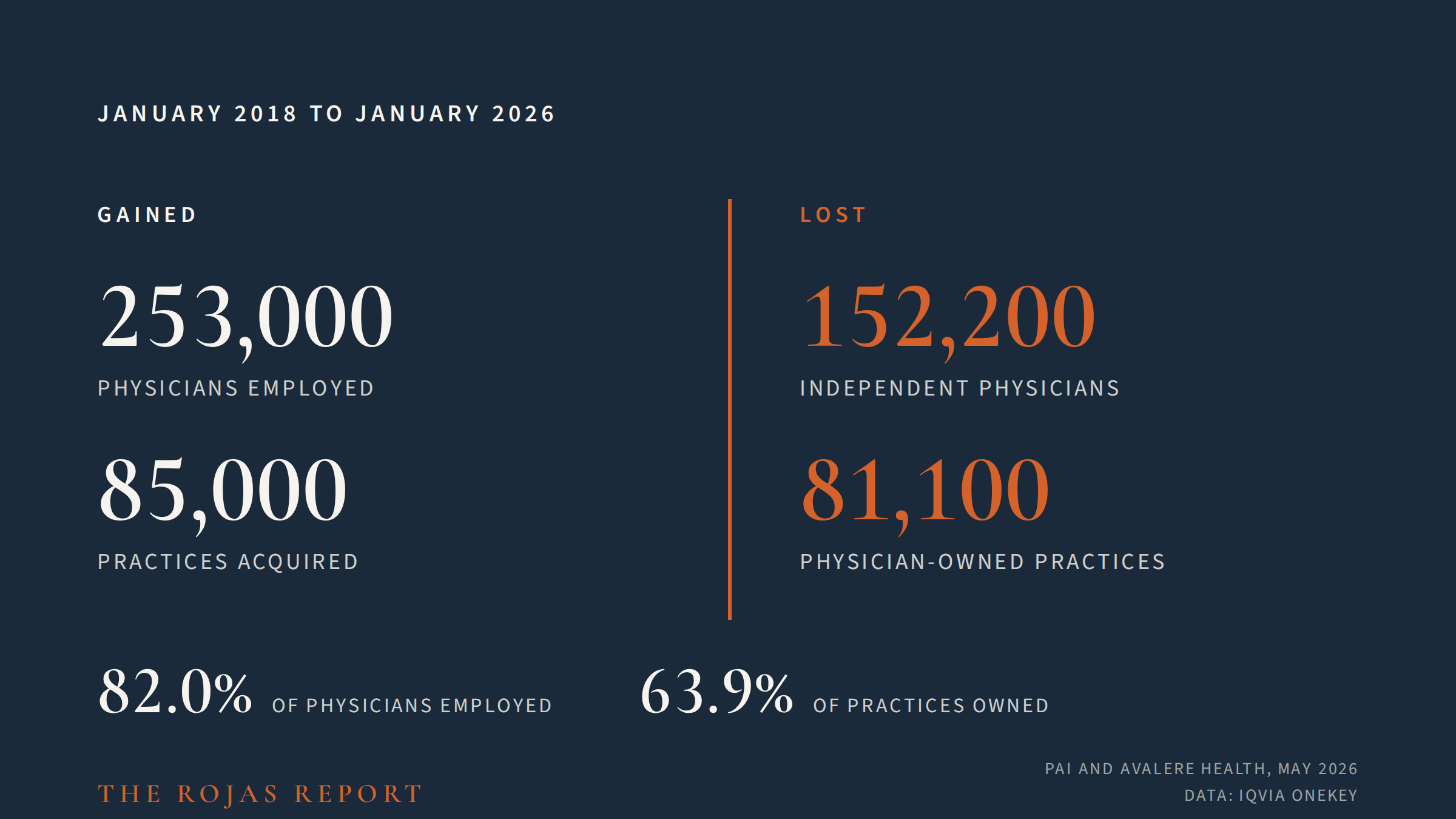
The Physicians Advocacy Institute and Avalere Health published their eighth-year update in May 2026, tracking practice acquisition and physician employment from January 2018 through January 2026 using the IQVIA OneKey database.
As of January 1, 2026, 82.0 percent of American physicians work as employees of hospitals or corporate entities. Hospitals employ 59.7 percent. Corporate entities, which include private equity firms and health insurers, employ 22.3 percent.
Across those eight years, 253,000 additional physicians became employees. Hospitals absorbed 181,200 of them, with 44,000 arriving in the last two years alone. Corporate entities absorbed 71,800, plateaued from 2023 through 2025, then hit a new peak in 2026.
Independent practice lost 152,200 physicians.
Practice numbers moved in the same direction. Hospitals and corporate entities now own 157,200 physician practices, 63.9 percent of the total, after acquiring 85,000 across the eight years. Corporate ownership at 33.2 percent has passed hospital ownership at 30.6 percent. Physicians lost 81,100 practices.
Note the sponsors, both of them. PAI is a physician advocacy organization, and it commissioned this employment research. The American Independent Medical Practice Association funded the Medicare expenditure study that appears later in this article, and Avalere states in that report that it retained full editorial control. Physician-side organizations paid for both principal studies here. This series applies the same standard to every study it cites, and the sponsorship belongs on the page.
Congress regulated the conflict it could see on an ownership document.
The rest of this article follows the money after the physician signs an employment agreement.
There is a reason your hospital’s general counsel reads this before you do.
