
Congress Has One Must-Pass Bill Before the Election. Your Priorities Ride It or Die.
September 30 is the only deadline Congress respects. Everything else negotiates for a seat.

Rojas Actual.
One bill.
Of everything pending in Washington, one bill carries a consequence neither party can ignore: the bill that prevents a funding lapse on September 30.
Twelve spending bills fund the government for FY2027. Three passed the House. Nine wait in line. The Senate Appropriations Committee had not begun.
The math does not close.
Everyone in the building knows the math does not close.
So one vehicle will dominate everything Congress tries to finish before the election: a continuing resolution, the stopgap that keeps the lights on. Leadership can argue over its length, its contents, and its votes. It cannot make September 30 disappear.
Congress has missed this deadline before, and paid for it with a 43-day shutdown last fall. Both parties remember.
And in a town where nothing else must move, the one bill that must move becomes the most valuable real estate in American law.
The vehicle eventually has to move.
The fight is over what gets bolted to it.
IN TODAY’S ARTICLE:
Twelve spending bills fund the government. Three passed the House. The Senate had not begun. One stopgap will substitute for all of it.
The continuing resolution is the only vehicle with a deadline strong enough to force action before November, which makes it the most valuable real estate in American legislation.
Healthcare policy travels as freight. The No Surprises Act was included in a spending package in December 2020. The pattern repeats every year.
Part Two of How a Bill Really Dies: most bills miss the train. Learn to read the one that leaves the station.
Glossary at the bottom of today’s article.
THE ONLY DEADLINE CONGRESS RESPECTS
FY2027 begins October 1. Current appropriations expire on September 30, and without new funding authority, the Antideficiency Act requires affected agencies to begin shutdown procedures. That is not a norm or a tradition. It is statute.
Most deadlines in Washington bend. Authorizations lapse, and programs limp along. Reports come in late. Hearings get postponed. The funding deadline carries the consequence leadership fears most: an immediate, visible government shutdown, five weeks before an election.
House appropriators have already introduced a stopgap, months before the deadline, and said so in their own press release. Whether it moves in July or September, the destination is the same, because three of twelve bills is not a budget.
The highway and transit authority expires on the same day. So do a stack of farm programs. The stopgap is the natural tow for those extensions, though nothing boards until leadership says so. The House-introduced proposal, notably, runs through December 4. Apply that date to everything below.
One locomotive.
Many cars.
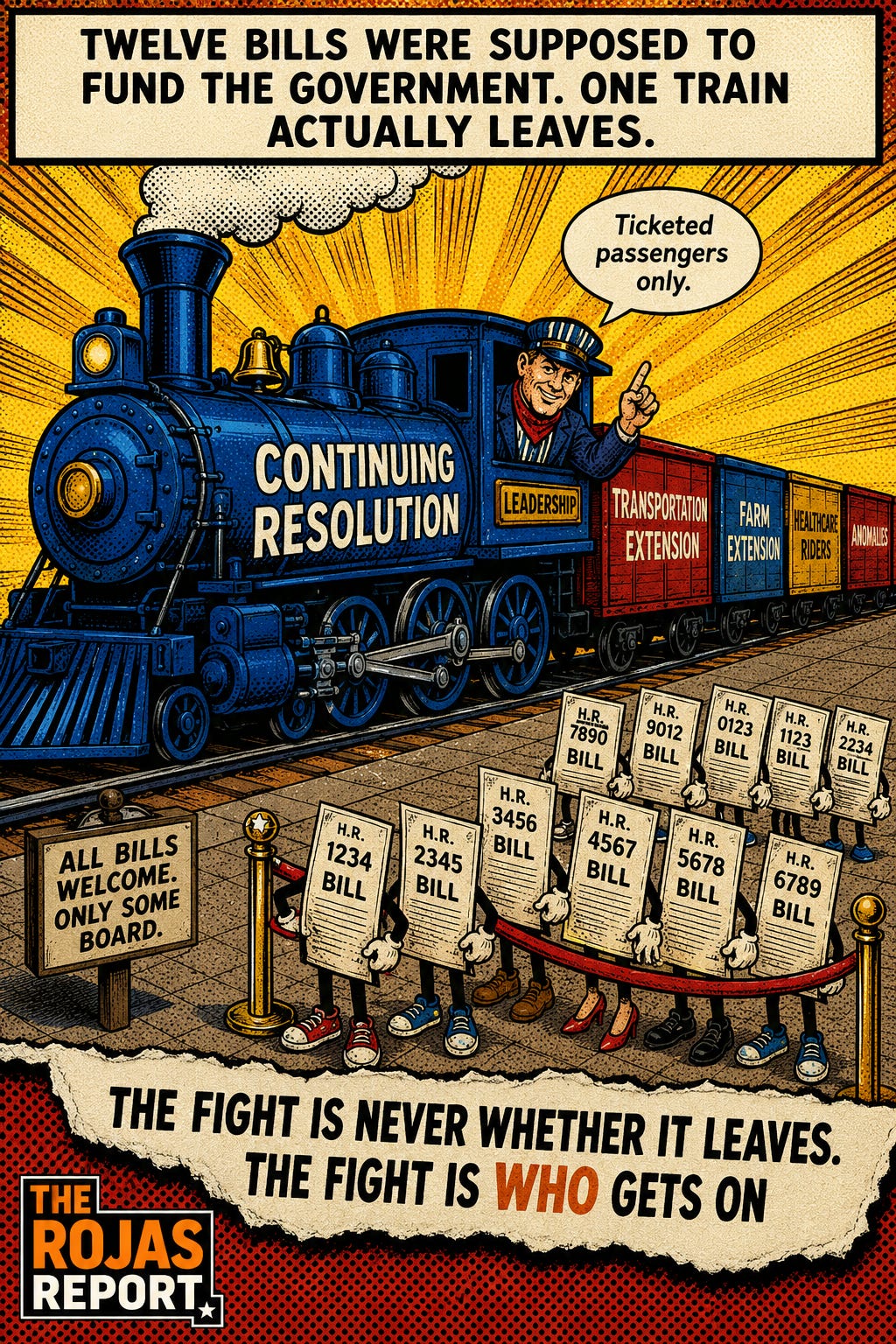
MUST-PASS MEANS MUST-CARRY
The mechanism is simple.
A must-pass bill is a bill leadership cannot afford to fail. Members know it. Lobbyists know it. So provisions with no path of their own, the ones that would die in committee or lose a floor vote or never get a hearing, apply for a seat on the train.
If your provision passes the boards, it becomes law without a separate final floor vote. Some freight arrives with years of committee hearings behind it; the No Surprises Act did, and some arrives with none, but the last vote either kind faces is the package’s. Members do vote against these bills, and the government has shut down over them. The freight gets the package’s verdict instead of one of its own.
Healthcare rides this train constantly.
Congress passed the No Surprises Act as part of a year-end spending package in December 2020. One of the most consequential healthcare laws of the decade, and it traveled as freight.
The Consolidated Appropriations Act of 2026 carried Section 6702, “Full rebate pass through to plan,” requiring PBMs to remit “100 percent of rebates, fees, alternative discounts, and other remuneration” to ERISA health plans, effective for calendar-year plans January 1, 2029.
A provision with consequences this publication will spend a series unpacking. The pattern is decades old, and it means the question that matters is never the one the press asks. The press asks whether a bill has the votes. The lobby asks whether it has a seat.
Come September, one document decides which healthcare provisions become law this year.
You can learn to read it in ten minutes, or you can find out what it carried in a press release written by the people who loaded it.
