
Déjà Vu Isn’t a Glitch. It’s a Signal.
Neuroscience tells you how. It refuses to tell you why. At fifty, you stop accepting that silence.

Had déjà vu yesterday.
Stopped me cold.
Not because it was strange. But rather because it was familiar in a way that felt like an accusation. Like I’d been caught remembering something I wasn’t supposed to know.
You’ve felt it. That split second where reality folds. Where you’re certain you’ve stood in this exact moment before. Not similar. Identical. The light is falling at this angle. The words form in this sequence. The weight in your chest matches a weight you’ve carried in a moment that never happened.
Then it vanishes. And you’re left holding the emotional residue of an experience that, according to every materialist framework, means nothing.
The neuroscientists have an explanation.
Temporal lobe timing mismatch.
The hippocampus stamps a memory as “past” before the prefrontal cortex finishes processing it as “present.” A filing error. A bug in the software. The brain is glitching.
Move along. Nothing to see here. But here’s what the explanation doesn’t cover: Why does a filing error feel like a revelation?
IN TODAY’S SUNDAY ARTICLE:
Why the materialist explanation for déjà vu answers “how” and refuses to answer “why.”
C.S. Lewis’s concept of Sehnsucht and the longing that implies a destination
The pattern of feelings that exceed their causes, and what that pattern suggests
What a healthcare operator learns about immeasurable things after twenty years of measuring
Glossary at the bottom of today’s article.
THE FILING ERROR THAT FEELS LIKE PROPHECY
Why does a memory glitch carry the emotional signature of homecoming?
If we’re purely material beings, running strictly material processes, a timing mismatch in neural encoding ought to feel like exactly that. A hiccup. A stutter. The biological equivalent of a screen flicker.
Instead, it feels like the truth.
The experience delivers meaning. Not confusion. Not randomness. Recognition. The sense that you’ve touched something real.
And the neuroscientists stay silent on that part.
Sunday is for the questions spreadsheets can’t answer. The weekday version of this newsletter follows the money. 60,000+ physicians and healthcare operators follow along. Join them.
C.S. LEWIS AND THE LONGING THAT IMPLIES A DESTINATION
Lewis didn’t write directly about déjà vu.
But he spent his entire intellectual life circling the phenomenon. He gave it a German name: Sehnsucht. And an English one: Joy.
Not happiness. Not pleasure. Joy. The inconsolable longing for something that has no name and no earthly object.
In Surprised by Joy, he describes moments of sudden, piercing recognition. A phrase in a poem. A scent on autumn wind. A bar of music. Something in the present connects to something beyond ordinary experience.
Not memory glitches. Glimpses.
His argument runs like this:
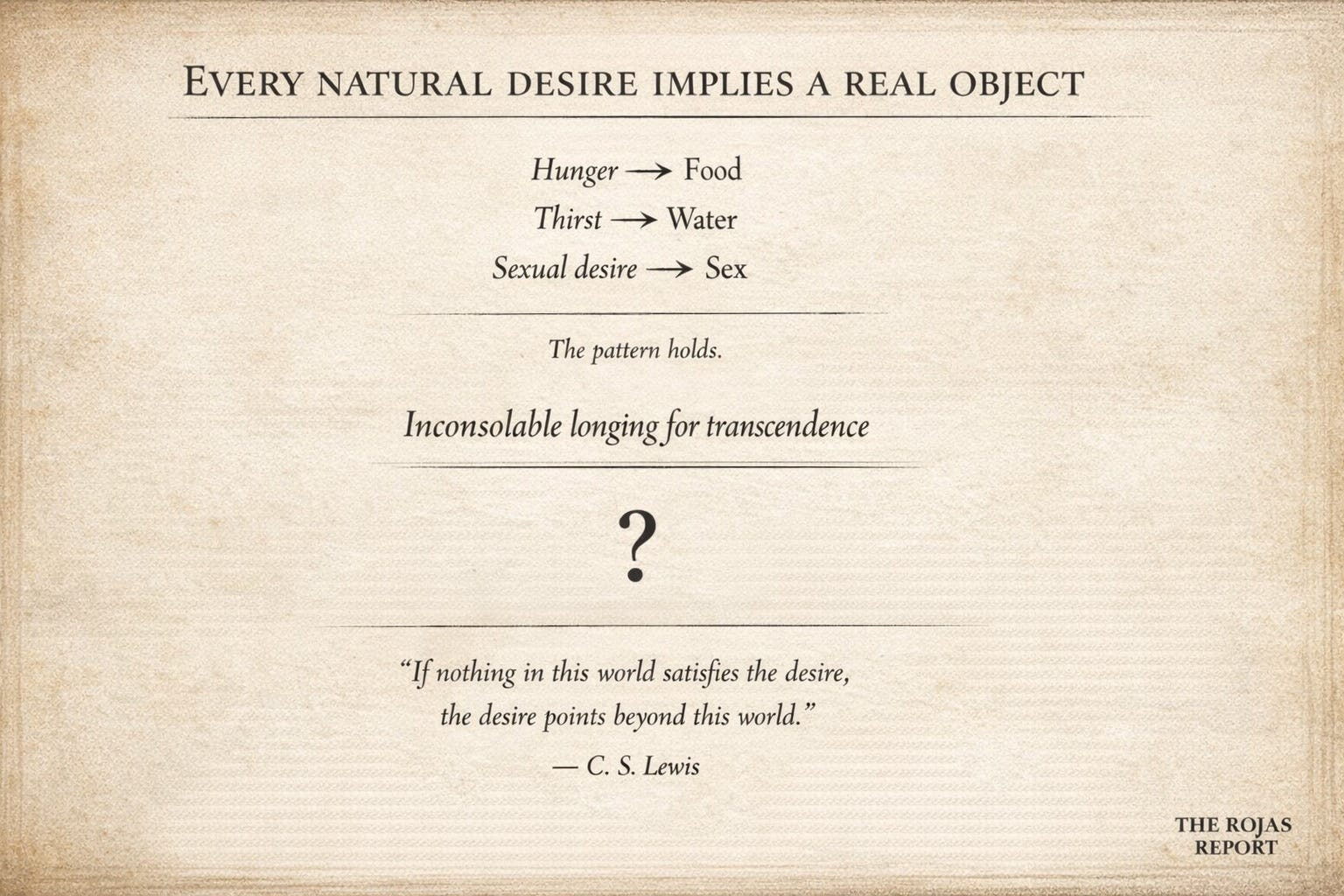
Every natural desire corresponds to a real object. Hunger implies food. Thirst implies water. Sexual desire suggests sex. The correspondence is so reliable that we don’t question it. Of course, hunger means food. That’s what hunger is for.
So what does Joy imply?
What does this nameless longing, this sensation of being exiled from something you’ve never seen, actually point toward?
Lewis’s answer: If we experience a desire that nothing in this world can satisfy, the most probable explanation is that we were made for another world.
The materialist response is predictable. The desire is a malfunction. Evolution gave us a longing for status, resources, and mates. The religious impulse is a misfiring of systems designed for social cohesion. The feeling of transcendence is a temporal lobe artifact.
But notice what this response does.
It answers “how.” It refuses to answer “why.”
It explains the mechanism. It ignores the meaning.
And meaning is precisely what the experience delivers.
THE AMPHIBIAN CONDITION
Lewis landed on a metaphor I can’t shake.
We’re amphibians. Built for two environments. Currently confined to one.
Déjà vu is the gill-memory of water in a creature now walking on land.
The fish doesn’t remember the ocean. It never left the ocean. The land animal doesn’t remember the water. It never lived there.
But the amphibian? The amphibian remembers both. The amphibian feels the absence.
Lewis argued that human beings live in a similar condition. We’re built for eternity, confined to time. Built for the presence of G-d, walking around in His apparent absence. Built for a world where seeing and knowing are the same act, stuck in a world where we see through a glass darkly.
The occasional glimpse breaks through. A moment of déjà vu. A sunset that makes you ache for something you can’t name. A piece of music that opens a door to a room you’ve never entered but somehow recognize.
These aren’t bugs. They’re features. They’re the gill-memory asserting itself. The materialist explanation isn’t wrong. The temporal lobe does misfire. The hippocampus does make filing errors.
But “how” and “why” are different questions.
And the materialist answer only addresses one of them.
You can learn how the system works. Or you can keep being surprised when it works against you. 60,000+ physicians chose the first option. This is where they get their information.
WHAT TWENTY YEARS OF MEASUREMENT TAUGHT ME ABOUT THE UNMEASURABLE
I’ve spent more than two decades measuring healthcare.
Costs. Outcomes. Utilization. Revenue. Margin.
Every spreadsheet tells you something. Most spreadsheets lie by omission.
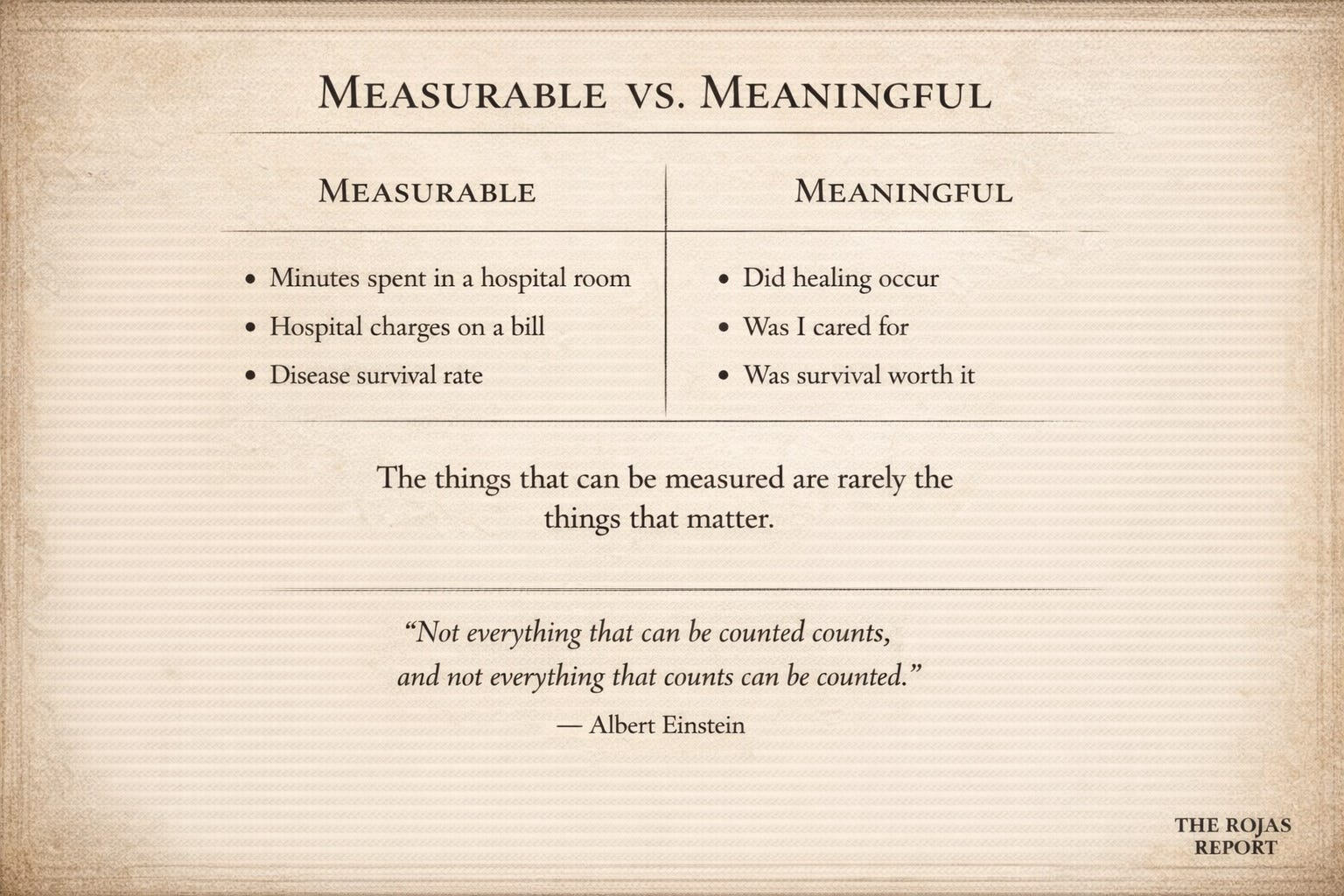
You can measure the minutes a physician spends with a patient.
You cannot measure whether healing occurred.
You can measure the charges on a hospital bill.
You cannot measure whether the patient felt cared for.
You can measure survival rates.
You cannot measure whether the survivor found the experience worth surviving.
The measurable is real.
But the immeasurable is also real. And the immeasurable is usually what matters.
At fifty, I have accumulated enough data to notice the pattern. The things that can be quantified are rarely the things that change your life. The things that change your life seldom fit in a cell on a spreadsheet.
Déjà vu doesn’t fit on a spreadsheet. Neither does love. Neither does purpose. Neither does the conviction, arriving without evidence and refusing to leave without a fight, that you were built for something more than optimization.
Lewis called it Joy. The mystics called it longing.
The philosophers called it the transcendental.I call it Sunday.
Sunday is the day I ask the questions that don’t generate revenue. The questions that don’t have KPIs. The questions that a purely material being, running strictly material processes, would never think to ask.
Why does a filing error feel like a revelation?
Why does a timing mismatch feel like homecoming?
Why do I keep glimpsing a place I’ve never been, and why does the glimpse feel more real than the room I’m standing in?
The materialists have their explanations. The explanations are probably accurate as far as they go. Temporal lobe. Hippocampus. Neural encoding.
But accuracy isn’t completeness. And the experience keeps exceeding the explanation.
THE LUXURY OF DANGEROUS QUESTIONS
At twenty, I didn’t have time for this.
At thirty, I was building companies. At forty, I was fighting the cartel. At fifty, I’ve earned the right to sit with the questions that have no commercial application.
Is the longing evidence? Is the glimpse a signal? Are we amphibians, built for two environments, currently stuck on land?
I don’t know.
Lewis thought he knew. He staked his life on it. He called himself a reluctant convert, dragged kicking and screaming into the kingdom of G-d by the weight of his own arguments.
I’m not there. I’m not not there either.
What I am is fifty. And at fifty, you stop pretending the spreadsheet contains everything important. You stop treating the unmeasurable as the unreal. You stop dismissing the glimpse because you can’t reproduce it in a laboratory.
Déjà vu hit me yesterday. For a split second, I was somewhere else. Somewhere I recognized. Somewhere that felt more like home than any address I’ve ever lived at.
Then it was gone.
But the residue remained. The emotional weight of having touched something. The sense that the filing error was actually a filing success, a brief moment when the correct file surfaced before the system buried it again.
The neuroscientists can explain the mechanism. Good for them.
I’m interested in the meaning. And on Sundays, I give myself permission to chase it.
-Rojas out.

GLOSSARY
Déjà vu: The sensation of having already experienced a present situation. From the French for “already seen.” Neurologically attributed to temporal lobe timing mismatches; philosophically attributed to much more.
Sehnsucht: German word for longing, yearning, or craving. C.S. Lewis used it to describe an inconsolable longing for something beyond earthly experience. He considered it evidence for a transcendent reality.
Joy (Lewis’s definition): Not happiness or pleasure, but the sudden, piercing sensation of desiring something beyond what the world offers. Lewis distinguished between the desire itself and the objects we mistakenly think will satisfy it.
Argument from Desire: Lewis’s philosophical argument that natural desires correspond to real objects (hunger implies food exists), and therefore the universal human longing for transcendence implies transcendence exists.
Temporal Lobe: Region of the brain involved in processing sensory input, memory formation, and language comprehension. Misfires in this region are the standard neurological explanation for déjà vu.
SOURCES
Lewis, C.S. Surprised by Joy: The Shape of My Early Life. Harcourt Brace, 1955.
Lewis, C.S. Mere Christianity. Geoffrey Bles, 1952.
Lewis, C.S. The Weight of Glory and Other Addresses. HarperOne, 1949.
Brown, Alan S. The Déjà Vu Experience. Psychology Press, 2004.
Happy birthday, #50!
We should all be so fortunate to take time to contemplate our existential reality, the mission, and ultimately who or what we serve. In 2025, I did more of that than ever, am stronger for that investment, and has me bullish about 2026, come what may. We all serve someone or something. Appreciate the reminder to slow down to go fast.