
Eight Men in a Room Built the Machine That Controls Your Healthcare

Before the lobbying, before the lawsuits, before the $146 million in revenue, there were eight men who wanted to run hospitals better. This is how it started.
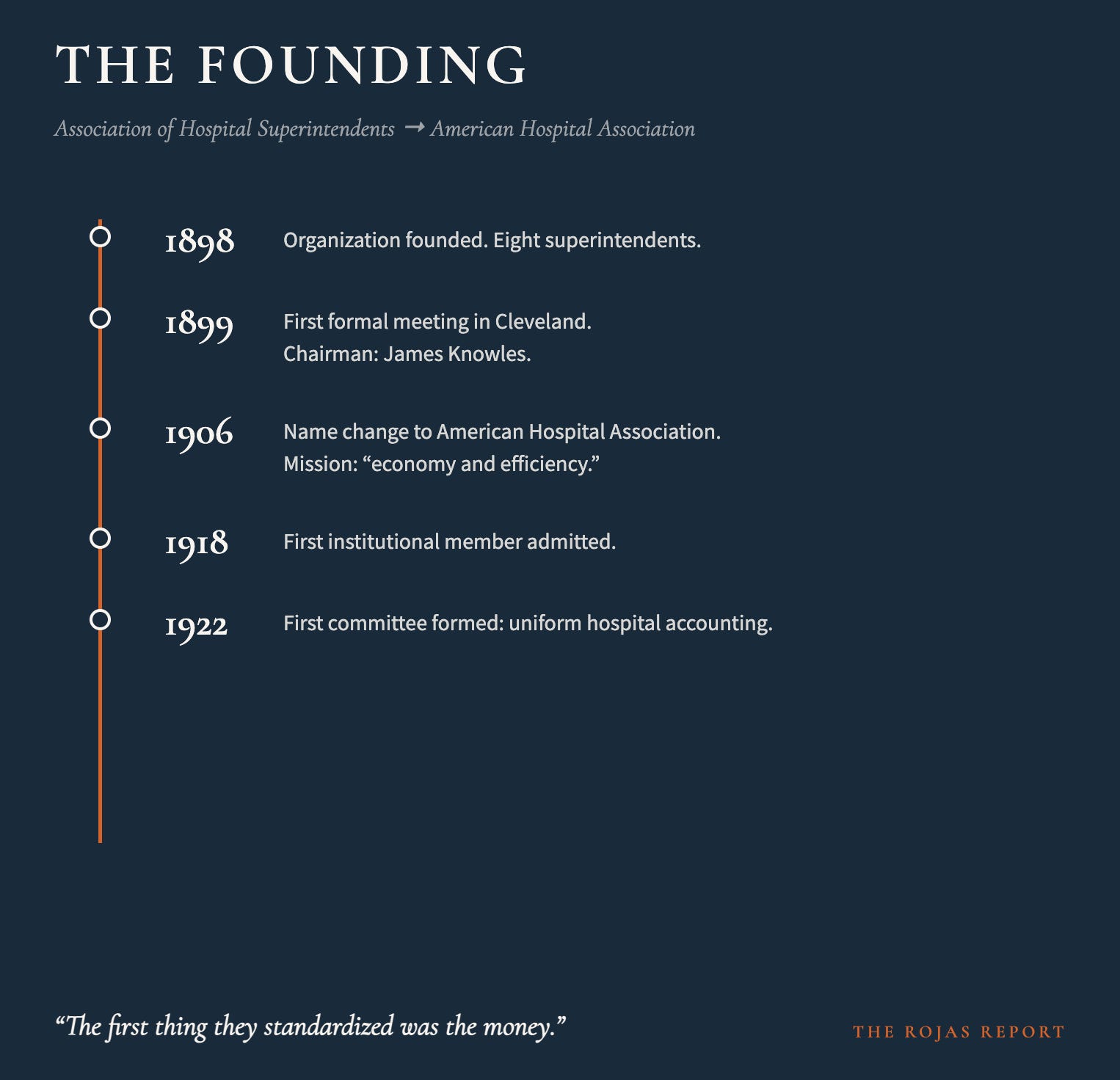
In 1898, eight hospital superintendents walked into a meeting in Cleveland.
They wanted to talk about accounting.
Standardized ledgers.
Uniform billing codes.
How to keep the lights on.
128 years later, the organization they built spends $29 million a year lobbying Congress, sued the federal government twice to keep hospital prices secret, and pays its CEO $3.4 million.
The mission was “economy and efficiency in hospital management.”
Read that again.
IN TODAY’S ARTICLE:
Eight administrators. One professional club. The infrastructure capture playbook followed.
How the AHA went from sharing best practices to controlling the billing codes that every hospital in America depends on
The first act of hospital self-organization was about revenue, not patients
Tomorrow: the AHA invents its own insurance system. You know it as Blue Cross.
Glossary at the bottom of today’s article.
HISTORY OF THE AHA
The American Hospital Association is the most powerful lobbying force in healthcare. It represents nearly 5,000 hospitals. It spends tens of millions influencing legislation. It sued the federal government to keep prices hidden from patients.
But it didn’t start that way.
The Rojas Report traces the AHA from its founding to its present form.
Day by day.
Decision by decision.
Dollar by dollar.
Today: the origin.
EIGHT MEN. ONE ROOM. ONE IDEA.
In 1898, eight hospital superintendents organized the Association of Hospital Superintendents of the United States and Canada. Their first formal meeting was convened from September 20-22, 1899, in Cleveland, Ohio, and was chaired by James Knowles.
In 1873, the first U.S. hospital census counted just 178 hospitals of all types, most of them long-term care facilities rather than general hospitals. By the turn of the century, that number was climbing fast. Hospitals were multiplying. But nobody was coordinating.
Every hospital ran its own books. Its own systems. It’s own rules. One hospital billed you one way. The hospital five miles down the road billed you another. No coordination. No standards. No accountability.
The eight superintendents wanted to fix that. The purpose was practical: share best practices, compare notes, and make hospital operations less chaotic.
This was not a political organization.
This was not a lobbying shop.
This was a professional club for administrators who thought hospitals could run better.
The consolidation playbook isn’t secret.
It’s just not reported.
Until now. 100,000+ physicians and healthcare operators read The Rojas Report daily.
Keep reading with a 7-day free trial
Subscribe to The Rojas Report to keep reading this post and get 7 days of free access to the full post archives.