
Federal Investigators Recommended Safety Rules. Congress Regulated Ownership.
The investigators named four fixes. None of them touched ownership.

Rojas Actual.
In January 2008, the federal government published an investigation into whether physician-owned specialty hospitals could manage medical emergencies.
It found real problems.
Then I read what the investigators recommended. Enforce the staffing and emergency-care rules already on the books. They did not recommend restricting physician ownership.
Two years later, Congress did.
IN TODAY’S ARTICLE:
What the federal investigators actually found in 109 physician-owned specialty hospitals, and the four fixes they named
The rule CMS had already written, covering every hospital in Medicare regardless of who owned it
What Section 6001 did instead: a grandfather date, an ownership freeze, a capacity freeze, and a closed door
Twelve articles, one question, and why a defense published five days ago makes it current again
Glossary at the bottom of today’s article.
WHERE THIS STARTS
I read the 2005 legislation first.
Then I read the federal investigation that followed it.
The government found real problems.
Congress solved a different one.
That gap is this series.
WHAT THE INVESTIGATORS FOUND
The Senate Finance Committee asked the HHS Office of Inspector General to evaluate patient care and safety in physician-owned specialty hospitals. Inspector General Daniel Levinson published the result in January 2008 as OEI-02-06-00310.
The investigators worked from 109 hospitals, reviewed staffing schedules, read written emergency policies, and interviewed an administrator at every one.
They found gaps. Hospitals relying on a 911 call to obtain medical assistance in stabilizing a patient, which CMS had already said violates the conditions of participation. Written emergency policies missing the appraisal of emergencies, initial treatment, or referral and transfer. Policies that never mentioned a defibrillator. Staffing schedules that failed the nurse and physician requirements on sampled days.
Those are real findings.
This series will not pretend otherwise.
Then read the recommendations.
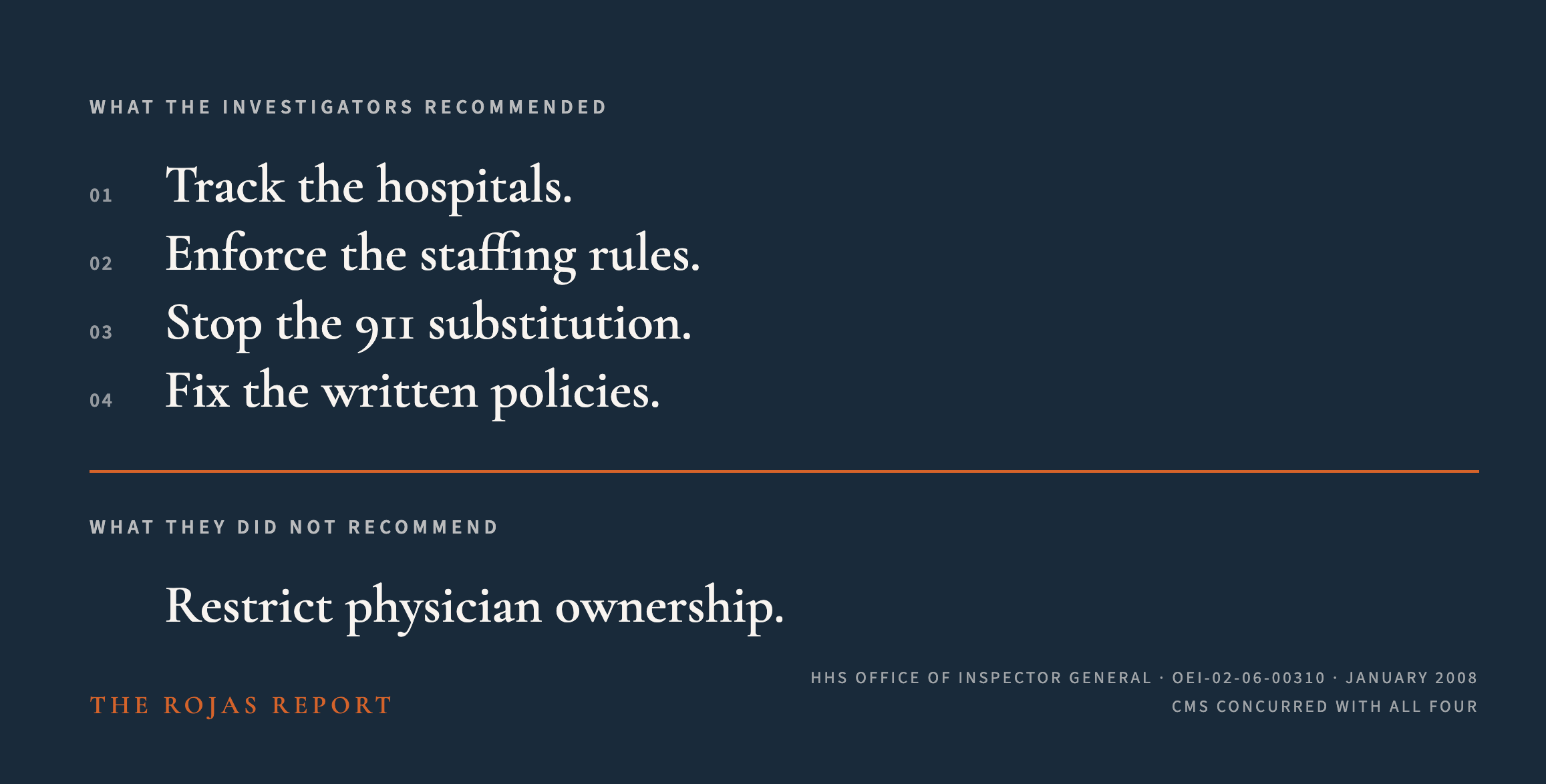
There are four, all directed at CMS.
Track these hospitals. Enforce the existing staffing conditions requiring a registered nurse on duty around the clock and a physician on call when none is onsite. Make certain hospitals can appraise and initially treat emergencies rather than leaning on 911 to do it. Require the missing content in written emergency policies.
The Inspector General added a note that some of those recommendations apply to all hospitals, not only to the ones physicians own. CMS concurred with all four.
No recommendation restricted physician ownership. No recommendation limited beds, operating rooms, or equity percentages. The investigators who found the safety problem named the safety fix.
THE CASE, TAKEN SERIOUSLY
The argument against physician-owned hospitals did not rest on that report alone, and it deserves a fair statement.
Critics said physician ownership creates an incentive to route profitable, healthier, better-insured patients toward facilities the referring physician owns. That patient mix, they argued, leaves community hospitals carrying Medicaid, dual-eligible, uninsured, and complex cases without the elective margins that fund them. They pointed to specialty facilities that operate limited service lines and carry limited emergency capability while calling themselves hospitals, and to patients who cannot tell the difference in an emergency. The diversion, on their account, threatens full-service and rural hospitals, and through them, community access.
Every one of those claims deserves testing. Some hold up. A safety problem can be real while an ownership restriction remains the wrong instrument for fixing it, and this series takes both halves of that seriously. Physician ownership creates an obvious financial incentive. So does hospital employment, and both get examined here under one standard. A community hospital carries obligations worth funding. That does not give it a legal claim to every profitable procedure in its market.
Write down what each allegation describes. Conduct. Capability. Incentives. Patient mix. Utilization. Outcomes.
Hold that list.
The statute and the Inspector General report have been public for eighteen years. Almost nobody reads them next to each other. This is where that gets done, twelve articles running.
THE RULE THAT ALREADY EXISTED
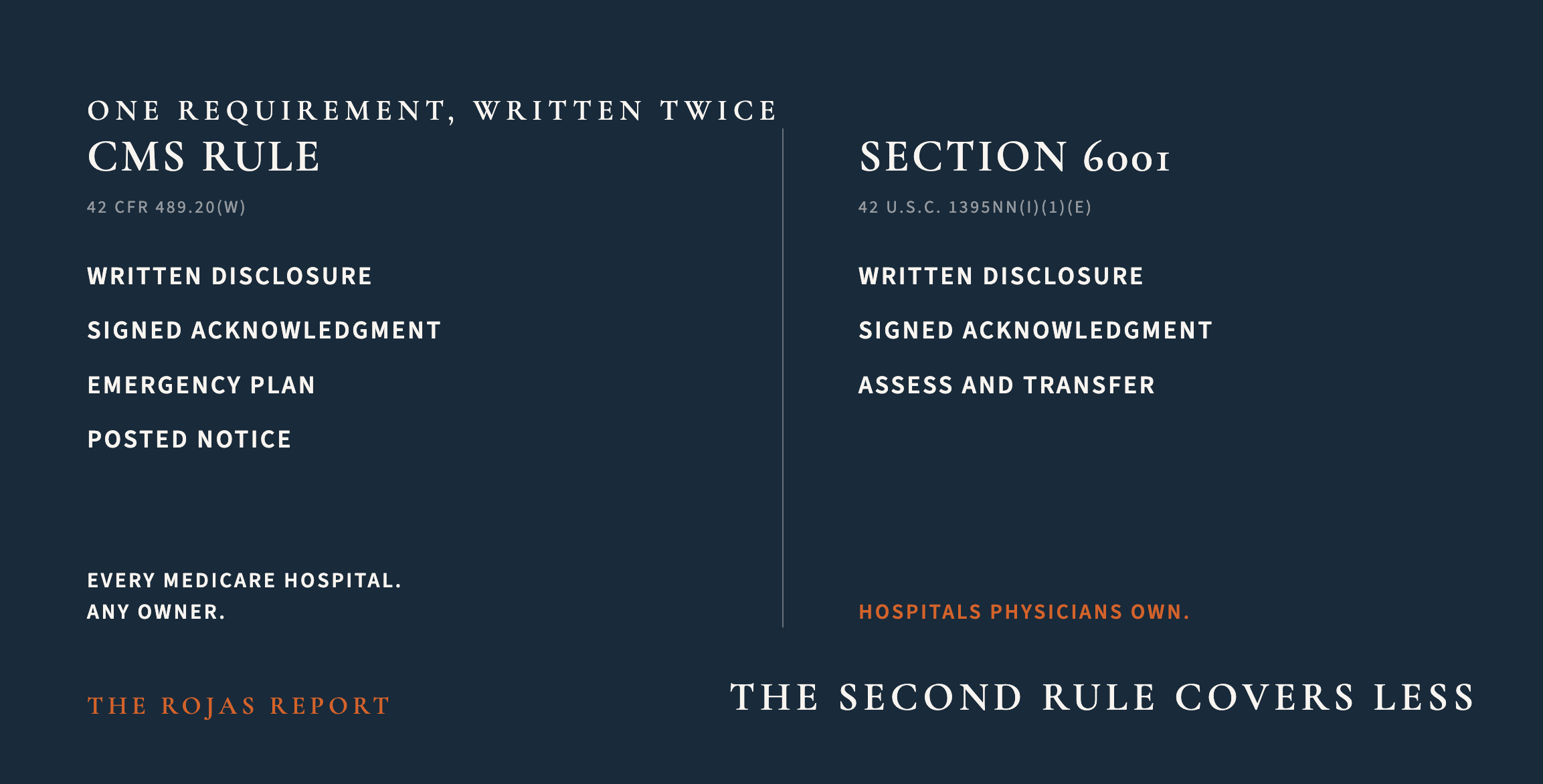
Here is the part that stopped me. Before the Inspector General published, CMS had already written the rule. Read 42 CFR 489.20(w).
A hospital gives written notice to every patient at the beginning of an inpatient stay, or an outpatient visit for observation, surgery, or any procedure requiring anesthesia, when no doctor of medicine or osteopathy is present 24 hours a day, 7 days a week.
The notice states that fact and explains how the hospital will meet the needs of a patient who develops an emergency medical condition while no physician is there. Before admitting that patient, the hospital obtains a signed acknowledgment. Any dedicated emergency department in such a hospital posts the same notice where patients entering it will see.
Written disclosure.
Signed acknowledgment.
Emergency plan.
Posted notice.
Every hospital participating in Medicare. Any owner. Nonprofit, investor-owned, system-owned, physician-owned.
In March 2010, Congress wrote that requirement again. Section 6001 added a patient-safety paragraph to the Stark law requiring a hospital to disclose the absence of an around-the-clock physician before admission, to obtain a signed acknowledgment from the patient, and to maintain the capacity to assess, initially treat, and transfer patients to hospitals that can treat them.
That paragraph is a condition of the ownership exception. It reaches hospitals with physician owners. It reaches nobody else.
The provisions are not word for word. Section 6001 states the assessment, initial treatment, and transfer capacity as an express condition, where the CMS rule reaches capability through the conditions of participation. Both address the same question: what a patient learns, and signs, when no physician stays onsite.
Congress did not face a choice between regulating conduct and doing nothing. An ownership-neutral rule covering every hospital in Medicare was already on the books. Congress restated a version of it as a condition of who may hold the equity.
WHAT SECTION 6001 ACTUALLY DID
Section 6001 did not outlaw physician ownership.
It narrowed an exception.
Before 2010, the Stark law let a physician with an ownership interest in an entire hospital refer Medicare patients there. Section 6001 kept that exception open only for hospitals that held both physician ownership and a Medicare provider agreement on December 31, 2010.
Hospitals that made the date live under three permanent conditions.
Their licensed beds, operating rooms, and procedure rooms cannot exceed what they held on March 23, 2010.
The share of the hospital owned by physicians in the aggregate cannot exceed what it was on that same date.
And an expansion exception exists on paper, available once every two years, capped at double the 2010 baseline, limited to the main campus, restricted to hospitals meeting county population growth and Medicaid admission thresholds, and closed to administrative and judicial review.
Hospitals that missed the date lost the exception.
New entry effectively ended.So the structure runs like this.
Existing facilities frozen.
New facilities shut out.
Expansion locked behind a narrow door with no appeal.
None of those conditions asks what a hospital did. None asks whether it staffed a nurse, kept a physician on call, wrote a complete emergency policy, or transferred a patient safely. A hospital’s compliance with emergency standards did not determine whether it qualified for the exception. Its ownership structure and operating dates did.
That is the mismatch.
Every allegation described conduct.
The statute turns on a date and a percentage
SIXTEEN YEARS LATER
On July 25, 2026, Wendell Primus published a defense of the restriction in MedPage Today. Brookings republished it two days later. Primus served as a senior health and budget adviser to Speaker Nancy Pelosi, and Brookings describes him as the lead House staffer in developing the Affordable Care Act.
His argument returns to the same categories of concern. Emergency readiness. Self-referral. Patient selection. Payer mix. Uncompensated care. The financial stability of full-service and rural hospitals.
He says so himself. Midway through the piece, Primus writes that the issue is not about ownership, and places the concern in the conflict created by self-referral and the effect of those referrals on a community’s access to care.
Every one of them describes conduct or consequence.
Self-referral is conduct.
Access is an outcome.
The law he defends still turns on ownership.That is why this remains open sixteen years later.
The framing never changed.
Meanwhile, the economy underneath it did.
Physicians did not leave their financial relationships with hospitals. They became employees, affiliates, and joint venture partners. Health systems kept acquiring specialty and outpatient facilities, and kept promoting physician-led governance inside them as a feature.
The procedures remained.
The physicians remained.
The financial relationship changed form.
This series does not claim to know why.
It asks the question and follows the documents.
WHAT THE NEXT ELEVEN ARTICLES DO
One evidentiary burden each, in three movements.
We begin with the evidence. The death in Abilene. The Inspector General report in full, including its denominator, its missing comparison group, and what it does not prove.
Then the economics. Self-referral. Physician employment. Cross-subsidies and patient mix. The Ascension acquisition of AmSurg.
Then the politics. Who sought the restriction and what they said about securing it. Primus’s own role in the legislation. And sixteen years of outcomes graded against what supporters said the law would accomplish.
The Federation of American Hospitals represents investor-owned systems. The American Hospital Association represents the broader field, including nonprofits. Both wanted this provision. They are different organizations, and this series will keep them distinct.
The federal investigators found a safety problem and recommended safety enforcement. CMS already had a disclosure rule covering every Medicare-participating hospital. Congress enacted an ownership restriction.
That does not prove Congress acted improperly.
It raises a question nobody has answered: What harmful conduct could Congress regulate only by restricting physician ownership?
-Rojas out.

GLOSSARY
Stark law: The federal statute at 42 U.S.C. 1395nn barring a physician from referring Medicare patients for certain services to an entity the physician holds a financial interest in, unless an exception applies.
Whole-hospital exception: The Stark provision permitting physician owners to refer Medicare patients to a hospital, so long as the ownership interest covered the entire hospital rather than one department of it.
Section 6001: The Affordable Care Act provision that narrowed the whole-hospital and rural provider exceptions, effective March 23, 2010.
Conditions of participation: The federal health and safety standards at 42 CFR Part 482 that a hospital meets to participate in Medicare. Failing them can cost a hospital its Medicare agreement.
Office of Inspector General: The HHS watchdog that audits and evaluates federal health programs and publishes recommendations to agencies like CMS.
Grandfathering: Letting facilities that existed on a stated date keep operating under rules that no longer admit new entrants.
Specialty hospital: Under the Stark law, a hospital primarily or exclusively treating cardiac patients, orthopedic patients, or patients receiving surgery.
SOURCES
HHS Office of Inspector General. Physician-Owned Specialty Hospitals’ Ability to Manage Medical Emergencies. OEI-02-06-00310. Daniel R. Levinson, Inspector General. January 2008. Verified against the complete report, July 30, 2026.
42 U.S.C. § 1395nn, Limitation on certain physician referrals. Subsections (d)(3) and (i) as amended by Pub. L. 111-148 §§ 6001(a) and 10601(a), and Pub. L. 111-152 § 1106. Verified July 30, 2026.
Primus, Wendell. “Restrictions on Physician-Owned Hospitals are Justified.” MedPage Today, Perspectives / Second Opinions, July 25, 2026. Republished by the Brookings Institution, July 27, 2026.
42 CFR § 489.20(w), Basic commitments. Current text verified against the eCFR, August 8, 2026. The Inspector General cited this paragraph in January 2008, which establishes that the rule preceded the report. The paragraph then sat at (v) and was redesignated to (w) by a later amendment; older secondary sources still cite the earlier letter.
CMS. Memorandum to State Survey Agency Directors, Provision of Emergency Services: Important Requirements for Hospitals. S&C-07-19, April 26, 2007.