
Fee-For-Service Inflation Was Not An Accident. One Man Designed It.
In one committee room in 1965, Wilbur Mills wrote the payment language himself, ensuring the bill would climb forever

You think reimbursement inflation is a bug.
It is the feature.One man wrote it into the law on purpose.
He needed two lobbies to stop fighting.So he paid them with language that never stops paying.
IN TODAY’S ARTICLE:
How fee-for-service inflation was engineered, not inherited
The cost-plus logic that pays a hospital more the more it spends
Why the AMA, after fighting “socialized medicine” for a generation, suddenly went quiet
The machine you inherited, and who designed it to leak
Glossary at the bottom of today’s article.
THE FIGHT YOU HAVE EVERY DAY STARTED IN A ROOM YOU NEVER SAW
You fight reimbursement every day.
The downcode.
The denial.
The rate that drops while your costs climb.
The sense that the math was rigged before you ever opened the claim.
It was.
It was rigged in 1965, in one committee room, by one man.
In Part 1, you met the committee. The House Ways and Means Committee. The committee that sits over the four levers that set what your work is worth: the tax treatment, the trust fund, the payment formula, and the rule that decides what the rest of Congress is even allowed to touch.
Today you meet the man who pulled all four at once. And you meet the two phrases he wrote that still decide who wins when you argue over a bill.
His name was Wilbur Mills.
THE TAX MAN WHO BUILT YOUR HEALTH SYSTEM
Wilbur Mills, Democrat of Arkansas, chaired Ways and Means from 1958 to 1974.
He was the most powerful figure in tax and health legislation of his era.
Nothing in his committee’s jurisdiction moved without him.
Not a rate.
Not a formula.
Not a comma.Here is the part that matters to you.
Mills was not a doctor.
Mills was not a hospital man.
Mills was the tax man.
Medicare lives inside Social Security. Social Security is funded by the payroll tax. The payroll tax is the tax committee’s property. So the elderly’s health insurance landed on the desk of the man who controlled the tax code, not the man who controlled medicine.
That is the whole reason your payment formula was written by a politician and not a physician.
Mills initially opposed hospital insurance for the elderly. Then he made a colder calculation. If this was going to pass, he would author it himself, thereby controlling its shape.
He took control.
That control is the entire story.
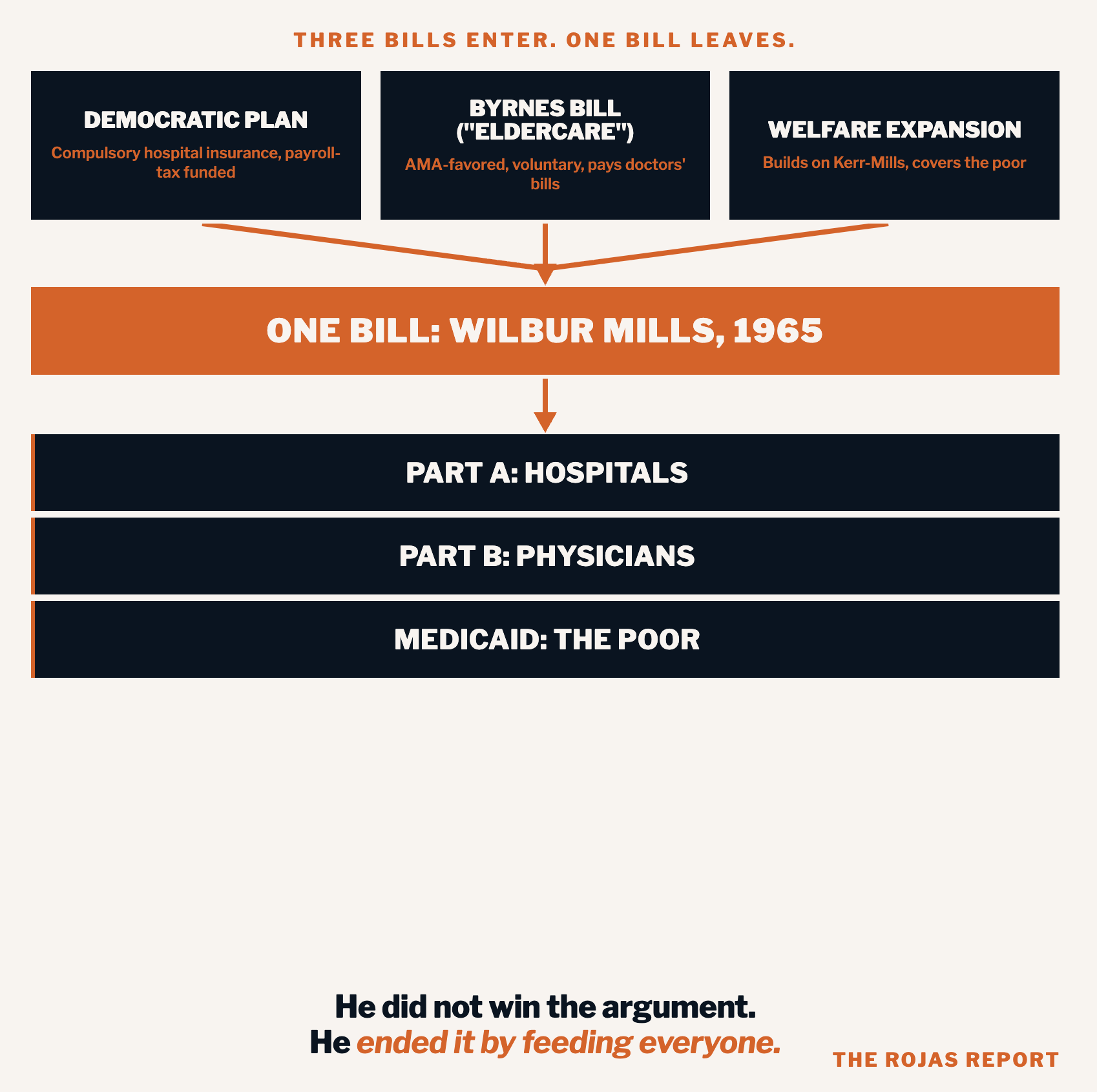
THE THREE-LAYER CAKE
Going into 1965, three bills were on the table, competing with one another.
The Democrats wanted compulsory hospital insurance for the elderly, paid by the payroll tax. The AMA and its Republican allies countered with the Byrnes bill, sometimes called “Eldercare,” a voluntary plan to help pay doctors’ bills. And there was a third track, an expansion of welfare medical assistance for the poor, building on the earlier Kerr-Mills program.
Washington expected Mills to pick one.
Three bills enter, one bill leaves.
Mills did something nobody saw coming. He took all three and stacked them.
The Democratic hospital plan became Part A of the Hospital Insurance program.
The AMA’s own bill plan became Part B. Physician insurance.
The welfare expansion became Medicaid. Coverage for the poor.He called it the “three-layer cake.” One bill, three layers, something for everyone who had been fighting.
Read what he actually did. He did not win the argument. He ended it. By handing every faction its own layer, Mills removed the reason to oppose. The hospital lobby got its layer. The physician lobby got its layer. The opposition dissolved because everyone got fed.
That is the architecture you bill into right now. Part A. Part B. Medicaid. Three names you say a hundred times a week. One man stacked them, on one afternoon, to make the fighting stop.
The bill that fused them was the Social Security Amendments of 1965. President Lyndon Johnson signed it on July 30, 1965.
Removing the opposition is not the same as fixing the problem. To get the lobbies to stop fighting, Mills had to pay them. And how he paid them is the part that still empties your pocket sixty years later.
The trade press will tell you fee-for-service inflation “emerged” in the decades after Medicare.
It did not emerge. It was authored, on purpose, by a man who needed two lobbies quiet.
This is where the architecture gets reported in language that makes the design obvious. 100,000+ physicians and operators read it.
