
Fewer Members. Thinner Benefits. Lower Earnings. Wall Street Applauded.
Wall Street restored the old multiple before UnitedHealth restored the old earnings.

Rojas Actual.
A turnaround has winners.
Ask the 600,000 seniors whose plans were discontinued.
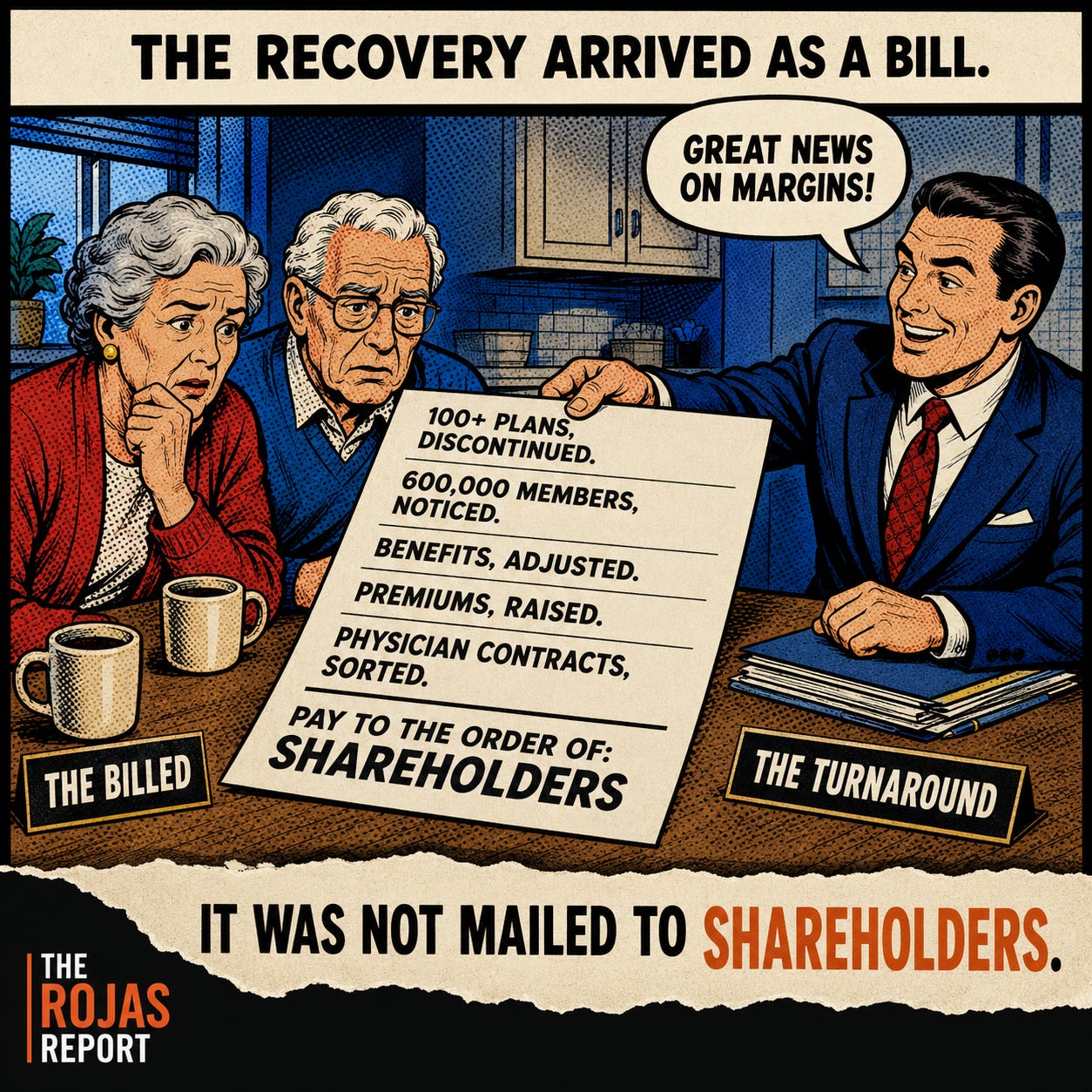
The recovery Wall Street is applauding arrived as a bill, not as a mailing to shareholders.
IN TODAY’S ARTICLE:
UnitedHealth is reducing Medicare Advantage membership by roughly 1.1 million in 2026, about one member in eight. Inside that number: more than 100 discontinued plans holding 600,000 members, 109 exited counties, and the benefit adjustments and competitive losses that account for the rest.
The members who remain pay the second line of the bill: thinner benefits, higher premiums, higher cost-sharing.
The physicians pay the third, in the company’s own categories: employed, contractually dedicated, or removed from the network, with value-based membership shrinking about 10 percent in 2026.
Wall Street rewarded the result with the company’s old valuation multiple, roughly 21.6 times earnings, on earnings roughly 29 percent below 2024. The old premium came back before the old earnings did.
Glossary at the bottom of today’s article.
THE FIRST LINE OF THE BILL: THE DROPPED
Start where the recovery started: with the rolls it reduced.
UnitedHealth is reducing its Medicare Advantage membership by roughly 1.1 million people in 2026. The company ended 2025 with 8.4 million Medicare Advantage members, which makes the reduction about one member in eight. The reduction has an anatomy, and the company disclosed it.
More than 100 plan options were discontinued for 2026, affecting about 600,000 members, concentrated in the PPO products the company calls less-managed. Within that, 109 counties were exited outright, covering roughly 180,000 people.
The rest of the contraction follows from what UnitedHealthcare’s chief executive described to investors in October 2025: significant benefit adjustments, targeted plan exits, and network reductions, plus the competitive losses that follow them.
On an earnings call, a plan exit is a slide. At a kitchen table, it is a letter. For the 600,000, the non-renewal notices went out in October 2025. The coverage ended December 31, and the senior holding one spent the annual enrollment window re-shopping networks, formularies, and physicians in the middle of retirement. Some found their doctor in the next plan.
Some found out in January that they did not.
The company describes this as a portfolio repositioning and an exit from underperforming markets. Both descriptions are accurate. Neither mentions that the underperformance belonged to the bids, and the exit belonged to the member.
THE SECOND LINE: THE REPRICED
The seniors who kept their plans paid the second line.
The 2026 repair repriced the book, and the receipt is the company’s own language. On the October 2025 earnings call, UnitedHealthcare’s chief executive told investors that the company had made significant adjustments to benefits and executed targeted plan exits and network reductions to offset elevated medical trend rates and government funding decreases.
In plan design, benefit adjustments in a margin year mean thinner supplemental benefits and higher cost sharing for the products that survive. The logic is standard underwriting.
The 2024 and 2025 bids assumed less care than members actually used, Washington tightened the payment formula, and the 2026 bids priced in the difference while trimming what the premium buys.
Hold the sequence still and look at it. The bids missed the medical trend, and the government tightened funding, according to the company’s own accounting. The correction was priced into the monthly budget of a retiree on fixed income.
The last article traced one Medicare dollar through four floors of the structure. The repair travels the same floors in reverse and settles at the bottom because the member stands on the ground floor and there is no floor below it.
THE THIRD LINE: THE TIGHTENED
The physicians paid the third line.
This series opened by counting them: the tens of thousands of affiliated physicians a national platform presents as its own. The recovery is the sequel to that count, and this time the mechanism is on the record.
Optum’s leadership told investors in October 2025 that the network had grown oversized and overreliant on less-aligned affiliated physicians, and described the repair in the company’s own categories: moving toward employed or contractually dedicated physicians, and removing the less-aligned from networks that will shrink further in 2026.
Value-based membership was projected to fall about 10 percent in 2026 as the platform exits markets and PPO contracts covering roughly 200,000 lives. In January 2026, Optum’s chief executive repeated the plan in plainer terms, leaving markets and ending contracts with physicians not aligned with the strategy, and announcing a $2.8 billion fourth-quarter charge that covered the restructuring, among other items.
The recruiting pitch was stability. The repair sorted the roster: employed, contractually dedicated, or removed. The physician who affiliated to escape standalone risk spent 2025 learning that the platform’s mispriced bids were his problem too, and 2026 learning which category he fit. The adjustment ran in one direction, and the physicians were the adjustable part.
The first three lines of the bill are itemized above. Supporters receive the payee, the arithmetic, and the multiple that turned it all into applause.
