
Five Companies Took 76% of the Program. Three of Them Sell You the Insurance, Adjudicate the Claim, and Dispense the Drug.
A physician asked how a 340B subsidy designed for rural hospitals ends up at the CVS in your suburb. This article is the answer.

Walgreens does not have a 340B problem.
Walgreens is the 340B problem.
So is CVS.
So is UnitedHealth.
So is Cigna.The carriers that sell you insurance also dispense the drug, adjudicate the claim, and bill the plan.
One parent. Three seats. One transaction. Every time.
IN TODAY’S ARTICLE:
The dispensing node where the 340B spread is actually captured, and who owns it
Why does a rural hospital in West Virginia generate a margin on a script filled in suburban Cleveland?
The corporate structure that the carriers do not want named in public
The receipt the Senate published last April, and the question it answers.
Glossary at the bottom of today’s article.
ARTICLE BODY
The Other Regulator named the fifth player.
EBSA.
ERISA.
The Department of Labor.The regulator that has the statute, has the authority, has the enforcement record, and has not yet been asked the question.
This article is about the dispensing node where the question gets asked.
THE NODE THAT WAS NOT IN THE STATUTE
The 1992 statute that created 340B did not contemplate a retail pharmacy.
The statute contemplated a hospital. The hospital bought the drug at the ceiling price. The hospital dispensed the drug to the patient. The hospital was both the dispensing node and the covered entity. The chain stopped there.
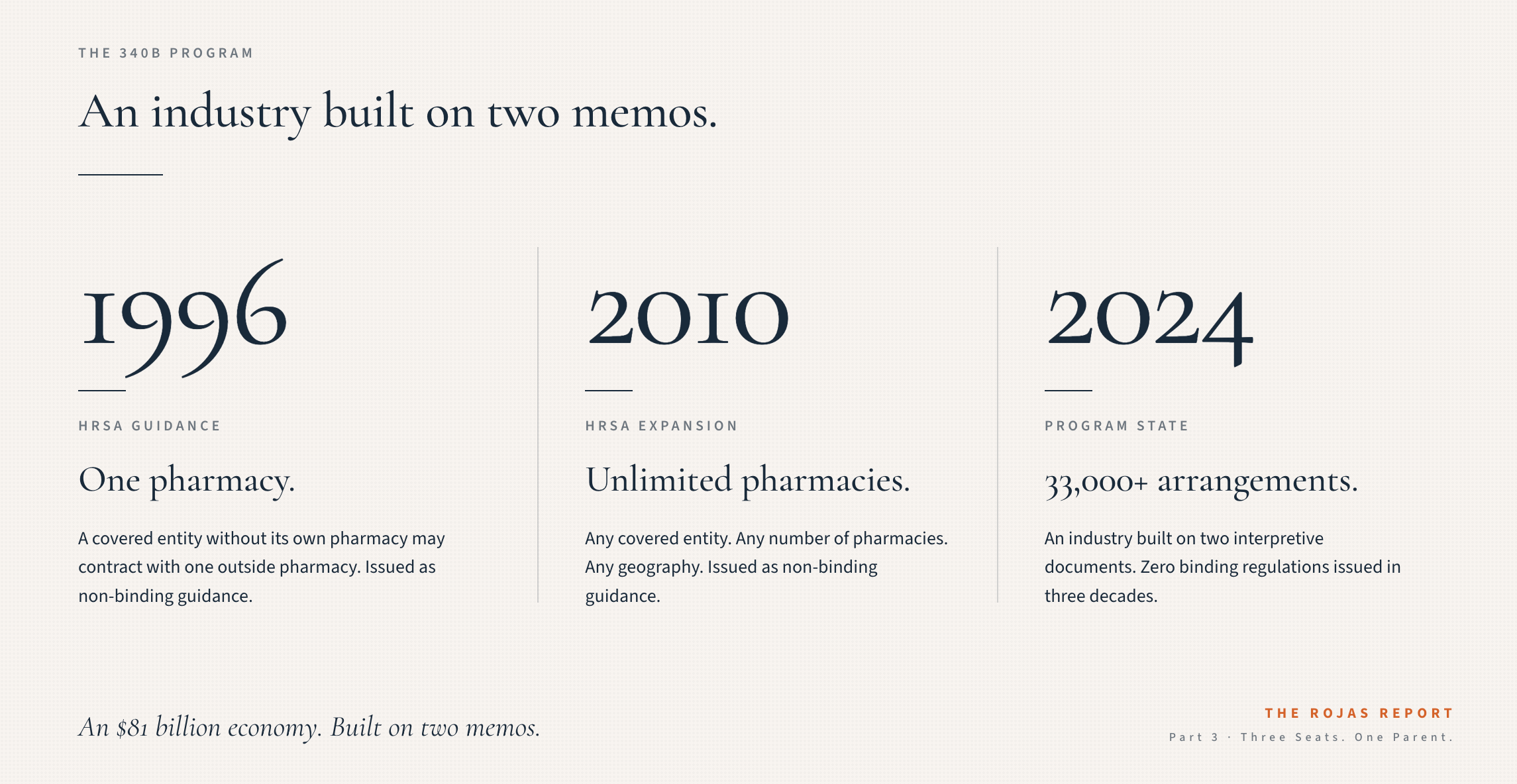
In 1996, HRSA issued guidance permitting a covered entity that did not operate its own pharmacy to contract with one outside pharmacy to dispense 340B drugs on its behalf.
One pharmacy. Singular.
That guidance clarified operational reality, not a redesign of the program. Some FQHCs and rural clinics lacked on-site dispensing capacity. The contract was a workaround for those entities. The dispensing remained close to the covered entity, the population the covered entity served, and the patient the statute named.
That lasted fourteen years.
In 2010, HRSA issued new guidance permitting any covered entity to contract with an unlimited number of outside pharmacies, in any geography, with no restriction on the relationship between the dispensing pharmacy and the population the covered entity served.
The single contract became thirty thousand contracts.
The pharmacy down the street became a CVS in a different state. The rural clinic’s discount became a national retail dispensing economy. The dispensing node, which had been an extension of the covered entity, became an industry of its own.
HRSA did not amend the statute. HRSA did not write a regulation. HRSA issued a non-binding interpretive document.
The carriers built the entire downstream economy on that document.
[INFOGRAPHIC PLACEHOLDER 1: “1996 → 2010 → 2024” three-column progression visual]
FIVE COMPANIES, 76 PERCENT
In 2025, Drug Channels Institute published the most recent concentration study of the 340B contract pharmacy market.
Five companies controlled 76.1 percent of all contract pharmacy relationships in the United States.
The five are CVS Health, Walgreens, Cigna, UnitedHealth Group, and Walmart.
Two of those five are retail pharmacy chains that operate downstream of the insurance industry. Walgreens and Walmart sell pills. They do not adjudicate claims. They do not sell the insurance product. They take a dispensing fee and a portion of the spread, but they sit on one side of the transaction.
The other three are different.
The carriers know how the program is structured. Their lobbyists wrote the structure. You can read about it here for the price of one cup of coffee a week, or you can keep paying for it in your premium.
