
Freedom Was Never About Doing Whatever You Want
The founders didn’t fight for comfort. They fought for the right to be beholden to no one. A Sunday meditation on what liberty actually required, and what we traded it for.

In 1581, the Dutch drafted their own declaration of independence.
One line stands out: God did not create people to be “slaves to their prince.”
They weren’t talking about speech. They weren’t talking about expression.
They were talking about dependency.
IN TODAY’S ARTICLE:
The Dutch concept of Ware Vrijheid (True Freedom) and why it had nothing to do with self-expression
How the American founders tied liberty to land, not to government provision
The uncomfortable truth both traditions shared
What this means for anyone who wants to be free
Summary of the last 7 days of The Rojas Report
Glossary at the bottom of today’s article.
THE REALIZATION
Freedom helped me realize something simple.
I didn’t want to work for anyone else. I wanted to work for myself.
That’s not a radical statement. Or it didn’t used to be. Somewhere along the way, the desire for independence became something to explain, to justify, to defend against accusations of selfishness or greed.
But the people who built the institutions we inherited would have found that strange. For them, independence wasn’t a personality quirk. It was the very definition of freedom.
WHAT FREEDOM MEANT
The Dutch in the 17th century had a phrase: Ware Vrijheid. True Freedom.
It had nothing to do with self-expression. Nothing to do with identity. Nothing to do with what the government would provide.
True Freedom meant provincial sovereignty. It meant religious toleration, not as a principle of pluralism, but as a practical policy to attract skilled immigrants who would generate wealth. And above all, it meant freedom of enterprise. The liberty to produce, trade, and accumulate without permission from a guild, a monopoly, or a king.
Spinoza, writing in Amsterdam, put it plainly: “The end and aim of the state, in fact, is Liberty.” But he meant something specific. Freedom was release from fear and domination, secured by a public order that protected rational life. It was not the absence of government. It was the purpose of the government when the government was rightly ordered.
The American colonists, a century later, built on similar foundations. For them, freedom was not a gift from government but a natural right secured by property. Land ownership provided economic self-sufficiency, the bedrock of personal independence, which in turn was the prerequisite for political independence.
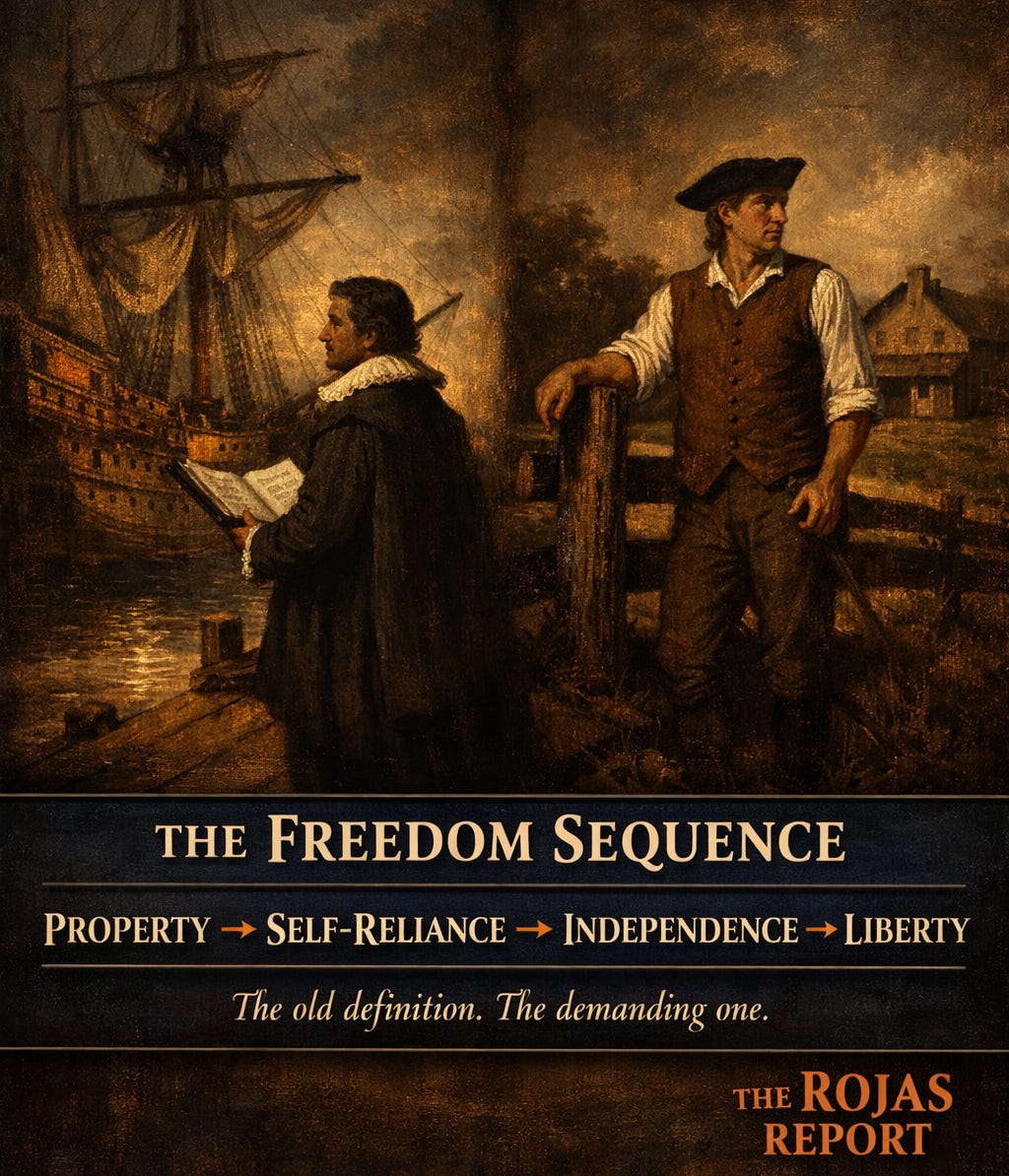
Property fostered self-reliance. Self-reliance guaranteed independence. Independence was the sole basis for liberty.
That was the sequence. And it was demanding.
THE DEMANDING CREED
Neither the Dutch merchant nor the American colonist would have recognized modern freedom-talk.
They would have found it inverted.
Freedom, for them, was not the right to be cared for. It was the capacity to care for yourself. A free man stood on his own land, supported himself by his own labor, and was beholden to no one. He had the virtue to govern himself and the independence to resist tyranny.
The Dutch equated freedom with being sui juris. Juridically and economically autonomous. This was not extended to servants or the dependent poor. They were not considered economically autonomous and therefore not truly free.
Harsh by modern standards. But clarifying.
Freedom was not a status you claimed. It was a condition you achieved. Through work. Through ownership. Through the refusal to depend on others for your survival.
Benjamin Franklin wrote that only a virtuous people are capable of freedom. An individual dependent on others for their livelihood could not be trusted to act for the common good. Virtue and independence were prerequisites, not afterthoughts.
A SUNDAY QUESTION
I didn’t learn any of this in school.
I learned it by building.
By refusing to stay employed.
By discovering that the only security I trusted was the security I created myself.
The Dutch merchant and the American colonist would have understood that instinct. They built their entire conception of liberty around it.
Freedom is not what someone gives you.
Freedom is what no one can take because you don’t depend on them for it.
That’s the old definition.
The demanding one.
It’s worth sitting with on a Sunday.
ROUNDUP:
THE INDEPENDENT PRACTICE OF MEDICINE
Six articles. Six insights. Six ways to freedom.
Monday, January 19:
$300 Million, 15% Membership, $486 Million Lobbying: The AMA Exposed. The AMA claims to represent physicians. The numbers tell a different story.

Tuesday, Jan 20,
55% of AMA Revenue Comes From Codes You’re Forced to Use. The AMA doesn’t need your membership. It has your billing codes.

Wednesday, Jan 21
$486 Million in Lobbying. Six Straight Years of Reimbursement Cuts. What Did They Buy? Follow the money. Then follow what it purchased.

Thursday, Jan 22.
The Hospitals With Lower Prices Are Illegal in America. Physician-owned hospitals had better outcomes at lower cost. Congress banned them.

Friday, Jan 23,
182 Rural Hospitals Closed. The hospitals that served communities couldn’t survive the system designed to destroy them.

Saturday, Jan 24
$3.2 MILLION FOR NOTHING. What happens when a physician pays into insurance empires for an entire career and receives nothing in return.

GLOSSARY
Ware Vrijheid: Dutch term meaning “True Freedom.” In 17th-century Dutch political thought, it referred to provincial sovereignty, religious toleration, and freedom of enterprise. The concept emphasized independence from centralized power and economic self-sufficiency.
Sui juris: Latin legal term meaning “of one’s own right.” In early modern philosophy, it described a person who was juridically and economically autonomous, not dependent on another for their livelihood or legal standing.
SOURCES
Secretan, Catherine. “’ True Freedom’ and the Dutch Tradition of Republicanism.” Republics of Letters, vol. 2, no. 1, Stanford Humanities Center.
Keyser, Richard. “Freedom in Colonial America, Introduction: Spiritual and Civil Liberty.” American Legal History to the 1870s.
Larkin, Paul. “The Framers’ Understanding of ‘Property’.” The Heritage Foundation, 2019.
Spinoza, Baruch. Theologico-Political Treatise, Chapter 20. Wikisource (1862 translation).
Act of Abjuration (1581). Declaration Project.
Couldn’t agree more, Dutch!
Sadly, so much of America and so many Americans have lost this vision of freedom, trading safety and dependency for it.
Many now grow up expecting government to give unto them, and others to pay so that government can do this.
Self-reliance, dependency on one’s own labor, traditional values literally are being burned to the ground in blue states and cities (and those fast becoming so).
We’ll keep on spreading the words you shared.