
Healthcare Isn’t Expensive. It’s Unpriced.
Part 1 of The Unpriced Economy

Imagine a five-trillion-dollar asset class with no ticker symbol, no forward curve, no benchmark price.
You can’t hedge it. You can’t short it.
You can’t even know what you’re paying for it until after you’ve bought it.
That’s the U.S. healthcare economy.
The largest unpriced market on Earth.
We’ve built an economy the size of Japan, denominated entirely in opacity.
Every other trillion-dollar sector, energy, agriculture, equities, has transparent pricing, derivatives markets, and liquidity. Healthcare remains pre-industrial.
Traded through bilateral contracts, intermediaries, and political negotiation rather than price.
This isn’t a cost problem.
It’s a market structure failure.
The Spreads That Never Close
Prices don’t converge in healthcare.
They can’t. There’s no mechanism to force them.
Colonoscopy: $1,500 vs $6,800
Knee replacement: $22,000 vs $58,000
MRI: $500 vs $4,500
CBC: $12 vs $150
PT visit: $95 vs $350
Same procedures. Same zip code. Sometimes the same parking lot.
Peer-reviewed studies document these extreme price dispersions, sometimes 20-fold or even 30-fold differences for the same procedure in the same metro area.
And nobody blinks.
In any functioning market, a spread like that would be arbitraged to oblivion within days. Capital would notice. Capital would move. The overpriced version would either justify the premium with measurably better outcomes, or it would reprice.
But healthcare doesn’t work like that.
There’s no benchmark index.
No way to short the markup.
No tradable spread between the $500 and $4,500 MRIs.
So the $4,500 version survives, not because it delivers better outcomes, but because opacity protects it from capital discipline.
If you're finding value in this breakdown, subscribe to The Rojas Report.
Subscribe Here.
Every Real Market Has Infrastructure
Let’s compare:
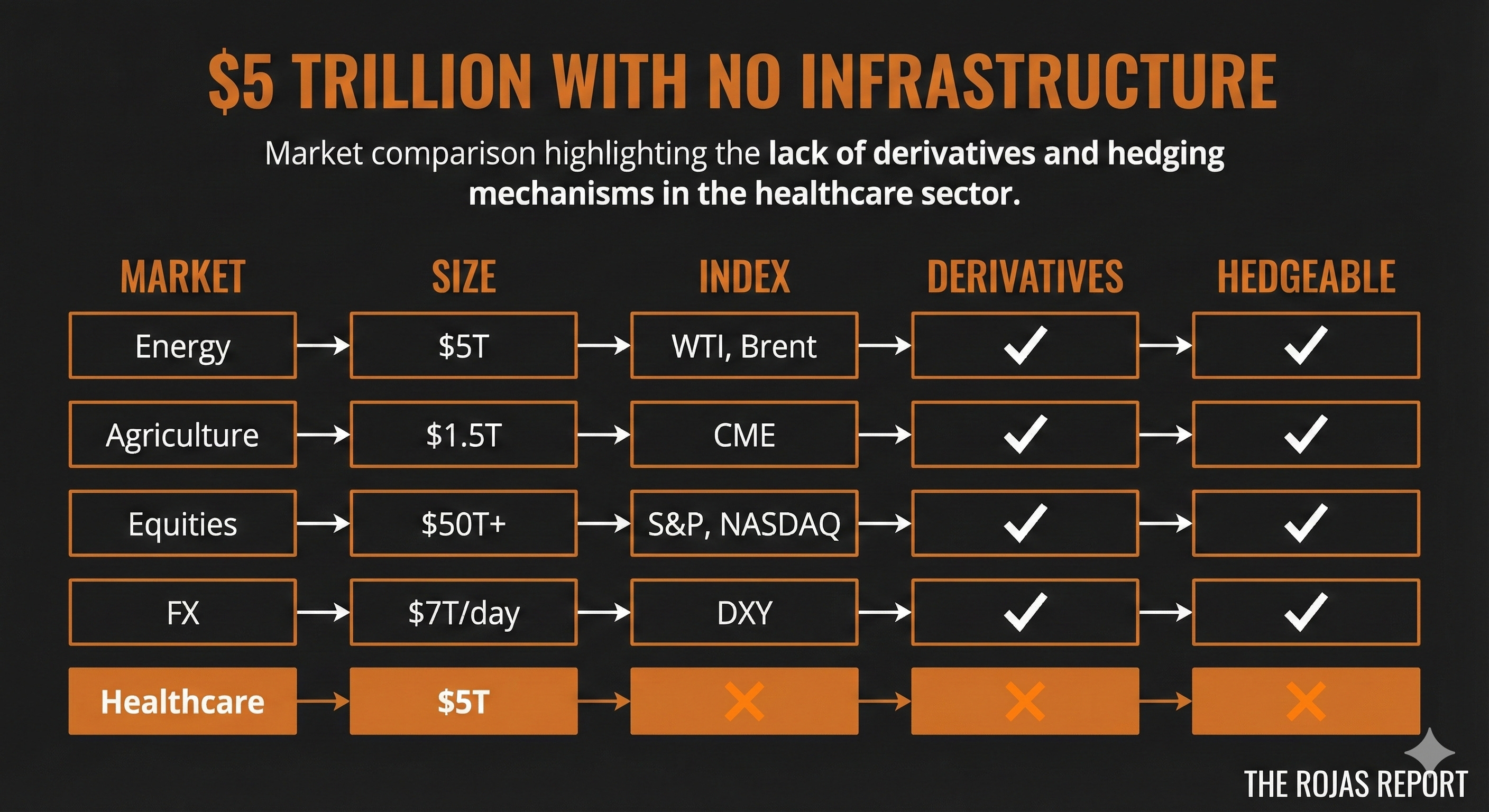
We spend more on healthcare than energy and agriculture combined.
And yet the market operates like a bazaar run on PDFs and vibes.
Oil didn’t always have WTI. Agriculture didn’t always have futures. These markets were once as opaque and fragmented as healthcare is today. What changed?
Someone built the infrastructure, the indices, the contracts, the clearinghouses, that turned raw commodities into tradable assets.
Healthcare is pre-1859 oil. Pre-CME agriculture. A massive economy waiting for someone to build the rails.
Why the Spreads Persist
The claim that healthcare is “too complex” to standardize is a lie told by incumbents who profit from opacity.
A total knee replacement has published outcomes data by age, comorbidity, and implant type. Complication rates for colonoscopy are stratified by facility type. An MRI is an MRI, same magnet, same physics, same image.
The data exists. It’s peer-reviewed. It’s reproducible.
The only thing missing is a settlement index, a published, weighted benchmark that converts that data into something tradable.
Without transactional data, you can’t build benchmarks. Without benchmarks, you can’t create derivatives. And without derivatives, you can’t manage risk.
So every dollar spent on healthcare is unhedged exposure. Every employer, every government, every patient, flying blind into a $5 trillion market with no instruments to navigate it.
What Price Discovery Actually Enables
Once prices exist, real, published, tradable, everything changes.
A fund notices the 20x spread between two MRI facilities. They pull the outcomes data. They find no clinical justification. They short the spread.
Capital flows to the efficient facility. Volume migrates. The overpriced version either proves its value or reprices.
That’s mean reversion. It’s not aspirational. It’s not ideological. It’s what happens when information becomes tradable, and inefficiency becomes a P&L opportunity.
Right now, $5 trillion flows through healthcare with no price gravity.
Build the infrastructure, and gravity appears. Everything else is just math.
The Formula
The path is straightforward:
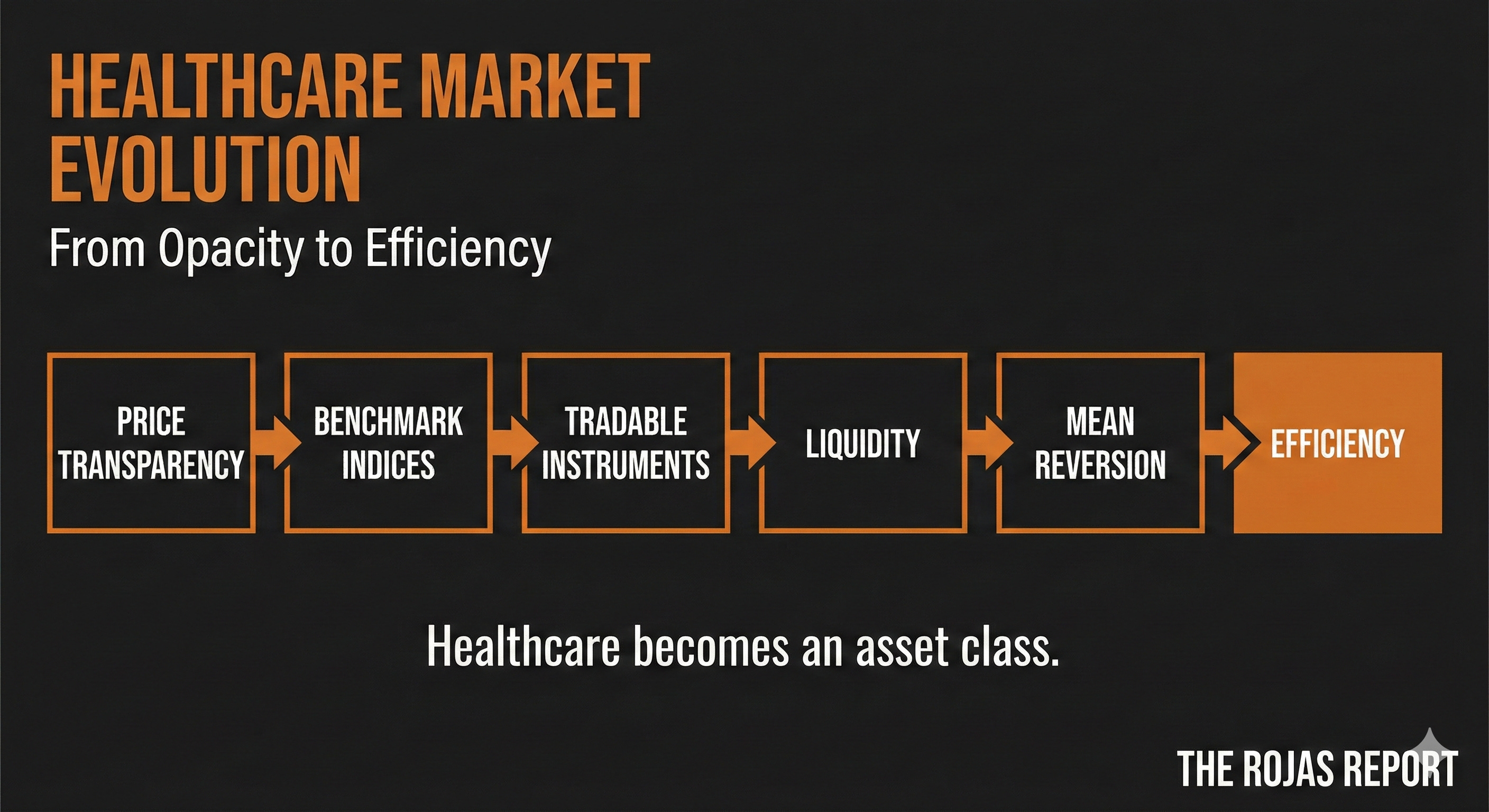
Healthcare becomes an asset class. Costs become prices. Prices become signals. Signals become discipline.
That’s how you solve the challenges of healthcare coverage.
Not by spending more.
Not by subsidizing the opacity.
By building markets that finally know what anything costs.
This is Part 1 of The Unpriced Economy, a short series about the markets that don’t exist yet, and what it’s costing us.
If this clarified something you’ve been feeling but couldn’t explain, subscribe and follow the next post.
Next up: Price transparency was never about helping patients shop.
It was supposed to build something else entirely.
Happy holidays!
May your claims be payable and your deductibles unmet.
-Rojas out

You’ve described the market we need. The reason healthcare can’t have its WTI moment isn’t complexity—it’s that we still settle transactions like it’s 1985. Near real-time adjudication creates the clean transactional data that benchmarks, indices, and derivatives require. Im working on it…Merry Christmas, Dutch. Thanks for all of your great work!