
How a $5.7 Trillion System Learned to Ignore Reality
It’s not greed. It’s not lobbyists. It’s not incompetence. It’s insulation.

$5.7 trillion.
That’s what American healthcare extracts every year.
And the system has one job:
Make sure no one notices.
IN TODAY’S ARTICLE:
What it means for a $5.7 trillion system to become self-referential
The two layers that keep the loop closed and funded
Why reforms that actually work are treated like threats
What happens when truth becomes dangerous
Why the only exit is outside the system
Glossary and sources at the bottom of the article.
What Happens When a System Stops Listening?
Autopoiesis is a concept from systems theory.
It describes a system that no longer responds to external reality.
Instead, it filters everything through its own internal logic.
Facts still enter. But they’re warped. Reshaped until they support what the system already believes.
An autopoietic system does not ask, “Is this true?” It asks, “Is this compatible?”
Once that shift happens, truth becomes dangerous. Outcomes become irrelevant. Survival becomes the only metric.
That’s where American healthcare lives now.
The system counts on you not paying attention. 60,000+ physicians decided to stop being surprised. You can keep guessing.
Or you can know. Subscribe.
What If Healthcare No Longer Cared About Health?
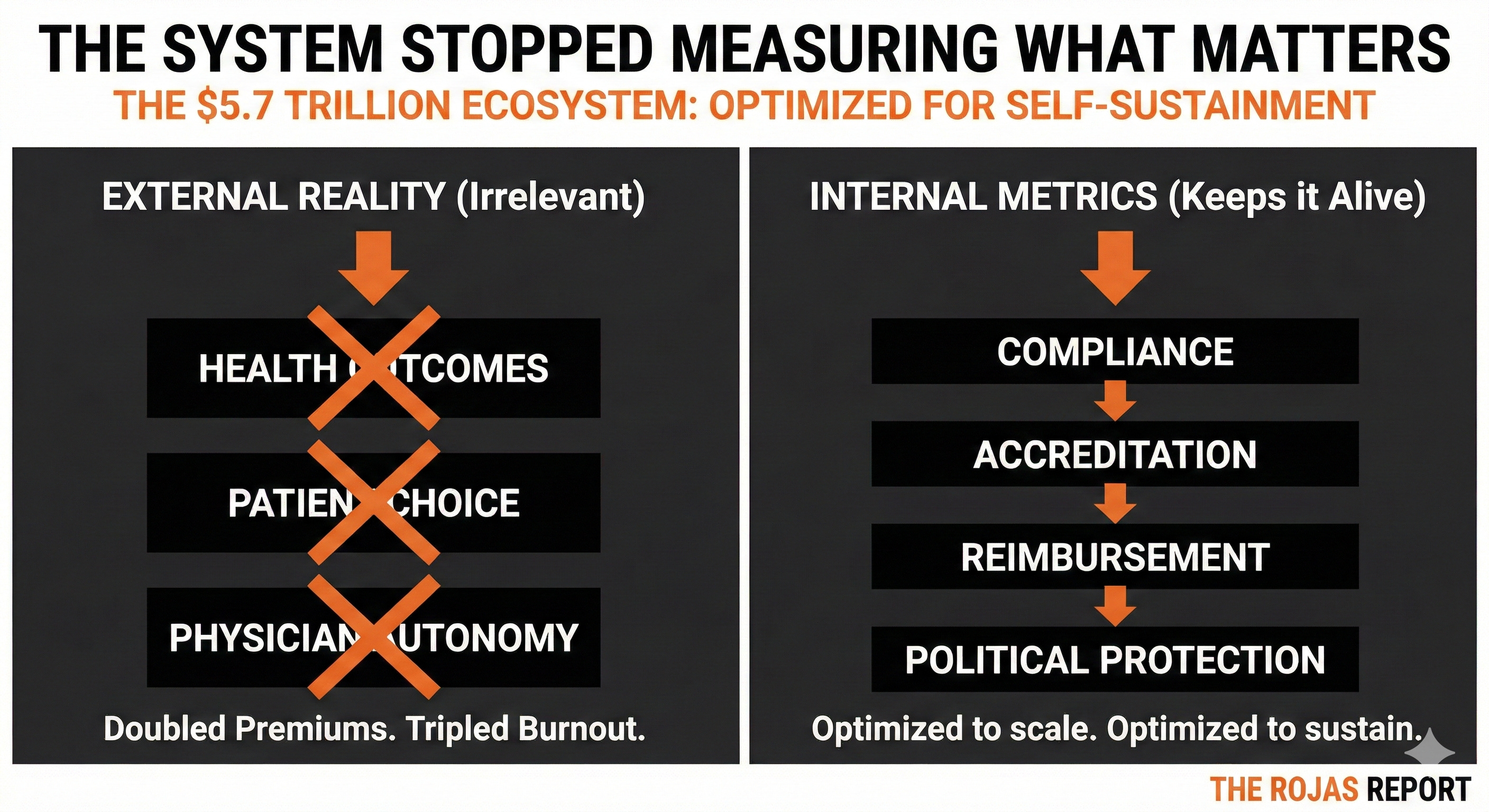
A real healthcare system would measure success by a few simple questions:
Are people healthier?
Are prices falling?
Are doctors empowered?
Do patients have a choice?
These used to matter.
They don’t anymore.
Now we ask:
Are we compliant?
Are we accredited?
Are we reimbursed?
Are we politically protected?
These are not health metrics.
They are survival metrics.
And survival metrics are what sealed systems optimize for. That’s why premiums can double while every institution insists we’re making progress. That’s why burnout can more than triple while “resilience initiatives” multiply. That’s why access can shrink while spending grows.
Who Really Runs the Healthcare Loop?
American healthcare is driven by two invisible ecosystems.
They pretend to be enemies.
They function as partners.
1. The Institutional Layer
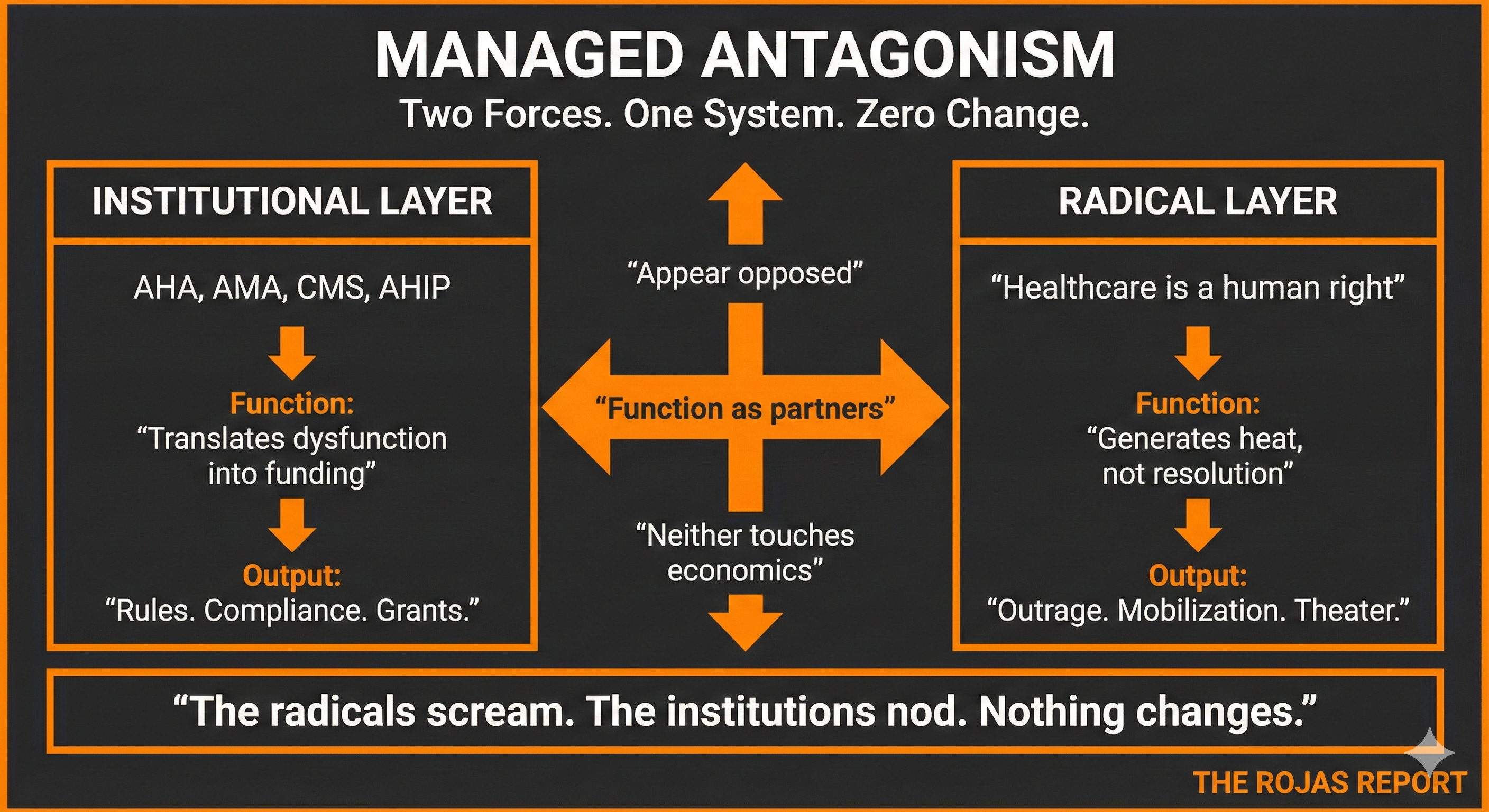
These are the groups that translate dysfunction into funding:
AHA, AMA, CMS, AHIP, AAMC. NEJM, JAMA, etc. Thousands of “nonprofits” and advocacy groups. Their job isn’t to fix healthcare. It’s to make failure legible.
When premiums rise?
“We need a new program.”
When physicians quit?
“We need workforce investment.”
When hospitals close?
“We need more subsidies.”
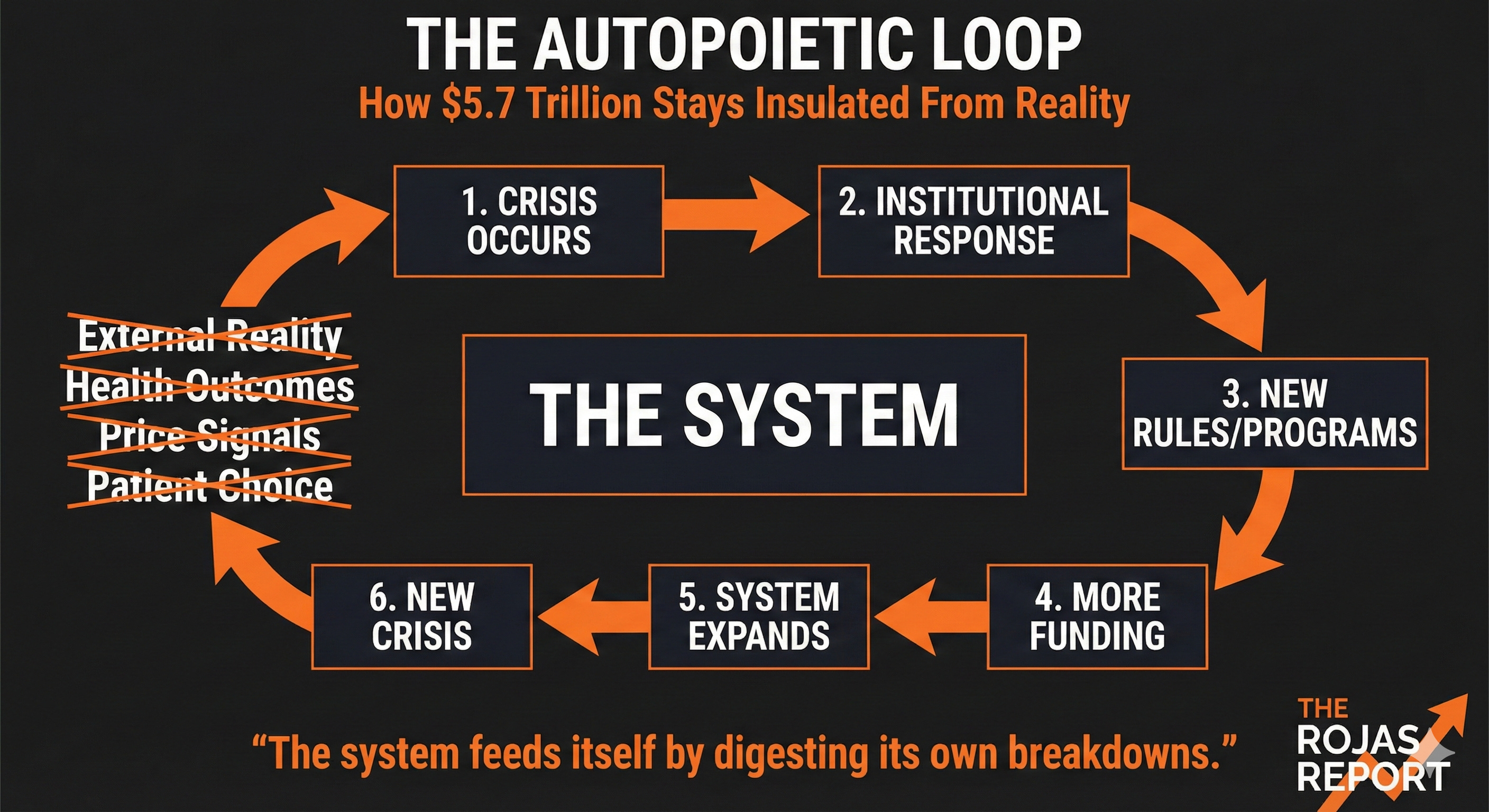
Every crisis justifies more rules. More compliance. More grants. More money.
The system feeds itself by digesting its own breakdowns.
2. The Radical Layer
Then there’s the emotional layer.
“Healthcare is a human right.”
“Abolish private insurance.”
“Nationalize hospitals.”
These movements generate heat but never resolution. They create outrage. They mobilize patients. They keep the moral temperature high. But they’re structurally incapable of winning. Because if they actually won, the institutional layer would vanish overnight. So the system keeps them alive like a pet volcano.
They scare Congress. They justify spending. They justify taxes. They justify reform theatre. And the system survives.
What Is “Managed Antagonism”?
The radicals scream.
The institutions nod solemnly.
Nothing changes.
This is managed antagonism. Two forces are locked in a staged conflict. Each pretending to fight the other. Each depends on the other to survive.
The radicals demand fire.
The institutions offer fireproof paperwork.
Neither side touches the core economics.
Because neither side can afford to.
Press releases are apologies for what already happened. This is where you find out before they write one. 60,000+ physicians. One signal. Subscribe.
Why Nothing Is Allowed to Work
When a system becomes self-referential, anything that proves it wrong becomes an existential threat.
That’s why these tools are treated as dangerous:
Price transparency.
Direct contracting.
Cash-pay medicine.
Physician-Owned Hospitals.
Site-neutral payments.
Direct to Patient marketplaces.
Independent surgery centers.
Healthcare commodities exchanges
Physician-led platforms
These aren’t radical. They’re just market logic.
But they commit a sin: external falsification.
They prove the system wrong. They show that care can be faster, better, and cheaper without it. So the system doesn’t debate them. It neutralizes them.
They are framed as unsafe.
Inequitable. Destabilizing.
Not because they’re flawed.
But because they’re true.
Why Do Premiums Never Go Down?
Premiums are reality. And reality is a threat. So premiums are ignored. Instead, we measure coverage rates. Coding accuracy. Risk scores. Value-based care participation. Compliance. All internal metrics. All compatible. None is capable of falsifying the system.
Why Truth Becomes Dangerous
In late-stage autopoiesis, something flips. Truth becomes radioactive.
A doctor who demonstrates that surgery can be performed at half the cost is blacklisted. An employer who bypasses insurance is audited, and a low-cost clinic is burdened by regulation. Because external success threatens internal coherence.
That’s why a single independent physician with a spreadsheet can terrify billion-dollar systems.
That’s why one viral video can humiliate an entire PR department.
That’s why reformers become defenders of the status quo.
Because inside the system, the only thing worse than being wrong is being right.
What If Healthcare Can’t Be Fixed?
This is what people feel, but can’t articulate.
That sinking sense. That no matter how many reports, reforms, or panels, nothing changes. They aren’t imagining it. The machine isn’t broken. It’s insulated.
And you cannot fix a system that doesn’t respond to correction.
You can only displace it.
What Does Collapse Look Like?
Autopoietic systems don’t collapse from protests or budget cuts. They collapse when the illusion fails. When people no longer believe the system has legitimacy. That’s the real threat.
Not whistleblowers.
Not lawsuits.
Not hearings.
Loss of belief.
What’s the Real Exit?
The exit isn’t political.
It’s competitive. The internet didn’t fix newspapers.
It rendered them obsolete.
Uber didn’t reform taxis. It replaced them.
Independent medicine won’t be saved by Congress.
Healthcare will be saved by parallel systems. Physicians. Employers. Patients.
Building outside the loop.
That’s what scares the incumbents.
Not anger. Not protests. Alternatives.
Is the System Afraid?
Yes. And it should be. It’s fighting price transparency, physician ownership, and site-neutral payments as if its life depended on it. Because it does. Those aren’t policy disputes. They’re exit signs.
And reality is the one thing this system cannot survive.
-Rojas out.
GLOSSARY
Autopoiesis: A system that no longer responds to external reality. It responds only to signals compatible with its internal structure.
Managed Antagonism: A relationship where two groups appear opposed but actually depend on each other for survival.
External Falsification: When evidence from outside a system refutes the system's predictions. Autopoietic systems cannot tolerate this. They neutralize it.
Internal Metrics: Self-reinforcing measures that always show progress. Used to preserve institutional survival.
Site-Neutral Payments: Paying the same rate across care settings. The American Hospital Association hates this.
Direct Contracting: Employers and physicians cutting out middlemen.
SOURCES
Maturana, Humberto R. and Varela, Francisco J. Autopoiesis and Cognition: The Realization of the Living. D. Reidel Publishing, 1980.
Luhmann, Niklas. Social Systems. Stanford University Press, 1995.
@DataRepublican (small r). “Minnesota as a Systems Failure: How NGOs process dissent until reality no longer matters.” X, January 9, 2025.