HOW TO GIVE THE STATE WHAT IT WANTS WITHOUT GIVING UP WHAT YOU HAVE
Legibility is the price of survival. But you get to choose what you make visible. And what you don’t.

Sell to PE. Lose ownership.
Join a hospital system. Lose autonomy.
Stay independent. Pay more for everything.
Those are the options they gave you.
Is there another option?
IN TODAY’S ARTICLE:
The illegibility trap: why the system wants you absorbed
Selective legibility: the exploit no one talks about
Coordination without merger: the third path
What we built
Glossary at the bottom of today’s article.
ARTICLE BODY
THE ILLEGIBILITY TRAP
Last Thursday we established the pattern.
States cannot act on what they cannot see. To govern, they demand legibility. Standardization. Schemas. What cannot be enumerated cannot be administered.
If you missed it, read “The Concept That Explains Every Regulation You Hate” first. Today builds on that foundation.

Independent medicine is illegible.
200,000 practices. 200,000 billing patterns. 200,000 compliance structures. 200,000 data streams the administrative state must individually monitor, audit, and discipline.
One hospital system with 2,000 employed physicians is one contract.
One EHR.
One compliance structure.
One data stream.
The math favors consolidation. Not because consolidated care is better. The data shows independent practices have equivalent or superior outcomes.
The math favors consolidation because consolidated care is visible.
This is the trap.
The system doesn’t hate you. It hates that it can’t see you.
And the default solution to illegibility is absorption.
Sell to the health system.
Become employed.
Merge into something large enough to be worth seeing.
That’s the path the system wants you to take.
There’s another path.
The consolidation playbook isn’t secret.
It’s just not reported. Until now.
THE INSIGHT: SELECTIVE LEGIBILITY
The state crushes what it cannot see.
But it also ignores what appears compliant.
This is the exploit.
The administrative state doesn’t actually care about your clinical judgment, your patient relationships, your practice culture, your operational autonomy. It cannot measure these things.
They are illegible by nature.
What it cares about is the data surface.
The schema. The reportable metrics.
Benefits administration. Human Resources.
Payroll. Compliance documentation.
Payer contracts. Risk reporting.
These are the things that make you visible.
These are the things the state can read.
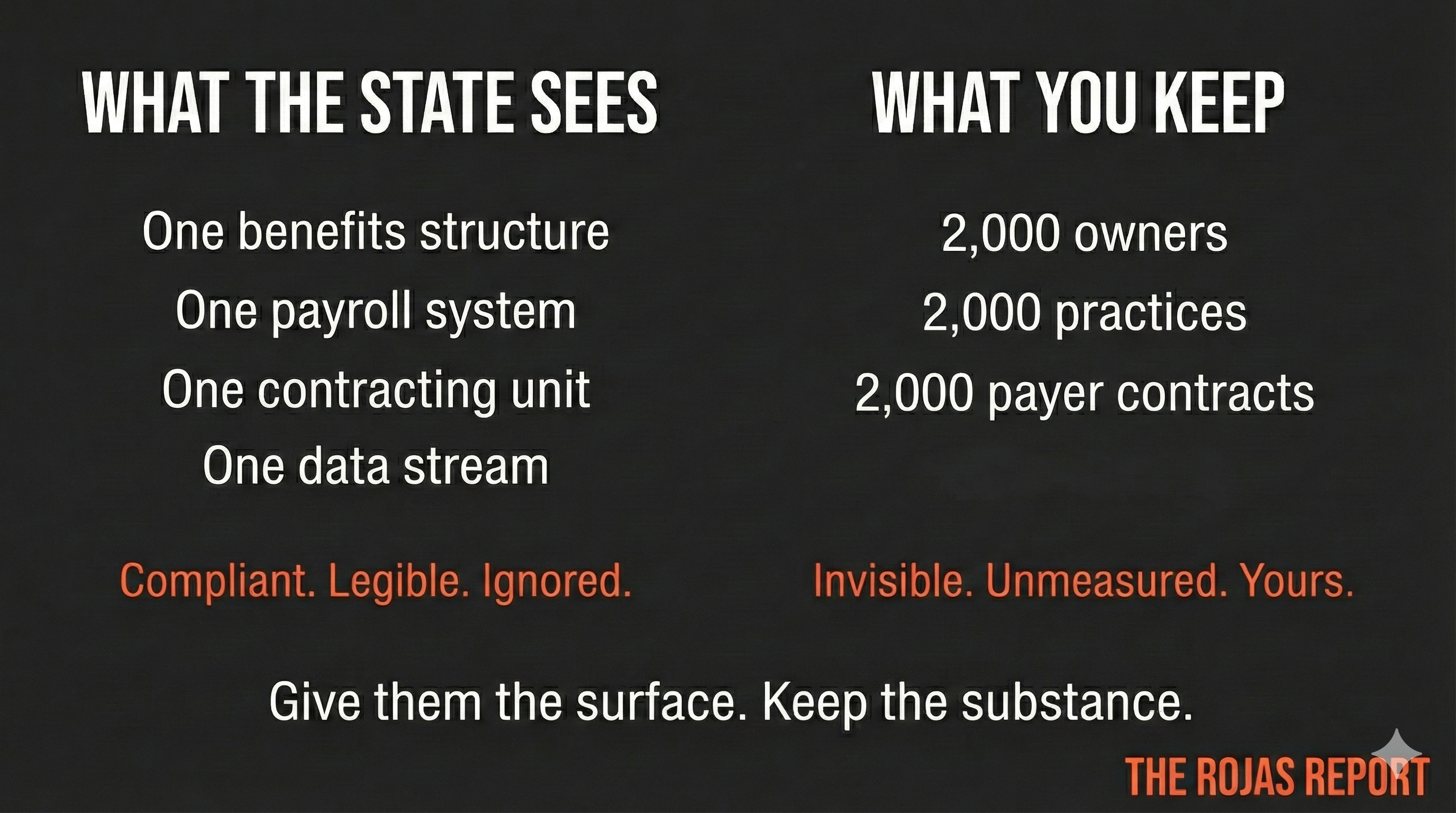
The insight: you can give the system the data surface it demands without surrendering the operational autonomy it cannot measure.
This is selective legibility.
From the outside, you look like one entity.
One benefits structure. One payroll system.
One contracting unit. One data stream.
From the inside, you remain 2,000 independent practices. 2,000 owners. 2,000 sets of clinical decisions made in the room, not in the protocol.
The state sees compliance. It stops looking.
You keep what matters.