
I Love North Carolina
A hospital administrator’s thank-you note to the state that pays him to forgive debt he was never going to collect.

I love North Carolina!
I go every year, not for the mountains, not for the coast, and not for an old girlfriend. I go for the regulatory climate, which is the only weather I have ever cared about.
This year I went because a man in Charlotte got a raise.
$25.8 million. Up forty-nine percent from the $17.3 million the year before. In 2017, his first full year running the place, he made $5.4 million. Call it a quintupling in seven years, at a system that pays no federal income tax, no state income tax, and no property tax.
That same year, the chief executive of the largest for-profit hospital company in America made $23.8 million.
Both words are load-bearing.
For-profit.
Nonprofit.The larger number is on the second one.
People saw the headline and thought North Carolina rewarded one executive.That is adorable.
North Carolina rewarded all of us.

Thank you for calling me public.
My favorite fact about Charlotte lives in the legal text, not the marketing.
The largest hospital system in the state operates as the Charlotte-Mecklenburg Hospital Authority. A hospital authority. A creature of state statute. A unit of local government wearing a brand name.
The statute supplied the description. I merely read it. That structure is also why the compensation shows up in a public filing at all. That structure buys four things at once.
The tax treatment of a charity. The borrowing cost of a municipality. The legal posture of a government body. The pricing power of a monopoly.
One entity. One market. One brand.
You call it a hospital.
I call it complete.
In 2024, that authority reported $12.6 billion in net operating revenue and $11.3 billion in net income. Some people call net income profit. I call it a record year, because it was one, and because the figure leaves out the Winston-Salem academic system and the Illinois and Wisconsin hospitals that joined in 2022 to build the parent company.
Third largest public health system in the country.
$35 billion in annual revenue.
160,000 employees. Public.
Walk down Tryon Street with me. Look up.
Please tell me which part of that skyline looks taxable to you.
Thank you for the map.
I can tell you where I am in this state without reading a road sign.
I look for cranes.
People see cranes and think growth.
Growth is what the crane says in the brochure.
I see a reimbursement signal.
A crane is a system that has run the arithmetic on what the same procedure collects under a hospital roof versus an office roof, and has concluded that the roof is the product.
So I drive.
Charlotte first, because Charlotte is the flagship, and a flagship is a building that bills at the flagship rate.
Winston-Salem, where medicine and the academy hold hands in public.
Durham, where the brand is older than the state’s insurance market.
Raleigh, which is not a medical city at all. Raleigh is where the rules that make the other three cities profitable get written, and I always slow down there, out of respect.
Four skylines. One business model. Every one of those towers is a thank-you note somebody else already wrote and forgot to sign.
Thank you for the one point eight billion.
Every year, the tax exemptions handed to nonprofit hospitals in this state are worth roughly $1.8 billion.
I did not apply for that. There is no form. It is a standing appropriation nobody votes on, renewed automatically, forever, by the simple act of nobody bringing it up.
In 2021, the Johns Hopkins Bloomberg School of Public Health ran the numbers with the State Health Plan and found that fewer than twenty-five hospitals in North Carolina spent more on charity care than the value of their own tax break.
Fewer than twenty-five.
A lesser operator panics when a study like that lands.
He hires a crisis firm.
He buys airtime.
He drafts a statement about the many forms community benefit can take.I did none of it, because I read the last page first, and the last page is the only page that matters.
Nothing happened.
Five years later, nothing has happened.
The exemption renewed itself anyway.
Thank you for the empty chair.
I recommend this one to colleagues in other states the way you recommend a restaurant.
The state’s own analysis says it plainly. In North Carolina, there is no public enforcement of hospital charity care. No agency holds a nonprofit hospital to the bargain that justifies its exemption. Hospitals report community benefit to the Department of Health and Human Services, and the department receives the report, and the department cannot intervene.
It receives.
My gratitude here is specific.
I am not thanking any official for looking away.
Nobody in that building declined to do a job.
I am thanking the General Assembly for never creating the job.
You cannot accuse a referee of bad calls in a league that never hired one.
So I file. Every year. On time, complete, beautifully formatted, and read by no human being with the authority to disagree with a word of it.
Community benefit is whatever I write in the box.
Thank you for paying me to forgive.
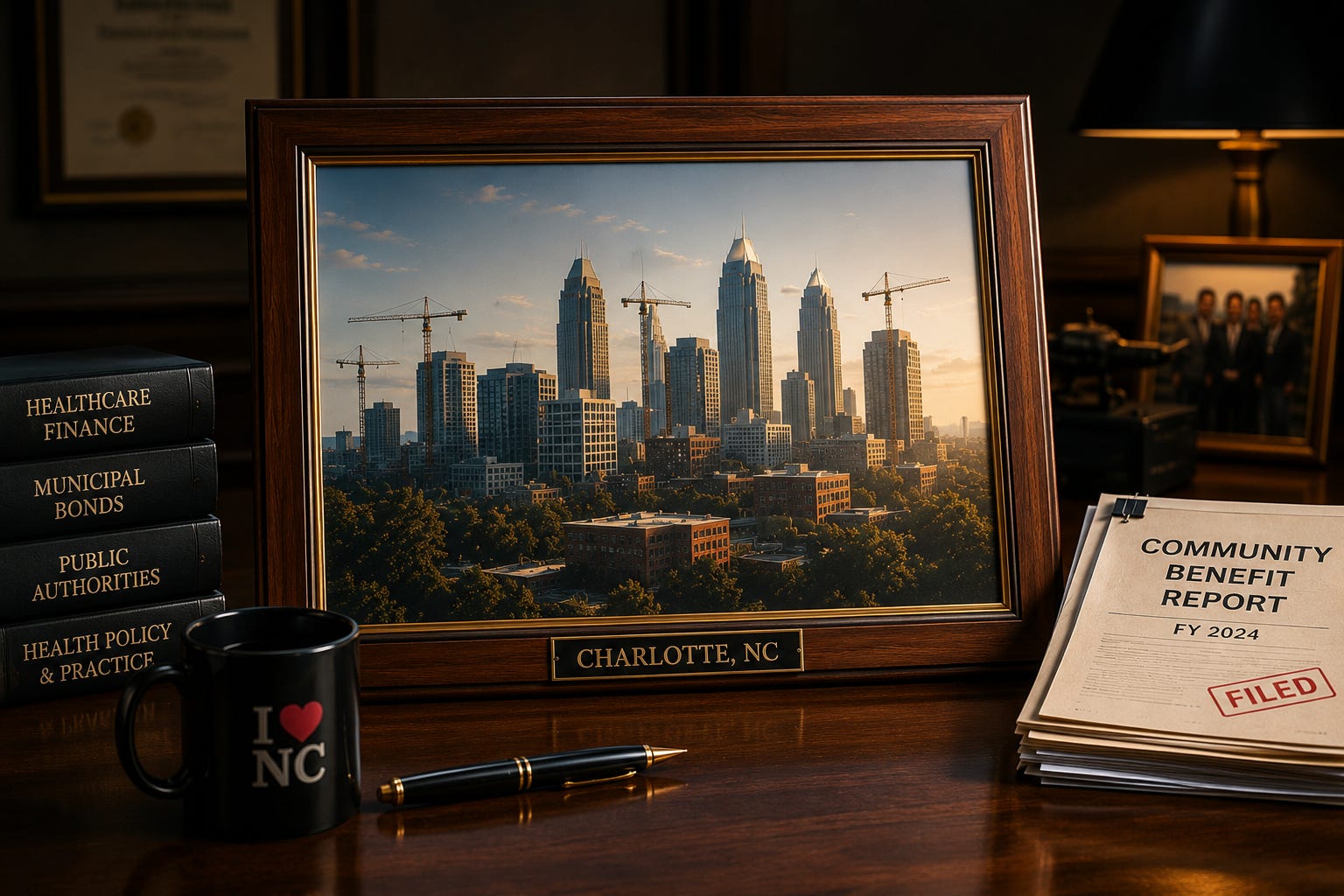
Now we come to the reason I keep a photograph of this state in my office.
In August 2024, every eligible hospital in North Carolina, all ninety-nine of them, signed on to a medical debt relief program. By October 2025, more than $6.5 billion in medical debt had been erased for more than two and a half million North Carolinians.
$6.5 billion.
Two and a half million people.
First program of its kind in America.
Beautiful. Genuinely beautiful. I have the press clipping framed and hung behind my desk where visitors can see it. Sentiment had nothing to do with that decision. I frame load-bearing documents.
Now let me walk you through the paperwork. Slowly.
Start with the eligibility condition, in the state’s own language. Participating hospitals were required to relieve medical debt deemed uncollectable.
Uncollectable.
They wrote it down. In the program documents. In public. And two and a half million people read a headline about $6.5 billion in forgiveness without ever seeing the adjective that made the whole thing affordable.
Let me show you an uncollectable account.
Almost nobody outside my industry has seen one.
It is a name. Attached to an address three moves stale. Attached to a phone number that belongs to a stranger now. My staff has worked it, then worked by a vendor, then worked by a second vendor at a lower contingency, then sold in a bundle for pennies to somebody who bought it the way you buy scrap.
You know the hardest part of collecting a ten-year-old account?
Finding the patient.You know the easiest part?
Forgiving it.
I have watched men build entire careers in revenue cycle chasing this paper. Good men. Disciplined men. Men who could recite the recovery curve from memory and knew exactly where on that curve a file stops being an asset and starts being a filing cabinet.
Year one, you collect. Year two, you collect less. Year three, the curve goes flat and stays flat and never comes back, and everyone in the room knows it, and the paper stays on the books anyway, because writing it off is an admission and holding it is merely optimism.
That is what $6.5 billion of forgiveness looked like on my side of the desk.
Optimism. Ten years of it. In a box. Now the other half of the trade.
Hospitals that adopted the debt policies became eligible for enhanced payments under the Healthcare Access and Stabilization Program. A state-directed payment, approved by Washington, that lifts Medicaid reimbursement for inpatient and outpatient hospital services toward the average commercial rate.
The average commercial rate! Medicaid, paid like a commercial plan. Enhanced payments estimated at $4 billion in the first year and projected higher in the second.
My chief financial officer cried in the conference room. The patients had nothing to do with it. He had spent nineteen years watching bad debt die on a spreadsheet.
Then he watched it convert.
Understand the trade. It is the finest of my career.
I released paper the state itself called uncollectable.
I received a rate.
Two and a half million people opened an envelope that told them their hospital had forgiven them.
Not one of those envelopes said who paid for it.
The former state treasurer, a Republican who spent eight years publishing reports that ruined perfectly good weeks of mine, called it a multibillion-dollar bailout for hospitals.
He said it on the record. He said it clearly. He said it while it was happening, which is the only time saying it would have mattered.
He was right, and it passed anyway, and that is the most North Carolina sentence I know.
Somewhere in this state there is a woman who cried at her kitchen table over that letter. I want to be honest with you, because this is a vacation and I am relaxed. I am glad she got it. Her life is better, and mine is not worse, and that is a rarer arrangement than you think.
I want you to notice which one of us was paid to be in that moment.
Thank you for the committee.
People outside this state assume Certificate of Need survives here because somebody voted for it.
Nobody votes for it.
That is the entire beauty of the arrangement.
In April 2025, the Senate passed Senate Bill 370, a full repeal of the Certificate of Need law. 31 - 17 on the recorded vote. A clean margin. Sponsors who meant it.
It cleared the Senate Health Care committee on a Wednesday and came out of Senate Rules with a favorable report on Thursday morning. Two committees. Two days.
In one of them, a senator who had spent years on a hospital board called the repeal long overdue. In his experience, he said, the process runs a minimum of two years and five hundred thousand dollars in legal fees. His own county took six years to get through it. Eight, counting the work-up before the clock started. Harnett County could not treat cancer until it finished.
On the twenty-eighth of April, the bill crossed to the House, passed first reading, and was referred to the Committee on Rules, Calendar, and Operations.
That is the last thing that has happened to it.
Four hundred sixty-six days ago.
No hearing.
No floor vote.
No obituary.
No villain.
A bill in a room.
The budget did give ground. This state went more than a thousand days without a full budget. When one finally arrived in July, it repealed Certificate of Need review for inpatient rehabilitation services and beds, effective the first of October.
Rehab. One service line. A thousand days of negotiation and the competitive barrier moved by exactly one category, delivered inside a $34 billion dollar spending bill where nobody has to defend it as policy or celebrate it as reform.
I sent appreciation for that one. A concession you choose is the cheapest thing you will ever buy.
Amateurs try to defeat legislation.
I have never defeated anything.
I have a calendar.
Thank you for the physician in New Bern.
There is an eye surgeon down east who has spent years trying to do cataract surgery in his own facility, at his own price, and who argues that the Certificate of Need law violates the state constitution.
One physician. One operating room. In 2024, the state Supreme Court observed that his allegations could render the Certificate of Need law unconstitutional in all of its applications, which is the strongest sentence any court has written on the subject, and the case is still climbing. It sits with the Court of Appeals now. It will climb further. It may well outlast the statute it is challenging.
That is the part outsiders never understand. The highest court in the state said the law might be entirely unconstitutional, and the law kept operating the whole time, and I kept building.
I want to be gracious about this man.
Gratitude is my whole religion.
He is correct about the economics.
His room costs less than my room.
Patients would pay less in his building.I have never argued otherwise in private, and I have never conceded it in public. I just did both in the same sentence.
He has patients scheduled Monday. Payroll on the fifteenth. A lease. One career, and he is spending it in a courtroom.
I have lawyers on salary. A government affairs department. A foundation. A communications team. A hospital authority. A hundred sixty-two thousand employees.
And time.
He files motions. I wait.
Time is the asset.
Everything else is decoration.
He is welcome to keep trying.
Thank you for the word access.
Watch the tape from any year, any session, any bill.
The moment competition gets close, the word arrives. Access. Rural access. Access for the underserved. Access to emergency care in a county that cannot support a surgeon on volume alone.
The argument is that if a surgeon builds a center that does the profitable cases well, the hospital loses the margin it uses to fund the unprofitable ones, and the community loses the service.
It is a real argument. It is genuinely true in some rural counties, and the people making it there believe every word.
Which is exactly why I use it in Charlotte.
The most powerful thing you can say in a policy fight is a true sentence deployed in the wrong county.
Thank you for the universities.
I drive through Durham and Chapel Hill and Winston-Salem on this trip every year, and I want to explain what I am admiring, because it has nothing to do with medicine.
Every profession teaches its students where value comes from.
Surgeons learn anatomy.
Accountants learn depreciation.
Lawyers learn where the ambiguity lives in a sentence.
Hospital executives eventually learn something more useful than any of it.Buildings bill differently than physicians.
Nobody teaches that. There is no course, no case study, no certification. It arrives around year four, usually in a contracting meeting, and once a person has seen it, they cannot unsee it, and every decision they make for the next thirty years is downstream of the moment they did.
These institutions do not produce that lesson. They produce the people who will receive it. And when reporters asked one of those academic systems what its chief executive earned, the figure did not arrive by the deadline.
Not a refusal.
Not a fight.
A deadline that passed.
There is a whole discipline in that.
I would endow a chair, except they already have one.
Thank you for the comparison.
The other executives in this state made $2.8 million, $2.3 million, $2 million, $1.9 million, and $1.7 million apiece.
Every one of those numbers ran next to mine, and every article framed it the same way. Look how much more he makes than the others. That framing was the best gift I received all year, and I want to explain why with some care.
It makes the argument about a man.
Once the conversation is about one executive’s pay, it is no longer about a hospital authority holding a metropolitan market. It is not about a repeal bill in a committee.
It is not about the $1.8 billion a year in exemptions and no agency assigned to check the work. It is not about ten years of dead receivables released in exchange for the average commercial rate.
It is about a line on a Form 990.
Be angry at the line.
The line is a person.
The person can retire.
The structure never retires.
The state line.

I stopped at the border on the way out, the way I always do. Got out of the car. Took off my hat, which I am aware is theatrical, and looked back at it.
Nonprofit systems worth billions.
Universities with public support and private appetites.Competition that requires permission from an agency, then permission from a committee that never meets, then permission from an appellate court on a schedule measured in careers.
Executives paid like partners at a fund. Charity care nobody audits. Debt forgiveness the state paid for with paper it had already called uncollectable.
And everyone, on every side of it, still talking about affordability. Other states make me work for this. North Carolina hands it over on a schedule, in daylight, with a ribbon cutting and a photographer.
Some people leave souvenirs.
I leave market share.
Thank you.
I love North Carolina.
See you next quarter.
-Rojas out.

What about WakeMed?
I fear this country is going down FAST.