
Kaiser: The Denial Comes From Inside the House
The $1.2 billion nonprofit that taught everyone else how to deny.

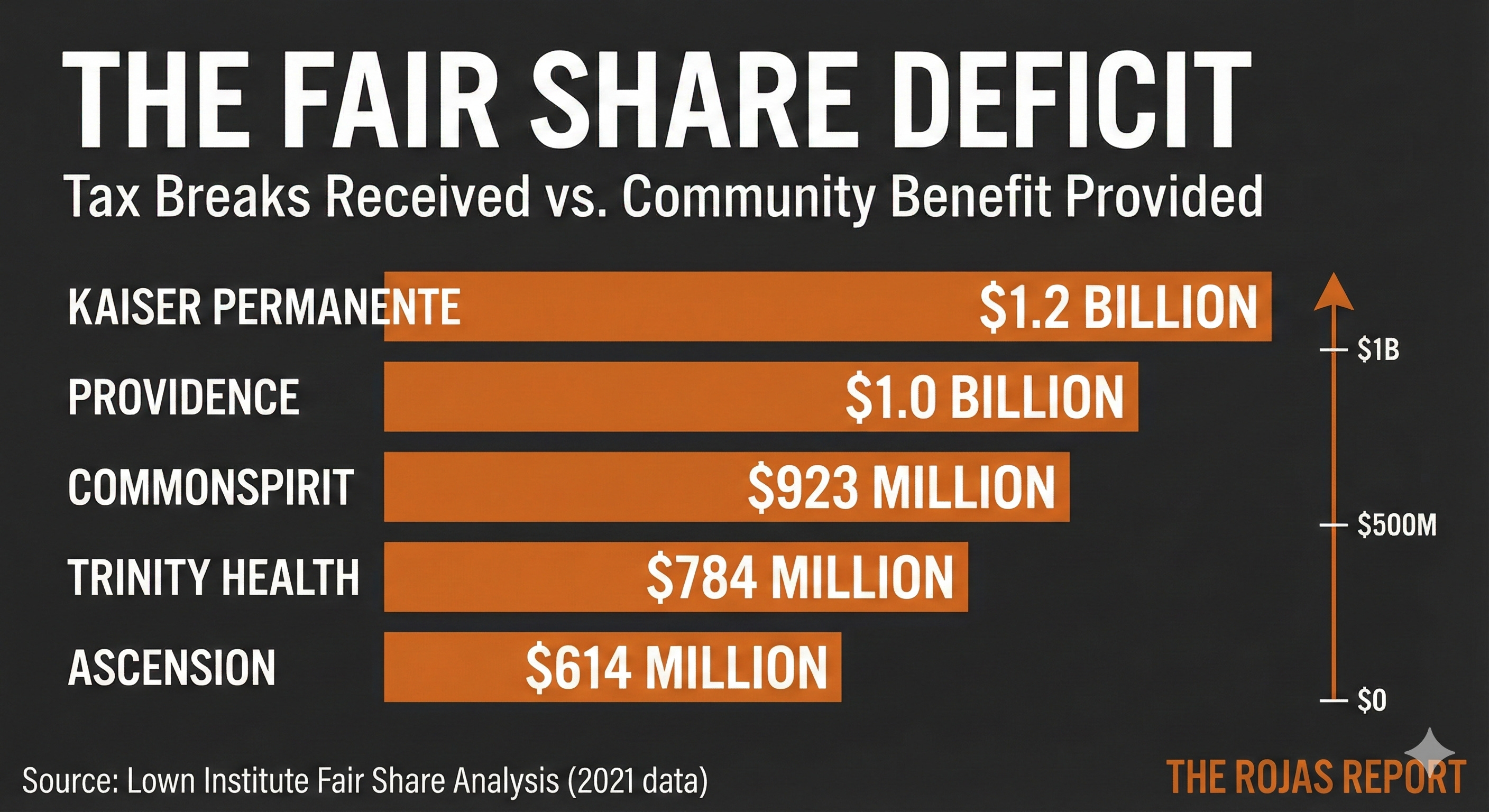
$1.2 Billion
That’s how much more Kaiser Permanente receives in tax breaks than it gives back in charity care.
The largest fair share deficit in the country.
Larger than Providence.
Larger than CommonSpirit.
Larger than any of the Catholic systems everyone loves to criticize.
And they still deny claims.
The Model
Before Optum employed 90,000 physicians, before CVS bought Aetna, before vertical integration became a Wall Street buzzword, there was Kaiser.
Kaiser Permanente didn’t just pioneer integrated healthcare.
They proved it works.
And in doing so, they created the template that everyone else would copy.
Own the insurance.
Own the doctors.
Own the hospitals.
Control the entire flow of care from premium to prescription.
The Five Families looked at Kaiser and said, “We can do that too.”
The Numbers (2024)
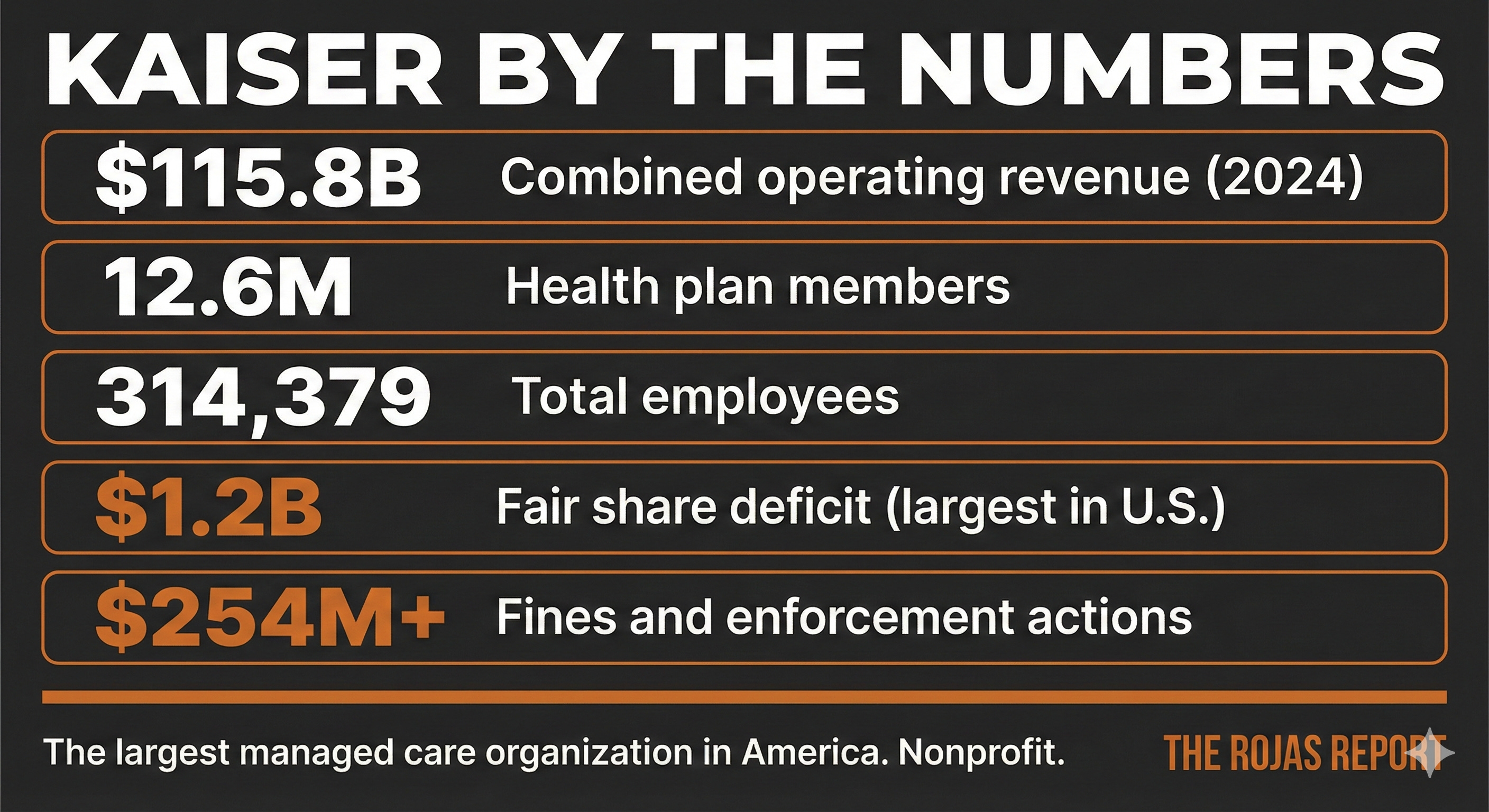
Combined Operating Revenue: $115.8 billion
Health Plan Members: 12.6 million
Physicians: 24,859
Total Employees: 314,379
Hospitals: 40
Medical Offices: 622
The largest managed care organization in the United States, with over 12 million health plan members. And a nonprofit.
The Structure Nobody Talks About
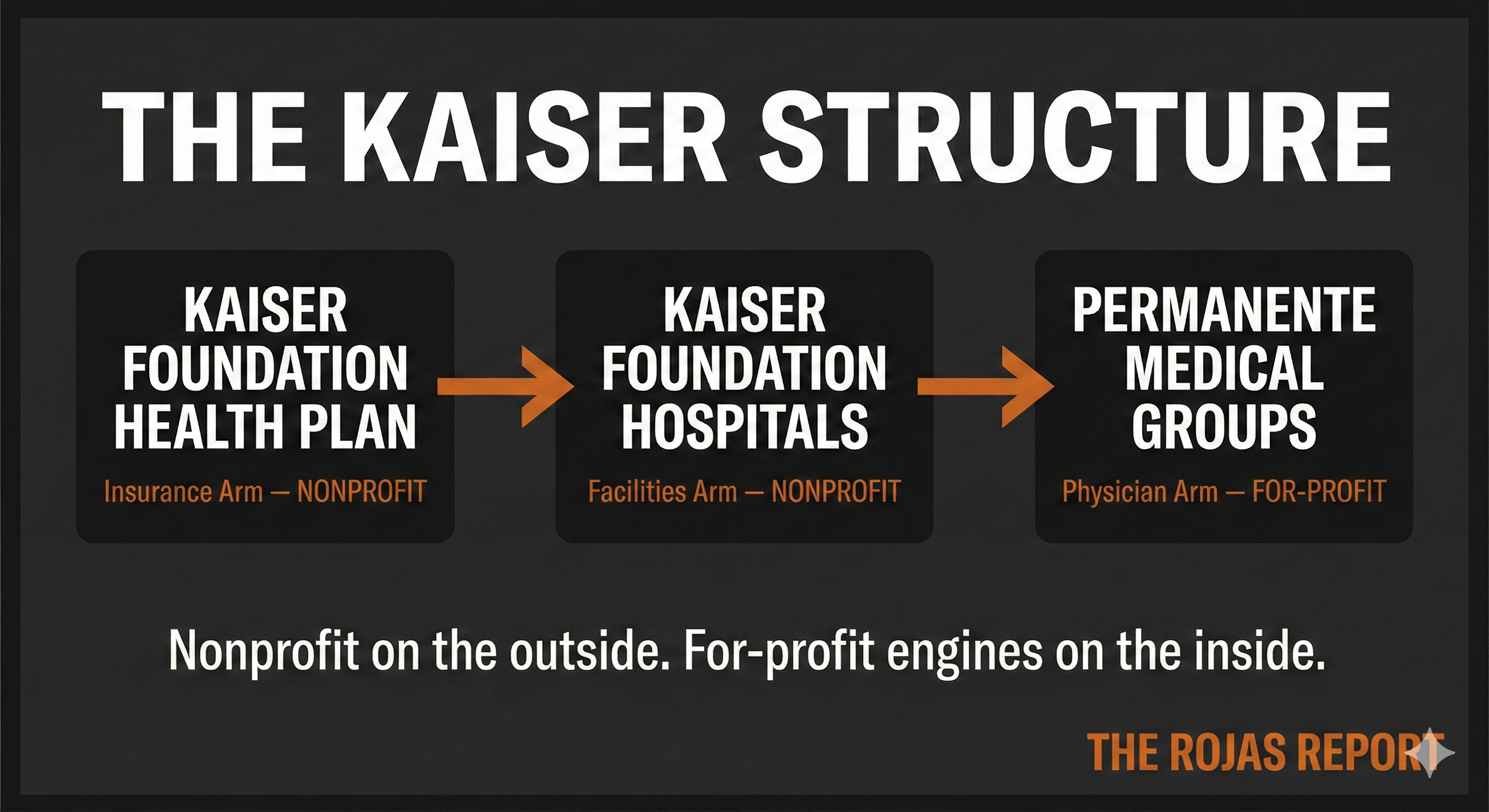
Kaiser isn’t one company. It’s three:
Kaiser Foundation Health Plan:
Collects premiums, manages enrollment, and a nonprofit.
Kaiser Foundation Hospitals:
Owns buildings, beds, infrastructure as a nonprofit.
Permanente Medical Groups:
Delivers care, employs physicians, and is for-profit
Read that last line again.
The physician groups inside Kaiser are for-profit partnerships.
Reimbursements from the nonprofit health plan fund them.
The nonprofit provides a tax-exempt shelter for the for-profit medical groups.
Nonprofit on the outside.
For-profit engines on the inside.
This is the model everyone copied.
The Denial Machine
Everyone thinks prior authorization and claim denials are insurance company problems.
United. Cigna. Aetna.
The for-profit villains.
But Kaiser denies too.
“When Kaiser denies you, the denial comes from inside the house.”
The same organization that employs your doctor is the one deciding whether to approve your treatment.
They just call it “care coordination” instead of “prior authorization.”
One lawsuit alleged that a mother lost her teenage daughter to suicide after Kaiser repeatedly denied individual therapy, even after the child had already attempted suicide.
This is not a for-profit insurance company.
This is the nation’s largest nonprofit HMO.
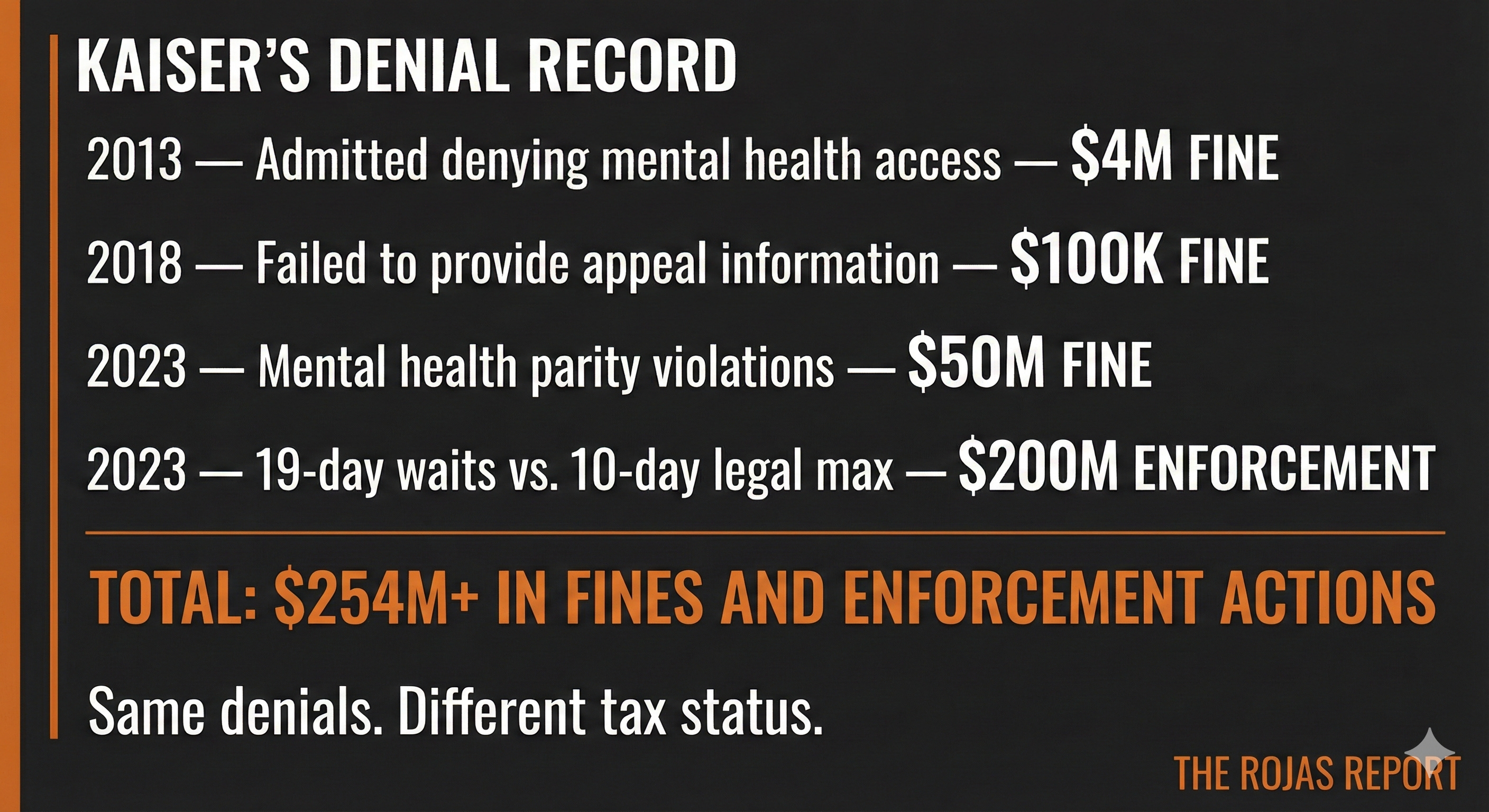
Same denials. Different tax status.
The Homework Everyone Copied
The Five Families didn’t invent vertical integration.
They copied Kaiser.
What Optum built:
90,000+ physicians employed or affiliated
Pharmacy benefit management (OptumRx)
Data analytics processing billions of transactions
Health plan administration
That’s Kaiser’s model.
Own the doctors.
Own the pharmacy.
Own the data.
Control the flow.
CVS did the same thing when it bought Aetna.
Elevance, Cigna, Centene, they’re all racing to integrate.
They looked at Kaiser and said, “If a nonprofit can build a $115 billion empire by owning everything from premium to prescription, so can we.”
The difference?
Kaiser kept its reputation while doing it.
The Expansion
Kaiser isn’t done.
In 2023, Kaiser Foundation Hospitals created Risant Health, a new nonprofit designed to acquire health systems nationally.
2024 acquisitions:
Geisinger (Pennsylvania): 1.2 million patients
Cone Health (North Carolina)
Combined membership: 13+ million.
Kaiser is no longer a West Coast HMO.
They’re building a national nonprofit empire.
And every system they acquire will run the same playbook: integrated care, utilization management, and denials when the algorithm says no.
“Nonprofit status doesn’t prevent denials. Integration doesn’t eliminate prior authorization. Mission statements don’t stop utilization management.”
The Uncomfortable Truth
Kaiser Permanente proves something most people don’t want to hear .
The structure that many uphold as a potential revolution for American healthcare, integrated and non-profit operates with the same denial tactics found in the for-profit systems that are often criticized.
While Kaiser’s mission statement may speak of providing high-quality care and affordability for all, the reality is stark: they recorded $1.2 billion in fair share deficit.
Their denial metrics highlight a significant gap between ideals and practices, showcasing $254 million in fines and enforcement.
The reality stands as: same denials, different tax status.
They just manage to maintain better PR.
Tomorrow: Dynasty 2
Explore the world of Academic Medical Centers, with a look at Hopkins, Penn, Duke, Cleveland Clinic, and UPMC. Discover how these institutions build moats with GME funding, CON protection, 340B drug pricing, and facility fees. Amid the details, we will start exploring potential reforms in healthcare practices, suggesting ways these giants could pivot towards more sustainable, patient-focused outcomes. These insights aim to spark hope and inspire change. Stay tuned for a glimpse into the future of healthcare transformation.
Hopkins. Penn. Duke. Cleveland Clinic. UPMC.
They built their moats out of GME funding, CON protection, 340B drug pricing, and facility fees.
And some of them own health plans too.
For Paid Subscribers: Saturday
The Physician Playbook: Competing Against Kaiser’s Model
If you’re an independent physician in a Kaiser market, you’re not just competing against a health system.
You’re competing against a $115 billion integrated empire that owns the insurance, the facilities, and the referral network.
Saturday’s paid-only piece breaks down:
How Kaiser captures patients and keeps them
Where the model is vulnerable
What independent practices can do to compete
The employers who are looking for alternatives
The Five Dynasties Series
Today: The Integration Template ← You are here
Wednesday: “The Prestige Cartel”
Thursday: The Cross-Market Consolidators
Friday: The Payer-Provider Fortresses
Next Week: The Safety-Net Exploiters
If this satisfies something that needed to be said, become a paid subscriber. Your support funds the journalism they don’t want published. What will you do with this information? Join us in transforming awareness into action and make your voice heard. Subscribe to The Rojas Report.
Dutch Rojas is a healthcare entrepreneur with a mission to make healthcare affordable and accessible to everyone, everywhere, and is the publisher of The Rojas Report. He is the author of Too Big To Care: How Nonprofit Health Systems Hijacked Healthcare.
Data Sources
$1.2B fair share deficitLown Institute (2024), Becker’s (March 2024)Three-part structure with for-profit PMGsKaiser Permanente official website, Wikipedia$115.8B combined revenueKaiser Permanente 2024 Financial Results12.6M membersKaiser Permanente Fast Facts40 hospitals, 622 medical officesKaiser Permanente Fast Facts (Sept 2025)24,859 physiciansKaiser Permanente Fast Facts (Dec 2024)314,379 employeesKaiser Permanente Fast Facts (Sept 2025)$4M fine (2013)LA Times, CA DMHC$100K fine (2018)Puget Sound Business Journal$50M fine (2023)CA DMHC Settlement Agreement$200M enforcement (2023)CalMatters, CA DMHCOptum 90,000+ physiciansBecker’s (Nov 2023)Risant Health / Geisinger / Cone HealthKaiser Permanente press releases