
Kennedy Is Not Failing. The Framing He Adopted Protects The Cartel.
Highly educated people write what they mean. The sentence is false. Its falsity is the most useful tool the cartel has ever received.

$5.3 trillion in US healthcare spending.
$2.2 trillion treats chronic disease.
That is 42%, not 90%.
Roughly $3.1 trillion is where the healthcare cartel lives.
IN TODAY’S ARTICLE:
The 2017 RAND study that quietly became the foundation of HHS messaging
What 90% actually measures, and why RAND’s authors disowned the popular framing
The line items the 42-to-90 gap hides: facility fees, 340B, PBM rebates, consolidation
The list of cartel mechanics HHS has not touched in 15 months
Glossary at the bottom of today’s article.
THE SWEATSHIRT
I love my “Surfers for Kennedy “ sweatshirt, I have a “Kennedy for President” mug, and I supported Robert F. Kennedy Jr. because I believed someone needed to break the captured federal health apparatus.
I still believe that.
What I no longer believe is that Secretary Kennedy or this administration is going to do it.
The reason has nothing to do with character or work ethic. It has to do with the model of healthcare cost Kennedy and his closest advisors operate on.
The model says food causes nearly all of the spending.
The model is false.
And the falsity is doing exactly the strategic work the cartel needs it to do.
THE SENTENCE
On May 13, 2026, Calley Means wrote this on X: “90% of all healthcare costs are tied to chronic diseases that are often preventable and reversible by food.”
Calley Means is highly educated. He is one of the most public faces of the food-as-medicine movement. He is not a sloppy writer. He writes what he means.
The sentence is false.
Both halves of it.
The first half misrepresents a study whose own authors have publicly disavowed the popular framing. The second half adds a layer of medical overreach on top of the misrepresentation.
This is why it pays to learn English as a second language. The first half of the sentence is not a synonym game. “Costs tied to chronic disease” and “costs of treating chronic disease” are different claims with different price tags. One was published by RAND in 2017. The other was invented in the retelling.
This matters because Calley Means is not a marginal commentator.
He sits inside the Kennedy orbit.
The sentence is not a one-off post.
It is the framing.
WHAT RAND ACTUALLY FOUND
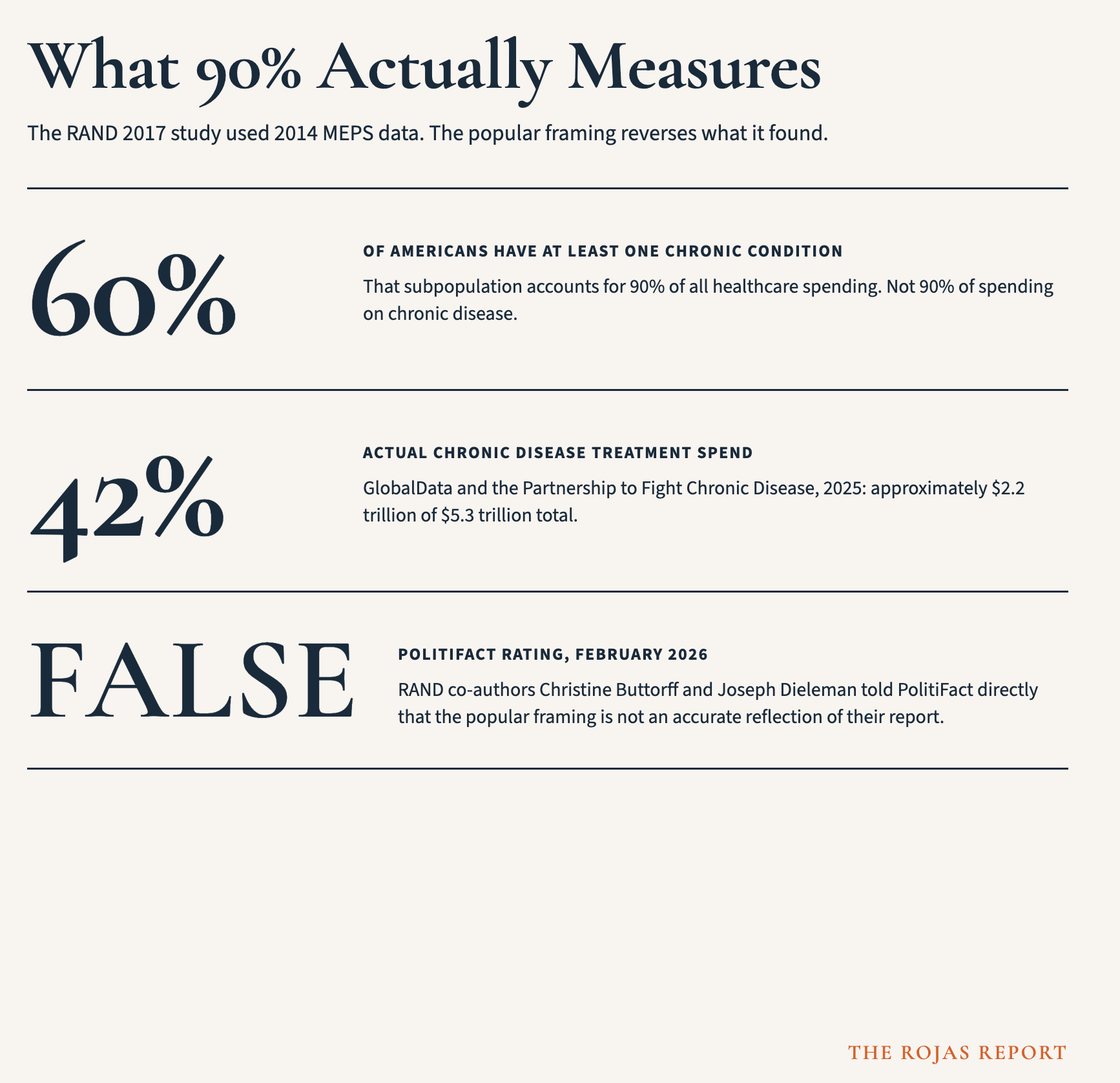
The 90% claim traces back to a 2017 RAND Corporation study using 2014 Medical Expenditure Panel Survey data. RAND found that approximately 60% of American adults had at least one chronic condition. That 60% of Americans accounted for 90% of all healthcare spending.
That is not the same thing as saying 90% of healthcare spending treats chronic disease.
If a person with diagnosed hypertension goes to the emergency room after a car wreck, that spending shows up in the 90%. If she gets pregnant, the prenatal care is in the 90%. If she gets an elective knee replacement, it is in the 90%. If she ends up in the ICU with COVID, it is in the 90%. The 90% captures all spending on every American who has a chronic condition. It does not isolate the cost of treating the chronic condition itself.
In February 2026, PolitiFact reached the RAND co-authors directly. Christine Buttorff told them that a person in a year spends or incurs health care costs for multiple related things, and the report’s estimates “lump all of that together.”
Joseph L. Dieleman, the University of Washington researcher who co-authored the spending estimates, said it more plainly: “Reality is, we spend a ton of money on things that people don’t associate with chronic diseases.” Buttorff added that the popular framing is “not an accurate reflection of our report.”
When researchers attempt to isolate actual chronic disease treatment spending, the number drops hard. A 2025 GlobalData report prepared for the Partnership to Fight Chronic Disease projected chronic disease medical costs at approximately $2.2 trillion annually. Total US healthcare spending is over $5.3 trillion. That puts actual chronic disease spend at around 42%.
PolitiFact rated the 90% claim False.
Anyone can repeat a statistic.
The Rojas Report reads the source documents and names what they say.
That is the entire difference.
Subscribe.
