
Lobbying Isn’t the Corruption. It’s the Operating System.
Everything you despise about Washington is how it actually works. Medicine never learned to play.

I told you lobbying was bribery.
It is not.
Bribery is illegal.
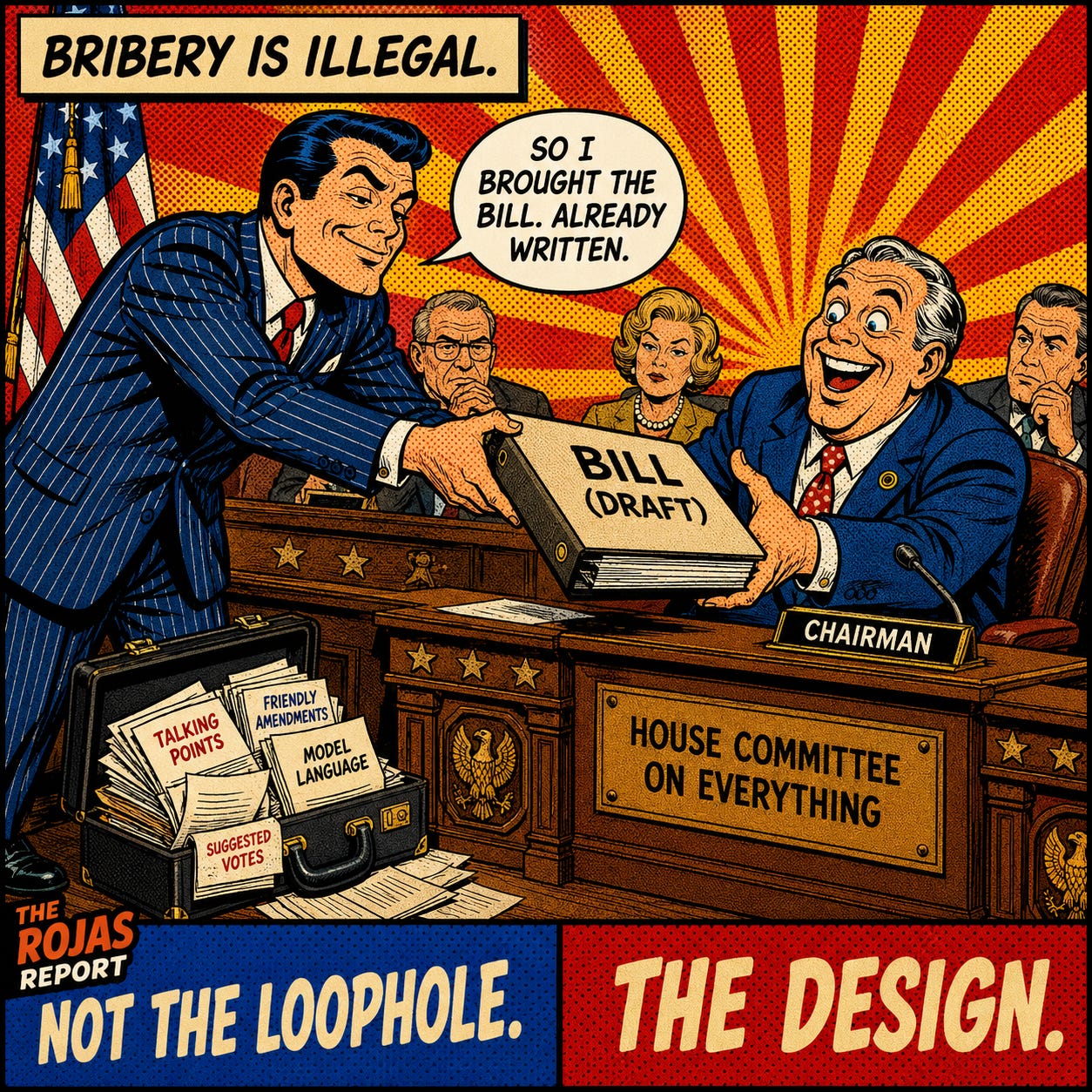
Lobbying writes the law that keeps it legal.The lobbyist does not slip an envelope under the table.
He hands the politician the bill, already written.That is the design.
IN TODAY’S ARTICLE:
The two-hundred-year history of lobbying, including the origin story Washington invented about itself.
How the “education” lawmakers receive becomes the legislation they pass.
The named actors who used this exact mechanism to ban physician-owned hospitals and push certificate-of-need across the country
Why opting out of the game is not principle. It is forfeit.
Glossary at the bottom of today’s article.
THE STORY WASHINGTON MADE UP ABOUT ITSELF
Here is the version you have heard. President Ulysses S. Grant liked to slip out of the White House and into the Willard Hotel lobby for a brandy and a cigar. Favor seekers learned to wait for him there. Grant supposedly called them lobbyists, and the word was born a short walk from the Treasury.
It is a great story.
The Washington Post told it.
The Hill told it.
The Willard’s own publicist told it for decades.
It is also false.
The political sense of “lobby” traces to the English House of Commons. The Oxford English Dictionary cites it back to the 1640s, describing the room where the public went to reach their members. Americans were already using the term by 1808 in Philadelphia and, through the 1820s, around the New York Statehouse in Albany, generations before Grant arrived in Washington.
So the first thing to understand about the lobbying industry is this.
Its earliest product was a flattering story about itself.
If they will launder the word, sit with what they do to the law.
WHAT LOBBYING IS ACTUALLY
Most people hear “lobbying” and picture a crime.
Cash in a briefcase.
A bought vote.
Wrong frame.
Bribery is a felony.
Lobbying is a constitutional right. The First Amendment guarantees the right to petition the government for a redress of grievances, and lobbying is that right industrialized. The Lobbying Disclosure Act of 1995 even defines the job: someone who makes more than one contact with covered officials and spends at least 20% of their time lobbying on behalf of a client. It is legal, professional, and licensed by its own disclosure regime.
The danger was never the envelope.
The danger is the information.
A member of Congress votes on thousands of bills a year across subjects no human being could master. Tax. Defense. Drug pricing. Spectrum auctions. They are starving for expertise, and they will take it from whoever shows up holding it. The lobbyist shows up holding it. He brings the research, the data, the projections, and the model language already drafted into clean legislative text.
He does not buy the vote. He writes the question. By the time the bill reaches the floor, the hard work of framing it is already done, and it was done by the party with the most to gain.
That is the education function the brochures praise. It is also the capture.
HOW THE MACHINE RUNS
The machine is older than most of the monuments.
One of the earliest recorded paid lobbyists in the country was William Hull, hired in 1792 by Continental Army veterans to push Congress for the back pay they were owed. As the federal government grew, the industry grew with it, because every new power Washington took created a new reason to influence how that power got used.
The regulation followed the same pattern every time. Congress passed a rule. The influence adapted around it.
The Foreign Agents Registration Act arrived in 1938 to track foreign influence. The Federal Regulation of Lobbying Act of 1946 told lobbyists to register and report. In 1954, the Supreme Court gutted that law in United States v. Harriss, narrowing it to direct, in-person contact with members of Congress. The Lobbying Disclosure Act was broadened again in 1995. Then the Jack Abramoff scandal broke in 2006, involving a lobbyist convicted of defrauding clients and bribing officials, and Congress responded with the Honest Leadership and Open Government Act of 2007, tightening gift rules and disclosure requirements.
And every single time, the influence persisted. It changed clothes.
The registered lobbyist became the “strategic advisor.” The “consultant.” Shadow lobbying, where the people doing the work stay just under the legal definition so they never have to register.
Strip away the era, and the mechanism is identical. A client pays. The lobbyist trades access and pre-written language for a lawmaker’s attention. Money moves to campaigns through political action committees. And former officials walk through the revolving door to sell the relationships they built on the public payroll. None of it is illegal. All of it is the system working exactly as designed.
Every lobbyist on K Street charges $600 an hour to understand the game you are about to see laid bare.
Over 100,000 physicians and healthcare executives will read this article.
The cartel would rather you didn’t.
