
Minnesota: The Hospital Cartel (Part 2)
How a 40-Year-Old Law Created Protected Monopolies While Nonprofit Executives Got Rich

Since 1984, it has been illegal in Minnesota to build a hospital without the state legislature’s permission. A striking consequence of this policy is its impact on healthcare access and inflation.
Since the law’s implementation, the cost of healthcare in Minnesota has surged, with hospital service prices inflating by over 200% compared to the national average increase of 117%. This legislative choke point underscores a systemic issue in the state’s healthcare system, severely limiting competition and inflating prices for Minnesotans.
Not a regulator.
The legislature.
You need a bill.
You need lobbyists.
You need campaign contributions.
You need relationships.

Consider the case of Lakeville, a growing community desperate for its own hospital. Residents there banded together, raised funds, and lobbied tirelessly to secure approval for their project.
Yet, after navigating the convoluted maze of political bargaining and campaign contributions, their proposal died a quiet death on the House floor.
The result?
Residents continue to face long travel times for emergency healthcare, forced to rely on overcrowded facilities miles away. This isn’t just policy; it’s the harsh reality of legislative control over healthcare development in Minnesota.
Forty years of this.
Yesterday, I showed you how Minnesota lost $9 billion to Medicaid fraud, the largest in American history.
Forty years of this.
If you missed Part 1: The $9 Billion Heist, read it here.
And subscribe so you don’t miss the rest of this series.Yesterday, I showed you how Minnesota lost $9 billion...
Today I’ll show you the system that made it possible.
Because the fraud didn’t happen in a vacuum. It happened in a state that spent forty years building a healthcare system designed to prevent competition, empower incumbents, and make oversight politically dangerous.
This system creates an environment where the incentives favor maintaining high occupancy rates over addressing actual patient needs, thus prioritizing profit and reducing the risks associated with regulatory oversight. By reinforcing these incentive loops, the system sustains its monopolistic and inefficient structure.
The criminals who stole $9 billion weren’t exploiting a glitch.
They were exploiting a feature.
The Protected Monopoly
The law was passed as a “temporary” three-year measure to control costs.
It was extended in 1987.
Extended again in 1990.
Made permanent in 1993.
A short-term solution became a forty-year protection racket.
The result:
Allina, Fairview, HealthPartners, Mayo, Essentia, they operate as protected monopolies.
No one can compete.
Patients have no alternatives.
This created a phenomenon called ‘bed banking,’ where incumbent hospitals hold licenses for beds they don’t actually use. In 2016, nearly 30% of all licensed hospital beds in Minnesota didn’t physically exist. This excess capacity ties into an economic cost that is not immediately apparent.

The large metro systems hoard capacity and strategically block the emergence of smaller, rural, or specialty competitors.
For taxpayers, this unused capacity translates into an estimated economic loss, as funds are effectively wasted on a system that prioritizes maintaining a facade of readiness over true utility.
An example could be the financial implications for taxpayers, estimating several million dollars in potential annual losses due to these unused beds, which could have otherwise contributed to more competitive and efficient healthcare services.
The consequences are devastating.
Minnesota ranks dead last in the nation in psychiatric beds per capita.
When families experience a mental health crisis, they can’t find a bed. Children wait in emergency rooms for days. An example is the Rodriguez family from Duluth, who found themselves in an emergency room for over 48 hours while seeking psychiatric help for their teenage son.
Families often search hundreds of miles for treatment, a taxing ordeal during an already distressing time. NAMI Minnesota’s Sue Abderholden testified: “You only worry about an open bed when you have mental illness.”
It got so bad that in 2022, the legislature passed a temporary exception. Just for psych beds. Expires in 2027. That’s how Minnesota solves problems—emergency exceptions to laws that shouldn’t exist.
Meanwhile, the health systems this law protects?
Swimming in cash.
This is the reporting the mainstream media won't do.
Subscribe to The Rojas Report.
The Nonprofit Hospital Racket
In 2023, Minnesota hospitals participating in the federal 340B drug discount program collected $630 million in revenue.
Eighty percent went to thirteen percent of hospitals, roughly $500 million.
The biggest winner: M Health Fairview University of Minnesota Medical Center, which generated $129 million in 340B profits.
These are nonprofits.
Tax-exempt institutions that exist, on paper, to serve the public good.
What do they spend on charity care?
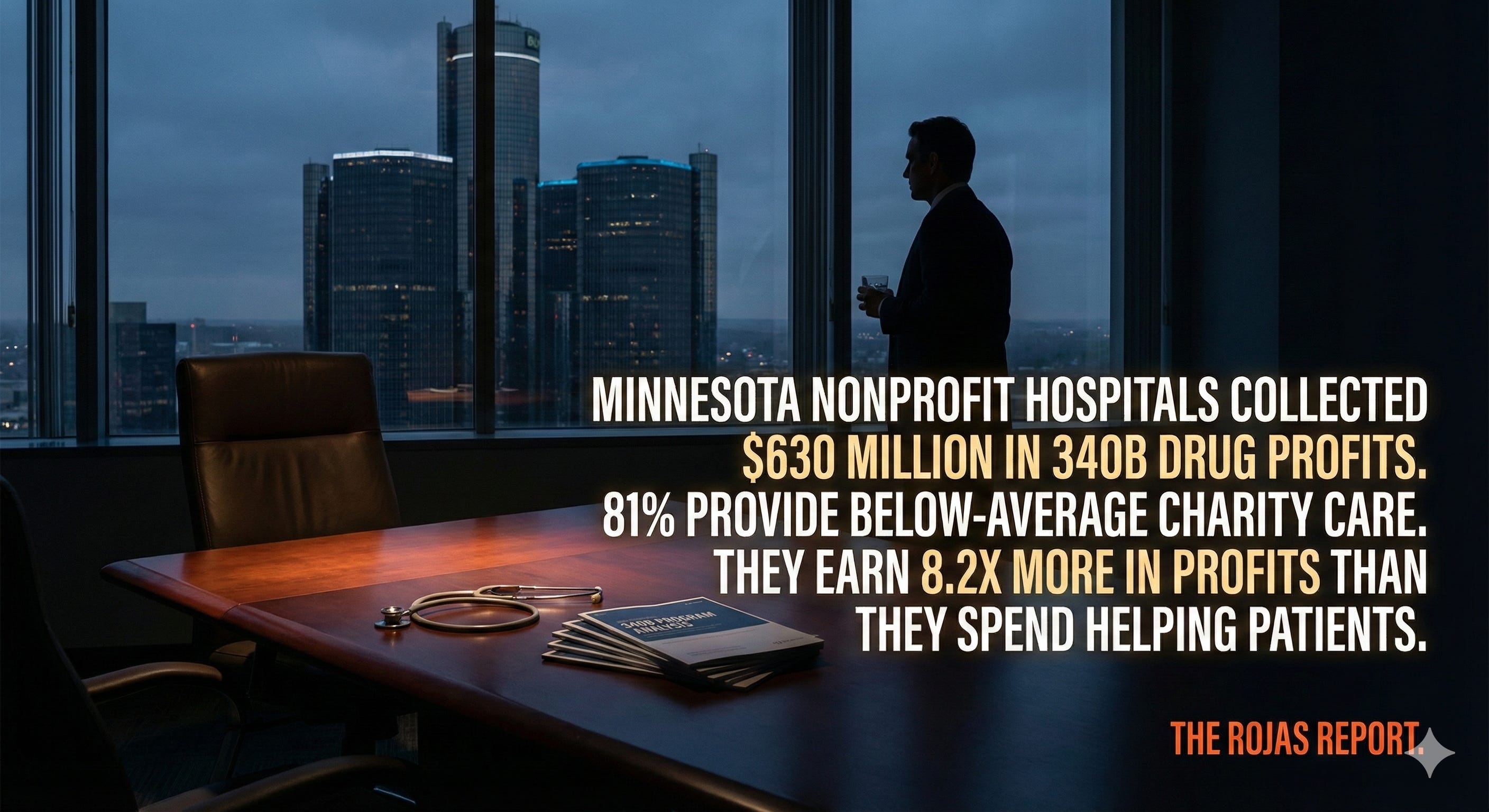
Minnesota 340B hospitals earn 8.2 times more in 340B profits than they spend on charity care. This disparity translates into significant community sacrifices.
For instance, the excess earnings could fund approximately 5,000 free chemotherapy sessions for uninsured patients. Despite these resources, 81% of hospitals provide below-average levels of charity care.
And executive compensation?
Allina’s CEO makes over $3 million. Total executive compensation: $22.8 million. M Health Fairview’s CEO made $3.55 million, which is 40 times what a nurse makes annually.
To put it in perspective, Medica’s former CEO walked away with $5.5 million in exit pay in 2023, equal to the annual salaries of approximately 65 full-time nurses, highlighting the stark contrast between executive and nursing workforce compensation.
They wrote a law that says you can’t compete with us. They collect hundreds of millions in drug discount profits meant for vulnerable patients. They pay executives millions while providing below-average charity care.

Then they complain about healthcare costs.
Then they blame Republicans.
This is a protection racket with a legislative seal.
The Hypocrisy Trifecta
Minnesota sends three of the most prominent Democrats in America to Washington. All three have made healthcare a signature issue. All three are now entangled in this scandal.
Senator Amy Klobuchar has made healthcare affordability central to her political identity. This week, she’s blaming Republicans for healthcare costs. Her state maintains a 40-year moratorium on hospital construction that blocks competition and protects incumbent hospital monopolies.
Her state ranks last in the nation in psychiatric beds per capita. Her state’s “nonprofit” hospitals collect hundreds of millions in drug discount profits while providing below-average charity care. Despite these issues, Klobuchar has remained largely silent on the $9 billion fraud happening in her backyard.
In a recent statement, however, she addressed the monopoly laws by stating, “While reforms are necessary, it is a complex issue that requires careful consideration.” Her cautious response highlights the lack of concrete action on these key issues.
Governor Tim Walz was the 2024 Democratic vice presidential nominee. He ran on Minnesota’s progressive record. Now he’s running for a third term while federal investigators unravel $9 billion in Medicaid fraud; fraud that occurred entirely on his watch.
Asked on Meet the Press if he takes responsibility, Walz responded: “Well, certainly, I take responsibility for putting people in jail.” That’s not responsibility. That’s spin.
In stark contrast, whistle-blower Jane Doe, who exposed the depths of the Medicaid fraud, recounted on the same program: “Speaking out cost me my job and peace of mind, but it was vital for accountability.
We deserve the truth about where our health dollars are going.” This compelling testimony sharply contrasts with Walz’s dismissal, inviting readers to critically evaluate the leadership’s sincerity and willingness to address root problems.
Representative Ilhan Omar represents Minneapolis, ground zero for the fraud. Many of the 78 defendants charged are of Somali descent. So are many of those charged in the housing and autism fraud schemes. Omar has called Trump’s attacks racist. She’s right that his language is inflammatory and that the vast majority of Somali-Americans are law-abiding citizens.
But she’s also been forced to acknowledge that lawbreaking occurred on a massive scale. The question isn’t whether the fraud happened. It did.
The question is whether Minnesota’s political leadership, including Omar, will take any responsibility for the conditions that enabled it.
So far, the answer is no.
If you believe sunlight is the only disinfectant, subscribe and share.
Paid subscribers fund the investigations the cartel doesn't want you to see.
The Reckoning
Minnesota’s healthcare model is often presented as a paragon of progressive values, emphasizing access and equity. Yet, despite these ideals, the structural issues embedded in the system reveal significant obstacles.
The certificate-of-need laws, initially intended to control healthcare costs, have instead stifled competition and fortified monopolies. The reimbursement models in place further entrench existing players, making it difficult for new entrants to offer alternative care options.
These economic levers transcend party lines, suggesting that the challenge isn’t solely about one political ideology over another, but a systemic flaw affecting all residents.
In light of these longstanding mechanisms, Minnesota has experienced $9 billion in Medicaid fraud, marking it as the largest in American history. The protective framework around hospitals not only blocks competitors but also leaves families without necessary mental health resources.
Meanwhile, nonprofit hospitals accrue substantial profits through drug discount programs, all while delivering below-average charity care.
Their state’s “nonprofit” hospitals collect hundreds of millions in drug discount profits while providing below-average charity care.
Their whistleblowers say they were threatened and retaliated against for trying to stop the fraud.
And Amy Klobuchar is tweeting about Republican healthcare policy.
$9 billion is gone. Children went hungry while fraudsters bought luxury cars. Some of that money may have funded terrorists.
Families can’t find psych beds while hospital CEOs make millions. It is time that we demand a full public audit of Minnesota’s healthcare system to uncover every detail of this fraud.
Only through transparency can we ensure that such abuses are never repeated. Additionally, we must push for a legislative vote to repeal the laws that allow these monopolies to stifle competition.
By transforming our outrage into action, we can create momentum for necessary change. This is not simply a Republican or Democratic policy. This is a call for accountability and reform.
This is Minnesota.
This is progressive healthcare.
And Klobuchar, Walz, and Omar own every bit of it.
Subscribe. Share. The cartel counts on your silence.
Tomorrow: You pay for healthcare seven times before you ever see a doctor. Here’s how the system ensures you never see the bill.
If this resonated, share it. The cartel counts on complexity to hide in plain sight. Sunlight is the only disinfectant.
-Rojas out

Found this document from the Minnesota government with in-depth coverage about the hospital-building moratorium. It includes historical information and statute references:
Minnesota House Research: Minnesota’s Hospital Construction Moratorium. January 2023: https://www.house.mn.gov/hrd/pubs/hospmorat.pdf
Contents:
Precursor to the Moratorium: Certificate of Need Program .................................. 2
Hospital Construction Moratorium ......................................................................... 3
Exceptions to the Hospital Construction Moratorium ........................................... 3
Emergency Waivers ................................................................................................ 8
Public Interest Review ............................................................................................ 8
Alternative Approval Process ................................................................................ 11
Utilization of Public Interest Review and Alternative Approval Processes .......... 14
Enforcement ......................................................................................................... 16
Appendix ............................................................................................................... 18