
Nearly a Thousand Hospital Systems Just Refused One Question. Here Is the Question.
Lilly's June deadline required the largest hospital systems in the country to prove the 340B discount reached the low-income patients it was built to serve.

Eli Lilly asked the hospitals one question.
Who received the discount?
Nearly one thousand of the largest systems in the country refused to answer.
The refusal is the confession.
In today’s article:
The single question Lilly’s June deadline put to 340B hospitals
Why the largest systems organized to refuse it
The $66 billion spread that an honest answer would expose
What the hospital lobby means when it says “safety net,” and who it leaves out
Glossary at the bottom of today’s article.
THE QUESTION
On June 1, 2026, Eli Lilly sent a letter to the head of HRSA, giving the holdout hospitals one week. Submit claims-level data on who actually received the 340B discount, or lose 340B pricing on Lilly drugs by June 8.
The drugs on that list are available at every safety-net pharmacy in the country. Mounjaro. Zepbound. Jardiance. Trulicity. Taltz.
Lilly did not ask the hospitals to return anything. It asked them to show their work. National Drug Code, dispense date, who got the unit. The same data every one of these systems already transmits to commercial insurers every single day.
By the deadline, roughly seventy percent of covered entities, about 2,350 of them, had handed over the data. Nearly one thousand refused.
The refusers were not rural clinics scraping by. They were the largest disproportionate-share hospital systems in the country, organized and coordinated through the American Hospital Association and 340B Health.
The biggest, best-funded systems in American medicine were asked to prove a discount written for poor patients reached poor patients. They organized to refuse.
THE SPREAD
Here is what an honest answer would expose.
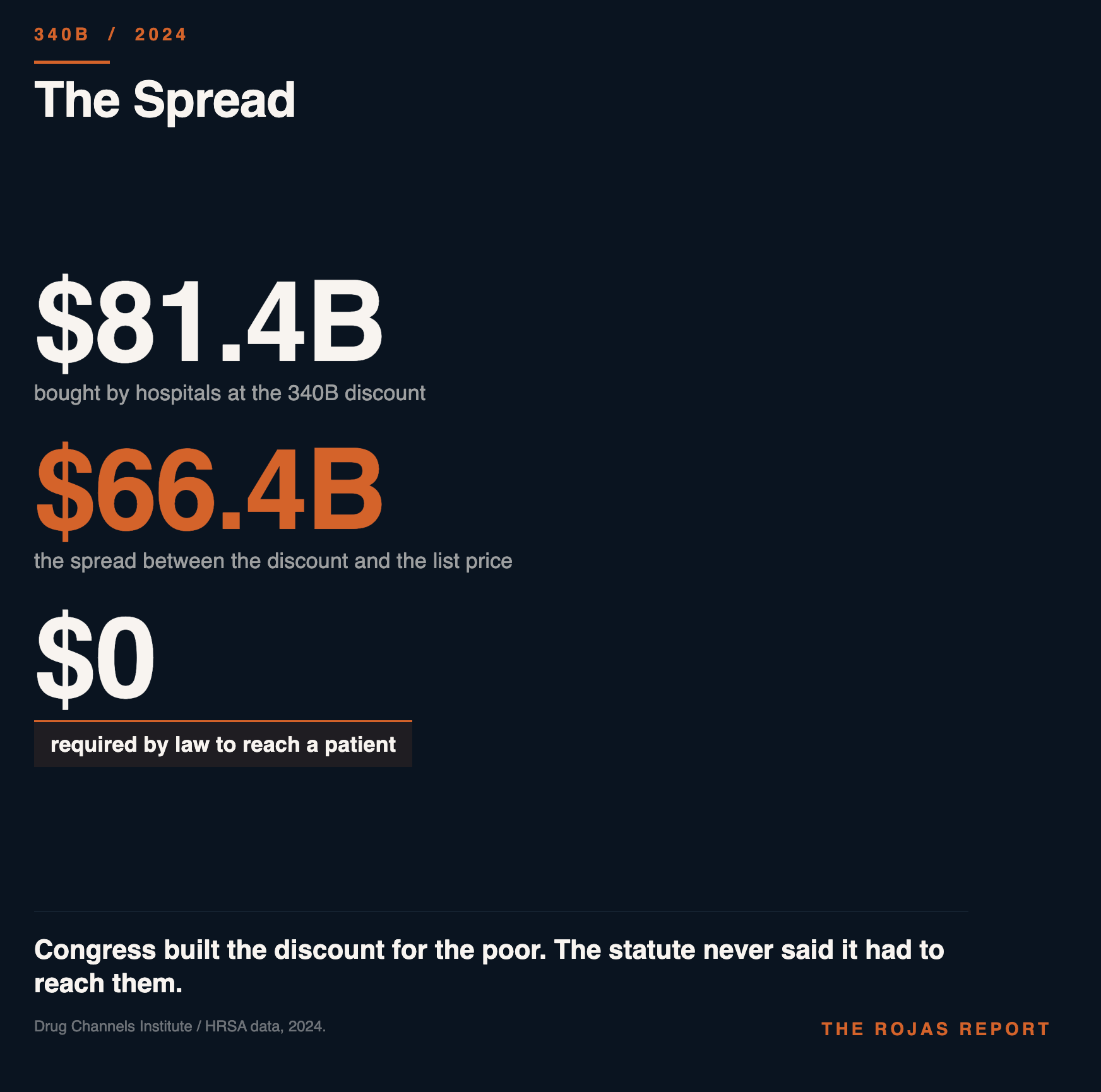
In 2024, hospitals and other covered entities bought $81.4 billion in drugs at the 340B discount. The Drug Channels Institute, using HRSA data, estimated the gap between the discounted price and the list price at $66.4 billion that year.
That $66.4 billion is the spread. It is the money the discount creates. Congress wrote 340B in 1992 to stretch scarce federal resources for low-income and uninsured patients.
Nowhere does the statute require a health system to hand a single dollar of that spread to the patient standing at the counter.
So it doesn’t. Federal investigations and economic studies have shown that commercial contract pharmacies rarely pass the 340B discount to the uninsured. The uninsured patient pays full retail. The covered entity and the pharmacy chain split the spread.
And hospitals capture 87 percent of all 340B purchases. Not federally qualified health centers. Not Ryan White clinics. Hospitals.
The captured systems are counting on you to stop reading at the words “safety net.”
Over one hundred thousand readers did not.
That is the whole difference between understanding the spread and funding it.
