

In November 2024, the Wall Street Journal reported that food stocks were sliding on RFK Jr.’s nomination and said the sell-off looked overdone.
Barron’s blamed the snack slump on prices and waved readers off the obesity drugs.
The smart money had a word for MAHA. Noise.
A campaign slogan with a shelf life.The food giants agreed.
They kept their formulas.
They kept their lobbyists.
They kept their guidance.Twenty-two months later,
Campbell’s has lost more than half its value.So has Conagra. General Mills is down 47 percent.
Nine of the ten largest food and beverage companies in America are underwater. The S&P 500 gained 33 percent over the same stretch.
The people who called it noise were not reading the tape.
IN TODAY’S ARTICLE:
Nine of the ten largest food and beverage stocks in America are negative since August 2024, while the S&P 500 gained 33 percent.
The consumer staples sector is fine. The damage is surgical, and it maps precisely to MAHA exposure.
SNAP restrictions in 23 states revealed how much of Big Food’s revenue was a federal transfer payment nobody called a subsidy.
Coca-Cola is the lone survivor, and the reason for its survival indicts everyone else.
Glossary at the bottom of today’s article.
THE TAPE DOESN’T CARE WHAT YOU CALL IT
The market has already ruled on MAHA. The verdict came in daily installments, session by session, from August 2024 through this month.
Here is the tape. August 2024 to July 2026.
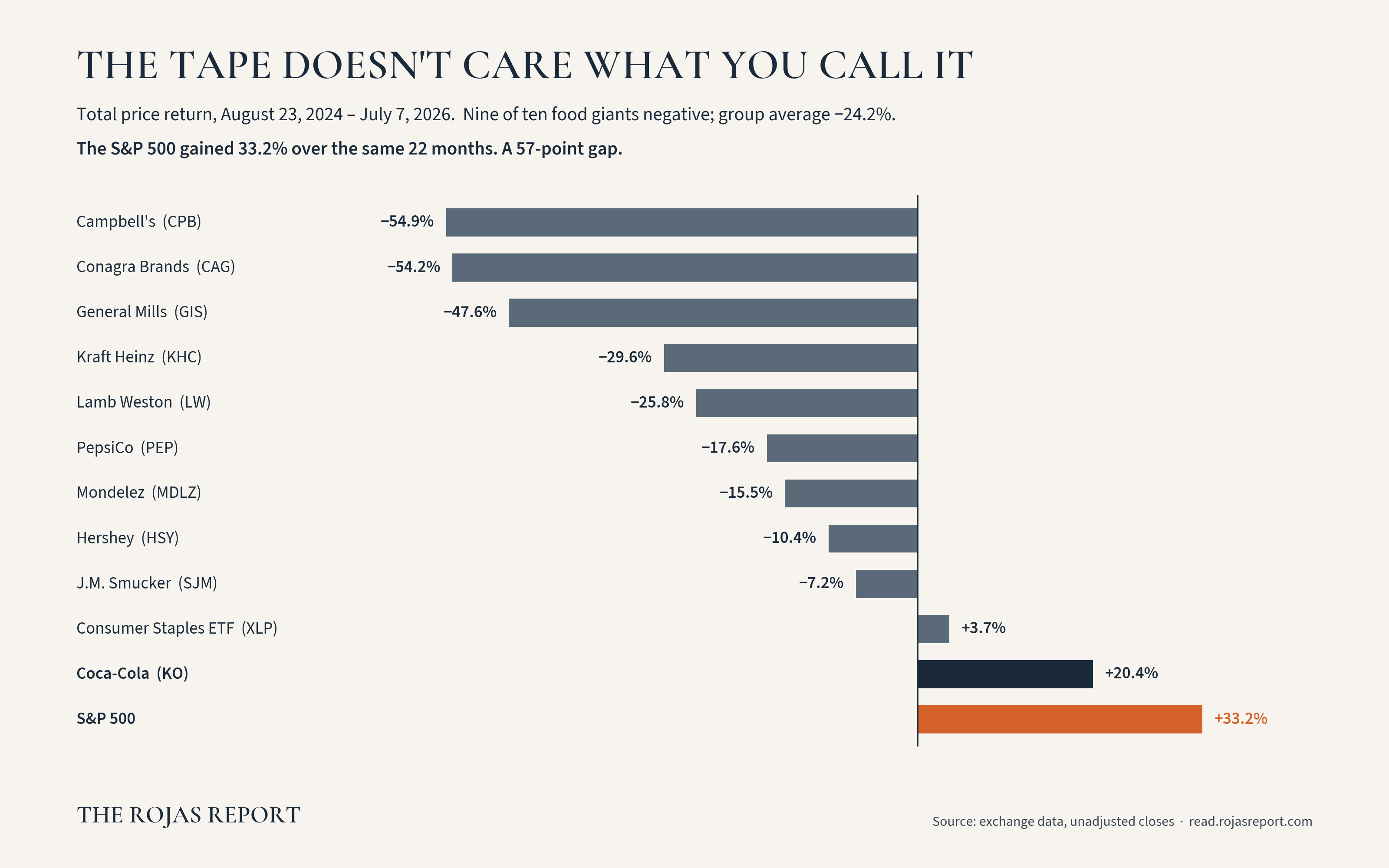
Nine of ten negative.
The group averaged a 24.23 percent decline.
Over the same 22 months, the S&P 500 gained 33.17 percent.
That is a 57-point gap between the companies that feed America and the market that prices them. During a bull market. During record index highs. During the biggest wealth creation stretch of the decade.
Campbell’s traded at $50.80 when RFK Jr. endorsed Donald Trump.
It trades at $22.90 now.
Conagra went from $30.63 to $14.03.
General Mills went from $70.83 to $37.10.
The soup is the same.
The cereal is the same.
The Secretary of HHS is new.
THE CONTROL GROUP
Every defense attorney for Big Food will reach for the same argument: consumer weakness. Inflation. Trading down. A tough macro for staples.
The tape already heard that argument and rejected it.
The Consumer Staples Select Sector ETF, ticker XLP, gained 3.69 percent over the same window. A modest return, and a positive one. And look at what carried it: the fund’s three largest holdings are Walmart, Costco, and Procter & Gamble. Retailers and household products held up the sector, while packaged food names dragged it down.
The staples sector is fine.
The retailers are fine.
The household products companies are fine.
The damage is surgical. It cuts along one line and one line only: exposure to ultra-processed food, sugary beverages, artificial dyes, and SNAP-funded junk purchases.
A macro problem hits the whole sector.
A repricing picks its targets.
This one picked ten.
THE TIMELINE THE MARKET TRADED
The sell-off tracked the policy calendar like a shadow.
August 23, 2024. RFK Jr. suspends his campaign and endorses Trump. The food names start drifting lower while the index grinds higher.
November 14, 2024. Trump nominates RFK Jr. to run HHS.
The next trading day, Lamb Weston drops more than 6 percent, PepsiCo more than 4 percent, Campbell’s nearly 3 percent, General Mills and Conagra more than 2 percent each. Even Coca-Cola, the eventual survivor, gives up 1.3 percent.
January 15, 2025. The FDA bans Red Dye No. 3. The first tangible regulatory strike on artificial ingredients.
February 13, 2025. RFK Jr. confirmed as HHS Secretary, 52 to 48. The MAHA Commission stands up by Executive Order 14212.
April 22, 2025. The FDA announces the phase-out of petroleum-based synthetic dyes from the food supply. Kraft Heinz and General Mills pledge to remove dyes within weeks.
2025 through mid-2026. Twenty-three states secure USDA waivers restricting SNAP purchases of soda and candy. [Source: CNBC, June 20, 2026]
June 22, 2026. Judge Amy Berman Jackson vacates the waivers in five of those states, ruling the USDA exceeded its authority. The other 18 stand, for now, on the same contested legal footing. More on that below.
Look at the second column of the dataset.
Measured from the nomination alone, General Mills is down 41 percent. Conagra is down 47 percent.
Campbell’s is down 47 percent.
Two names tell a different story since the nomination.
Hershey is up 2.94 percent, and Smucker is up 5.91 percent from the nomination date, meaning their damage came early, and the market has already sorted the merely exposed from the structurally condemned.
The market did not wait for the regulations to take effect. It never does. Capital prices the future, and the future it priced was one where the ultra-processed food business model loses its two quietest advantages: regulatory silence and taxpayer-funded demand.
100,000 physicians, healthcare executives, and lawmakers read The Rojas Report every month.
The portfolio managers who dumped these stocks read the same receipts 18 months ago.
You can read them now, or you can keep learning about repricings after they happen to you.
