
The 50-State Map: Only 8 Attorneys General Have the Legal Authority to Stop a Nonprofit Hospital Merger Before It Closes
Nonprofit hospitals do not answer to the IRS. They answer to their state attorney general. We mapped all 50 states, ranked every AG by enforcement power, and here is what we found....

The Rojas Report | Nonprofit Hospital Accountability Series, Part 1 of 7
$257 Billion in taxpayer subsidies
$28 billion in federal tax exemptions.
$16 billion in charity care delivered.
38 states. No documented enforcement actions in a decade.
The trade was a tax exemption for charitable conduct.
Half the trade got delivered.
The other half never showed up.
IN TODAY’S ARTICLE:
Why the IRS is not the enforcer of nonprofit hospital accountability, and who actually is
The three-tier map of attorney general authority across all 50 states
The 8 states with pre-approval authority to block a nonprofit hospital merger before it closes
Why having the authority and using the authority are two different decisions, and what Ohio’s record proves
Glossary at the bottom of today’s article.
Every reform conversation about nonprofit hospitals starts at the wrong agency.
The IRS does not enforce accountability requirements for nonprofit hospitals. It cannot. Its only enforcement tool is revocation of tax-exempt status, an action the IRS has not taken against a major nonprofit hospital system in decades.
The enforcer is the state attorney general, empowered by parens patriae, a common-law principle that makes the AG the legal guardian of charitable assets held in public trust.
Every nonprofit hospital in America operates under that doctrine.
Almost none of them operate as if it applies.
THE ENFORCER NOBODY TALKS ABOUT
A nonprofit hospital is not owned by anyone. That is the technical meaning of “nonprofit.” Its assets are held in trust for the public benefit. Its board members are trustees, not shareholders. Its tax exemption is the price the state pays for that trust relationship.
When a trustee breaches the trust, the law gives someone standing to sue the trustee. That someone is the attorney general.
The AG can subpoena board members, issue civil investigative demands, block mergers and acquisitions, sue for breach of fiduciary duty, and demand compliance with charity care. In some states, the AG can revoke charitable status outright.
These are not theoretical powers. They are statutory powers, common law powers, and, in eight states, healthcare-specific statutory powers.
The IRS is largely a paper tiger when it comes to nonprofit hospital enforcement. The state AG is the regulator that the law actually empowered.
The carriers know this. The hospital systems know this. The AGs know this. The patient does not.
This article is about the patient’s findings.
THE MAP
Authority over nonprofit hospitals is divided across three tiers. We mapped every state.
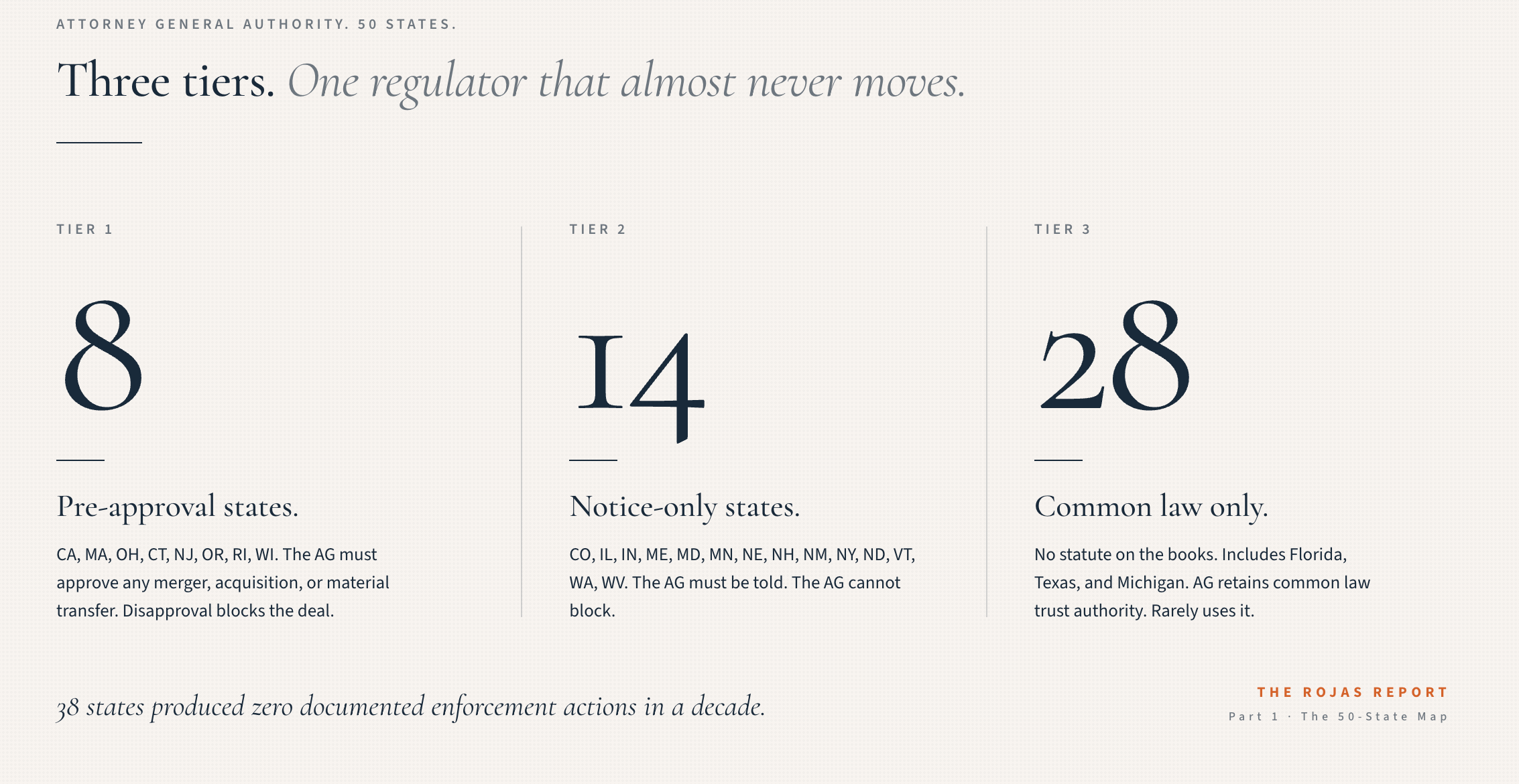
TIER 1: PRE-APPROVAL AUTHORITY (8 states). California, Massachusetts, Ohio, Connecticut, New Jersey, Oregon, Rhode Island, and Wisconsin. In these states, a nonprofit hospital cannot complete a merger, acquisition, asset sale, or material transfer of control without the AG’s affirmative written approval. The AG has statutory authority to disapprove, condition, or block the transaction. Appeals run through the civil court.
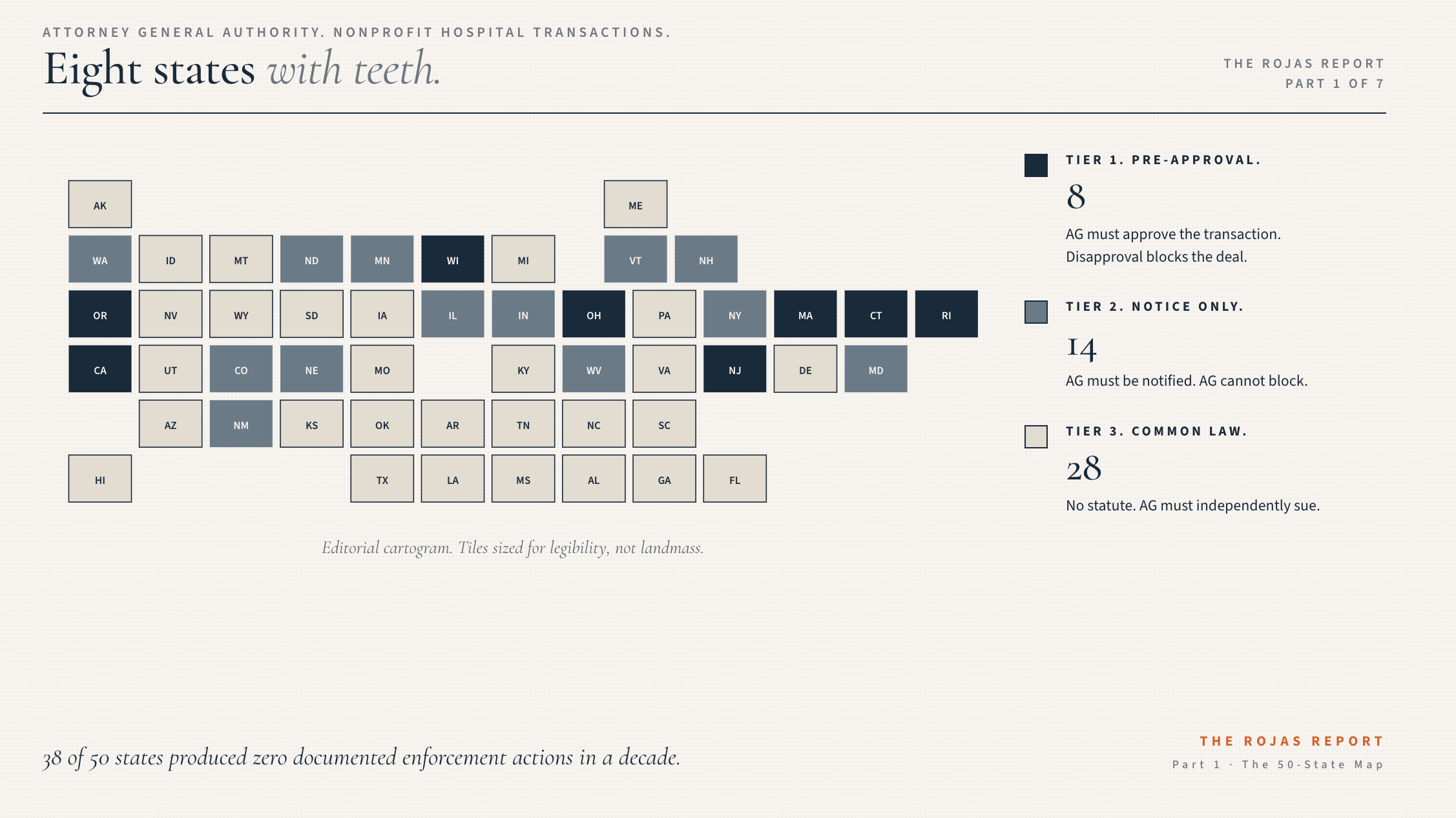
TIER 2: NOTIFICATION WITHOUT CONSEQUENCE (14 states). Colorado, Illinois, Indiana, Maine, Maryland, Minnesota, Nebraska, New Hampshire, New Mexico, New York, North Dakota, Vermont, Washington, and West Virginia. In these states, a nonprofit hospital must notify the AG before a transaction closes. The AG may comment, investigate, or object. The AG cannot block. The transaction proceeds whether the AG approves or not.
TIER 3: COMMON LAW ONLY (28 states). Every other state. The AG retains common law authority over charitable trusts, but no healthcare-specific statute requires notice, review, or approval of nonprofit hospital transactions. Florida and Texas, two states with combined nonprofit hospital revenues exceeding $36 billion annually, sit in this tier. Michigan, the only state that wrote a hospital exemption directly into its charitable trust statute, sits here too.
To take control of hospital transparency and community impact, subscribe now. Gain direct access to plain-language, actionable insights delivered weekly.
