The Arithmetic of Decline
You’re not imagining it. The game has changed.

The most reliable path to wealth in America is no longer building something.
It’s navigating something.
And every civilization that made that trade has a name we study in history books.
In 1776, Adam Smith published The Wealth of Nations and identified the central question of political economy: why do some nations grow rich while others stagnate?
Two and a half centuries later, the question may be reframed: why do prosperous nations experience decline, losing their ethical foundations even as their wealth persists?
The United States in 2026 exemplifies this dilemma. Despite its remarkable affluence by most measures, a more complex challenge persists: determining how virtue aligns with, or diverges from, material reward.
When extraction becomes the primary path to wealth, a fundamental transformation occurs within a society’s structure. Institutions are central to this process.
For example, regulatory bodies that impose complex compliance requirements foster industries dedicated to navigating these complexities, rather than advancing production.
Likewise, agencies that enforce monopolistic policies incentivize companies to prioritize market dominance over innovation.
Whether this structural shift can be reversed remains an open question.
The Founders’ Wager
The American experiment was, at its core, a bet on virtue.
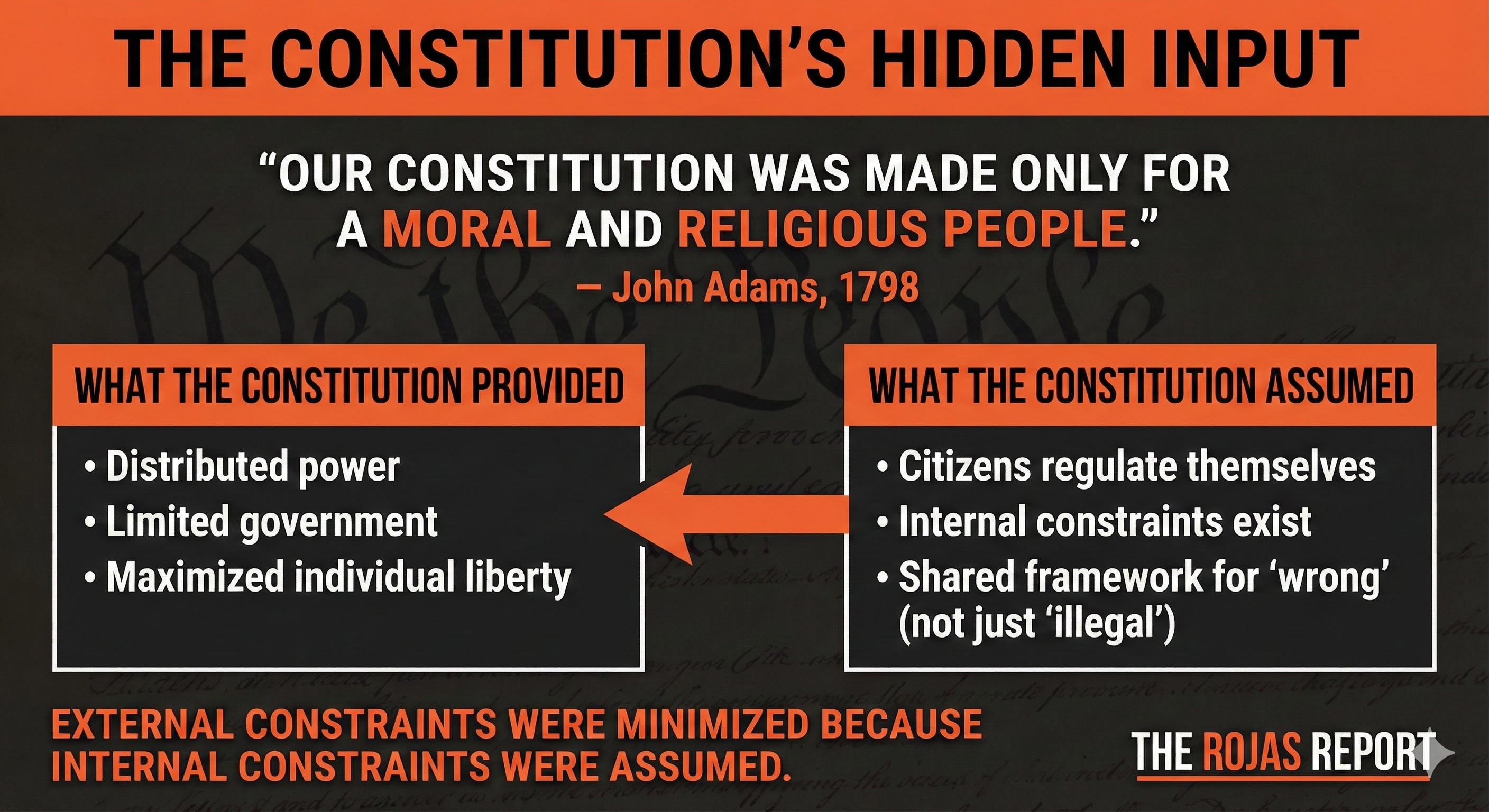
John Adams stated it explicitly: “Our Constitution was made only for a moral and religious people. It is wholly inadequate to the government of any other.”
There was no sentiment in the statement. The Constitution distributed power, limited government, and maximized individual liberty precisely because it assumed citizens would regulate themselves. External constraints were minimized because internal constraints were considered.
Jefferson’s concept of a “natural aristocracy,” in which leadership derives from virtue and talent rather than birth, relied on institutions capable of identifying and promoting such individuals.
Washington’s emphasis on personal honor reflected his recognition that republican government ultimately depends on public confidence. When trust in the character of leaders erodes, the system itself is at risk.
The Founders read their Cicero.
They knew how the Roman Republic ended.
They designed against it.
But they also knew that no design is stronger than the people operating it.
The Historical Pattern
Civilizational decline has a recognizable arithmetic.
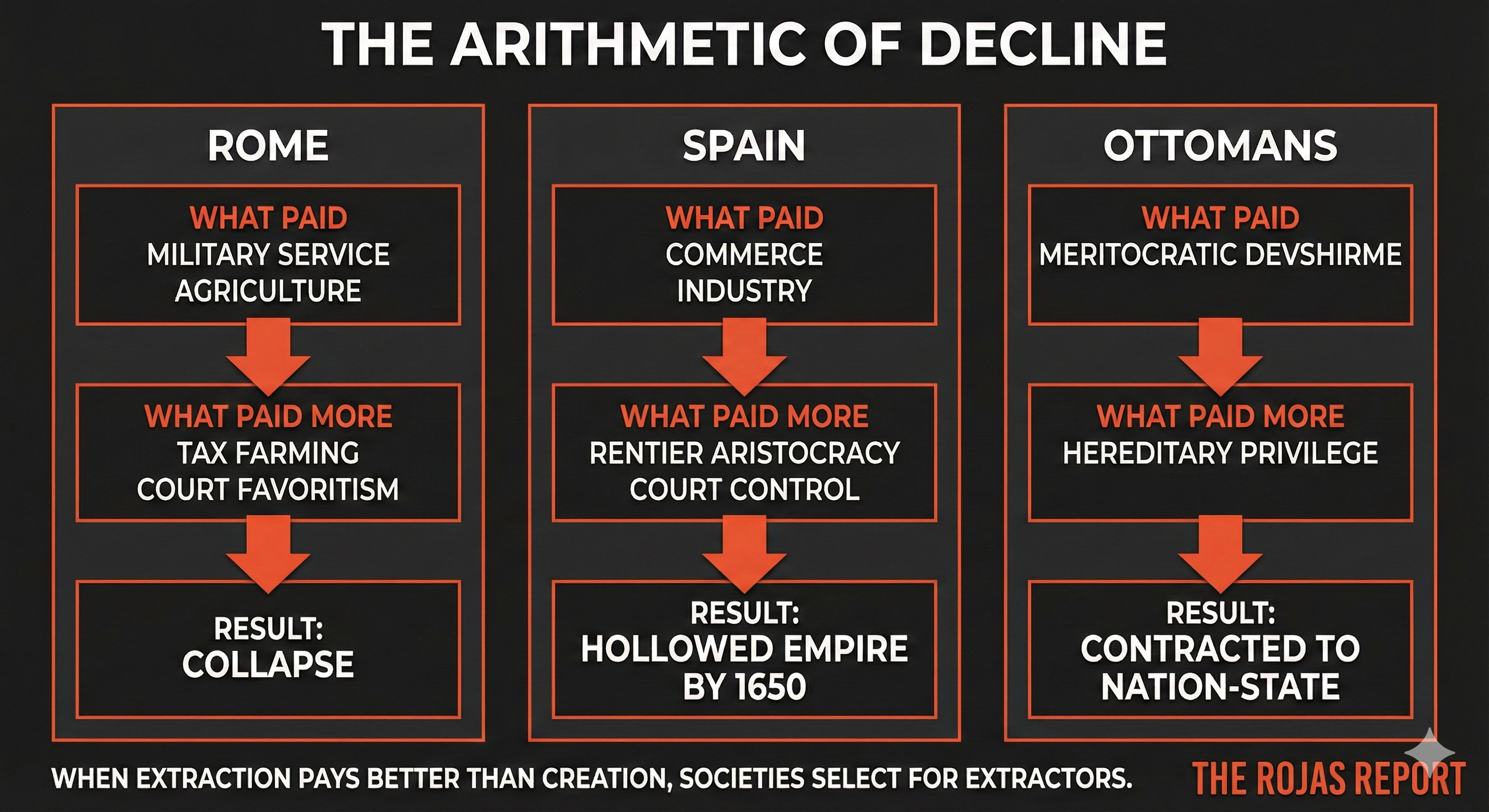
In the late Roman Empire, the most reliable path to wealth shifted from military service and agricultural production to tax farming and court favoritism. During this time, tax farming became so profitable that revenues sometimes exceeded those from productive land use. The result was predictable: the ambitious pursued proximity to power rather than productive enterprise.
In Habsburg Spain, the extraction of New World silver created a rentier aristocracy that disdained commerce and industry. The money flowed to those who controlled the court, not those who created value. By 1650, Spain was a hollowed empire, still wealthy on paper, increasingly irrelevant in fact.
In late Ottoman Turkey, the devshirme system that once elevated talent regardless of birth calcified into hereditary privilege. The reformers who might have saved the empire were precisely the people the system had learned to exclude.
The pattern remains consistent: when extraction yields greater rewards than creation, societies tend to favor those who extract. This is not a moral judgment, but rather a reflection of shifting incentives.
As institutional rules evolve, they reshape the landscape of opportunity, directing talent toward the most lucrative paths. For instance, when proximity to power is more rewarding than productive enterprise, individuals are drawn to power over production. This dynamic illustrates how incentives shape behavior independently of moral considerations.
Most newsletters tell you what to think. This one tells you what they’re hiding.
Subscribe to The Rojas Report.
America by the Numbers
Consider the contemporary United States:
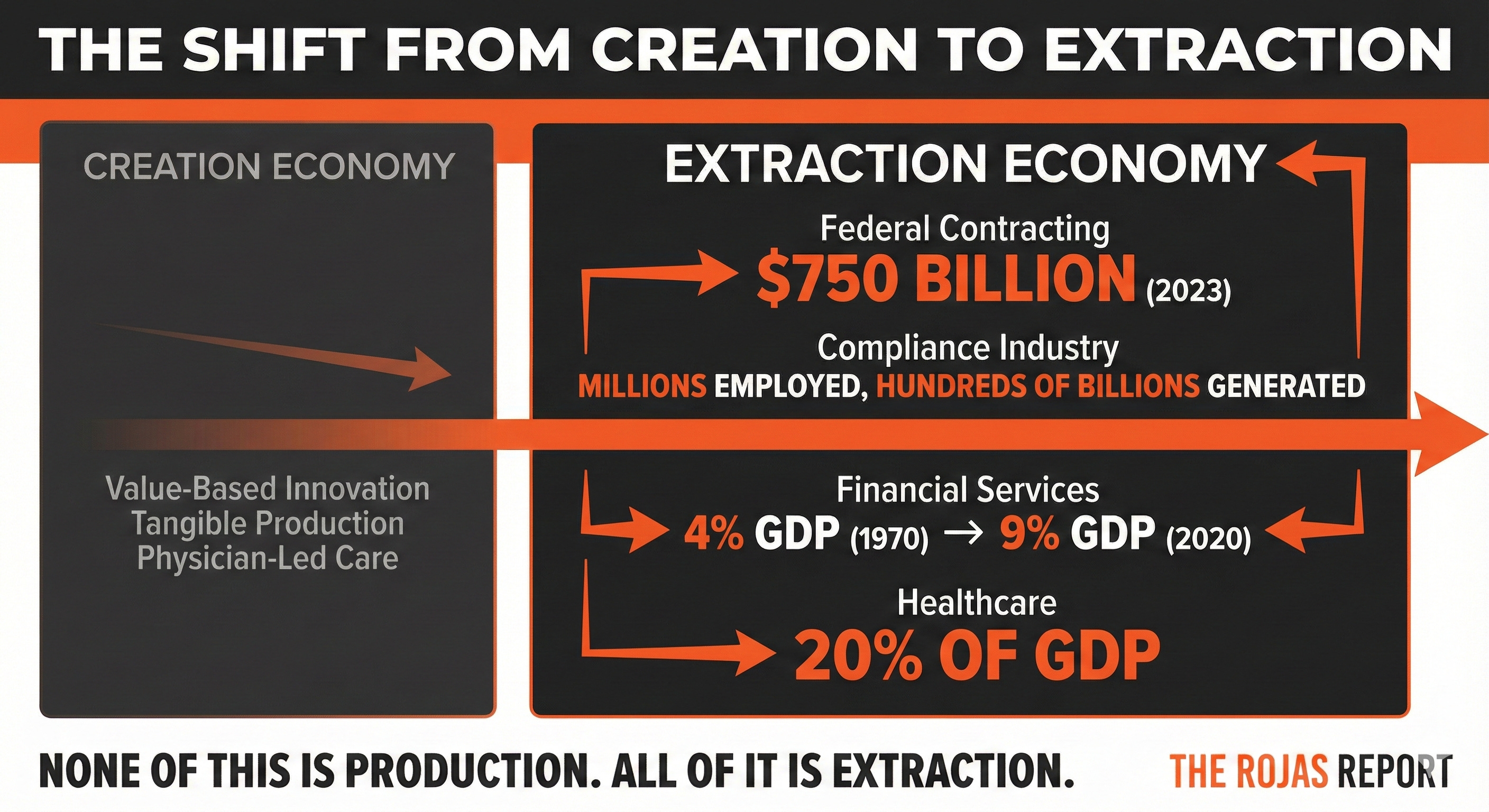
Federal contracting surpassed $750 billion in 2023. The compliance industry, including lawyers, consultants, and lobbyists who manage regulatory complexity, employs millions and generates substantial revenue.
These activities do not constitute production.
They represent extraction facilitated by complexity.
For example, one of my early-stage technology companies allocated more resources to legal fees and compliance than to research and development during its initial two years. This burden diverted attention from innovation, highlighting the significant consequences of a system oriented toward extraction rather than creation.
The financial sector’s share of GDP increased from approximately 4% in 1970 to nearly 9% by 2020. Financial services primarily function as intermediaries rather than producers. While some intermediation is essential, a doubling of its economic share indicates that intermediaries increasingly extract value from transactions instead of merely facilitating them.
Healthcare now accounts for nearly 20% of American GDP.
A significant portion of this expenditure is attributable not to direct patient care, but to regulatory compliance, administrative complexity, and the exploitation of information asymmetries. This distribution of spending raises critical questions regarding the efficiency and priorities of the sector.
The pattern is legible in the data.
The paths to wealth have shifted.
The Dissolution of the Framework
But incentives alone do not explain the current moment. Incentives have always existed. What has changed is the framework within which incentives operate.
Adams specified the need for a “moral and religious people.” These descriptors were intentional, indicating that the system required participants who believed in values beyond material success, such as enduring accountability and moral judgment beyond legal negotiation.
That framework has eroded.
Perhaps inevitably.
Perhaps not.
The secularization of American society is well-documented. However, the more consequential shift is not merely the decline in church attendance, but the erosion of a shared vocabulary for moral judgment.
When concepts such as “good” and “evil” are reduced to personal preference, society loses the ability to differentiate between profit and exploitation. Both may be legal and profitable. In the absence of a framework for moral wrongdoing, the distinction between ethical and unethical conduct disappears.
What remains is compliance, which becomes merely another operational cost.
The Possible Recoveries
History is not deterministic.
Civilizations have recovered from corruption before.
Victorian Britain is instructive. The early nineteenth century was an era of extraordinary venality. Rotten boroughs, purchased commissions, nepotism so systemic it was barely noticed. By 1870, Britain had established a professional civil service, competitive examinations for government posts, and norms of public conduct that would last nearly a century.
What changed? Multiple factors: evangelical religious revival, utilitarian reform movements, a rising middle class that demanded competence over connection, and leadership that saw integrity as a competitive advantage in an industrializing world.
The recovery required both moral revival and institutional reform.
Neither alone was sufficient.
Whether the United States can replicate such a recovery remains uncertain. The conditions, scale, and pace of information and capital flows differ significantly from historical precedents. Further analysis ought to consider factors such as social trust indices, the adaptability of political institutions to reform, and the resilience of economic systems to external shocks. Examining these measurable conditions may clarify potential paths forward and help transform this uncertainty into a research agenda for further inquiry.
The good news?
The historical record suggests it is at least possible.
The Alternative
The alternative is also visible in the historical record.
Rome did not recover.
The Republic gave way to the Principate, the Principate to the Dominate, and the Dominate to collapse. Each transition represented a narrowing of the class that benefited and a broadening of the class that was extracted from.
Spain did not recover.
The wealth flowed out. The talent emigrated. The empire contracted over two centuries, leaving what remained a peninsula with memories.
The Ottoman Empire did not recover.
The reformers came too late. The structures were too calcified. What emerged was a smaller, weaker nation-state, shorn of empire.
These are not analogies.
They are data points. Civilizational decline is not inevitable, but it is common. The nations that avoid it are the exceptions, not the rule.
The Individual Question
This is where my thoughts reach their natural limits.
Structural analysis can describe the problem.
It cannot solve it.
Incentive mapping can identify the pressures.
It cannot tell an individual how to respond.
The Stoics addressed this gap.
Marcus Aurelius governed an empire in decline and knew it. His response was not structural reform. He had no illusions about reversing Rome’s trajectory. His response was personal integrity. “Waste no more time arguing about what a good man should be. Be one.”
This perspective does not reflect fatalism, but rather a realistic assessment of the limits of individual agency amid civilizational change. While it is not possible for one person to reform the incentive structures of a $25 trillion economy, individuals retain agency in determining their own conduct within these systems.
The question is not whether virtue pays.
In the short term, it often does not.
The question is what you are willing to trade for payment.
The Stakes
The American experiment was never guaranteed.
The Founders knew this.
The structure they built assumed inputs they could not ensure.
The American experiment continues in real time.
A society that has eliminated a shared moral framework, dismissed the importance of judgment, reduced ethics to compliance, and prioritized extraction over creation faces a critical question: can it sustain itself?
The historical record suggests the odds are not favorable.
But history is not destiny.
It is precedent.
What happens next is not yet written.
The central question is whether a sufficient number of individuals will recognize the importance of the moral framework. Not for material gain, but because, in its absence, societal cohesion cannot be maintained.
60,000+ physicians and healthcare operators read The Rojas Report across platforms. Not because it’s comfortable. Because it’s true. Subscribe here.
-Rojas out.