
The Autism Gold Rush:
How a Therapy for Children Became the Fastest-Growing Extraction Machine in Medicaid

Applied Behavior Analysis therapy is supposed to help children with autism. Private equity, unqualified technicians, and a payment system that rewards volume over outcomes turned it into the fastest-growing line item in Medicaid history.
There are children with autism who need intensive therapy. Thirty to forty hours a week. One-on-one. For years.
There are also companies that hired 18-year-old relatives with no training, paid parents cash kickbacks to enroll their children, billed Medicaid for therapy that never happened, and collected billions.
The billing code is the same for both.
IN TODAY’S ARTICLE:
Why Applied Behavior Analysis became the fastest-growing Medicaid line item in the country, and who captured the money
The billing structure that lets a registered behavior technician with 40 hours of training bill Medicaid at the same rate as a master’s-level clinician
574 autism therapy centers acquired by private equity firms, Blackstone’s $700 million acquisition that ended in bankruptcy, and the workforce model that prioritizes volume over outcomes
The OIG audits that found $56 million in improper payments in Indiana (with all 100 sampled months noncompliant), $18.5 million in Wisconsin, and 90% of claims flagged in Minnesota
Glossary at the bottom of today’s article.
THE SAME PATTERN. A DIFFERENT CODE.
Over the past two articles, we’ve mapped what happens when Medicaid spending concentrates in the hands of a few.
We found 98 entities that collectively account for 42.5% of all personal care spending nationally.
We found 47 authorized officials controlling 130 separate billing entities worth $9.2 billion. We found spending that doubled under COVID emergency rules and never returned to pre-COVID levels.
The billing code was T1019.
Personal care services.Today, the billing code changes.
The pattern does not.The code is 97153.
Adaptive behavior treatment by protocol, administered by a technician, face-to-face, every 15 minutes.
In plain English: an aide sits with a child diagnosed with autism and runs a behavioral therapy protocol for up to 40 hours a week. The aide is typically a Registered Behavior Technician. The entry requirement for that credential is a high school diploma and 40 hours of training.
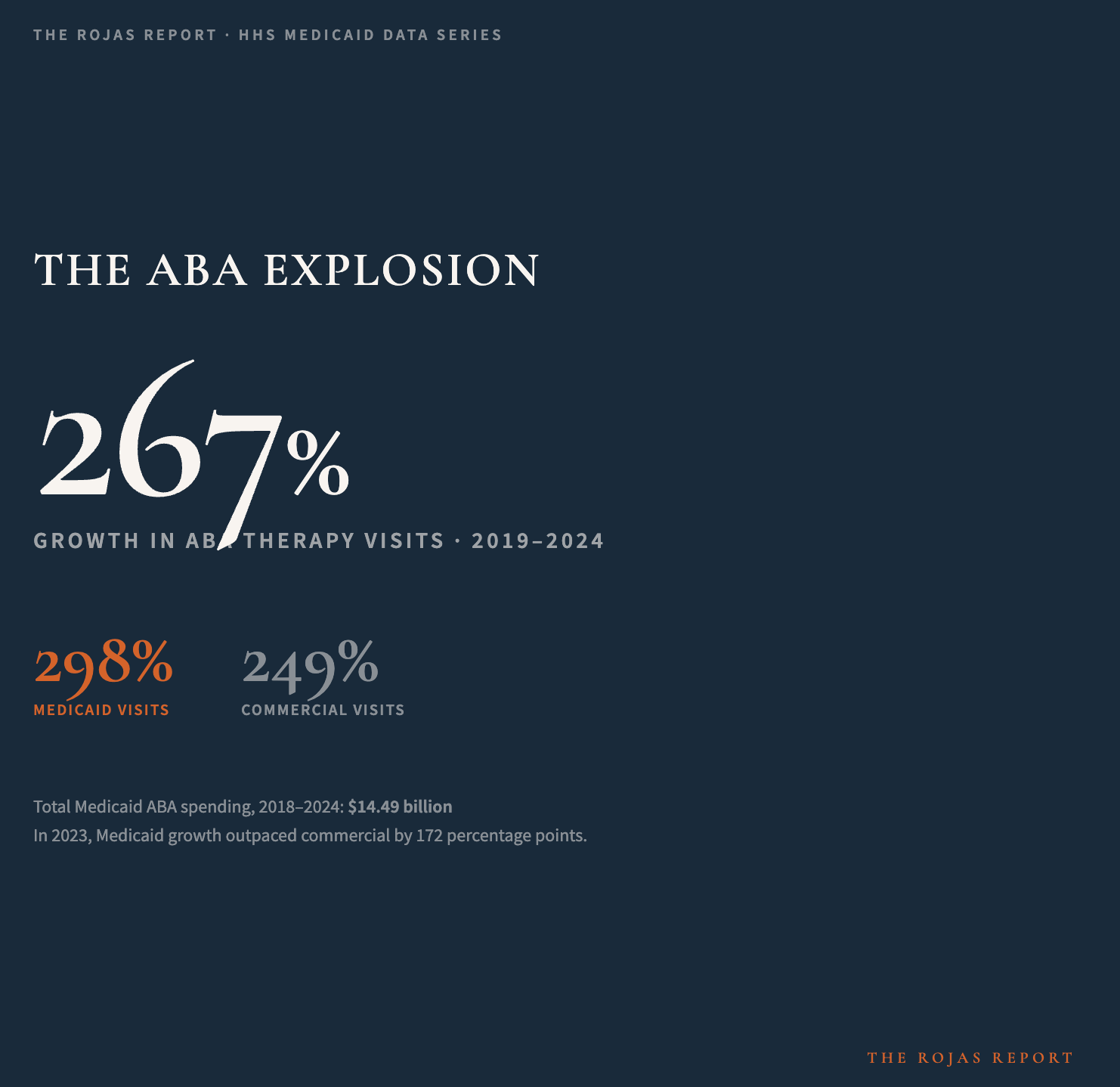
The nationwide volume of ABA therapy visits has grown 267% since 2019, according to Trilliant Health. Total Medicaid spending on ABA codes grew 279% from 2018 to 2024, reaching $14.49 billion across all states. Medicaid-covered ABA visits increased 298%. In 2023, Medicaid growth outpaced commercial insurance growth by 172 percentage points.
This is not a story about children with autism getting help. Many do. ABA therapy, when delivered properly by qualified clinicians, changes lives. Parents report that non-verbal children learn to speak, hug, and say “I love you” within weeks of starting treatment.
This is a story about what happens when unlimited government money meets a fragmented industry with minimal oversight, no accreditation requirements for therapy companies, and a billing structure that rewards hours over outcomes.
The same thing that always happens.
THE STATE-BY-STATE DETONATION
The national number is 267% growth in visits.
The state-level numbers are the ones that stop you cold.
Nebraska.
In 2020, Medicaid paid $4.6 million for ABA therapy.
In 2024, it paid $85.6 million.
That is a nearly 1,760% increase.
The number of individual ABA clinicians billing Nebraska Medicaid grew from 389 to over 2,700. Nebraska had among the highest reimbursement rates in the country, and out-of-state companies set up operations specifically to capture the money.
Indiana.
Medicaid coverage for ABA started in 2016.
The state spent $21 million in 2017.
By 2023, spending hit $611 million.
A 2,800% increase.
The HHS Office of Inspector General audited Indiana’s 2019 and 2020 ABA payments and found at least $56 million in improper payments and an additional $53.2 million in potentially improper payments. All 100 sampled claim-months contained at least one improper or potentially improper payment. Cheaper group therapy was billed as more expensive than individual therapy. Non-therapeutic time, like meals and bathroom breaks, was billed as treatment.
North Carolina.
The cost of covering autism services is estimated at $639 million in fiscal 2026. That is a 425% increase from 2022. Five autism therapy companies accounted for roughly 41% of the state’s increase in spending in a single fiscal year.
Wisconsin.
The OIG found at least $18.5 million in improper fee-for-service Medicaid payments for ABA services. The state had never conducted a single post-payment review of ABA claims since the program began in 2016.
These are not rounding errors.
These are structural failures in payment systems that disburse billions annually with virtually no verification that services were delivered, that clinicians were qualified, or that children actually had the diagnoses their treatment plans claimed.
Centria Healthcare billed Medicaid $450 million for autism services. Blackstone bought the largest ABA company in the country and drove it into bankruptcy in four years. You did not read about either in the news. You read about them here. That is the point. Subscribe
