
The Billion-Dollar Club
How 98 Home Health Agencies Captured Half of Medicaid's $122.7 Billion Personal Care Budget

The HHS Medicaid Provider Spending dataset is now publicly available for the first time, and what it reveals about code T1019 is an indictment of anyone who claims Medicaid has adequate oversight.
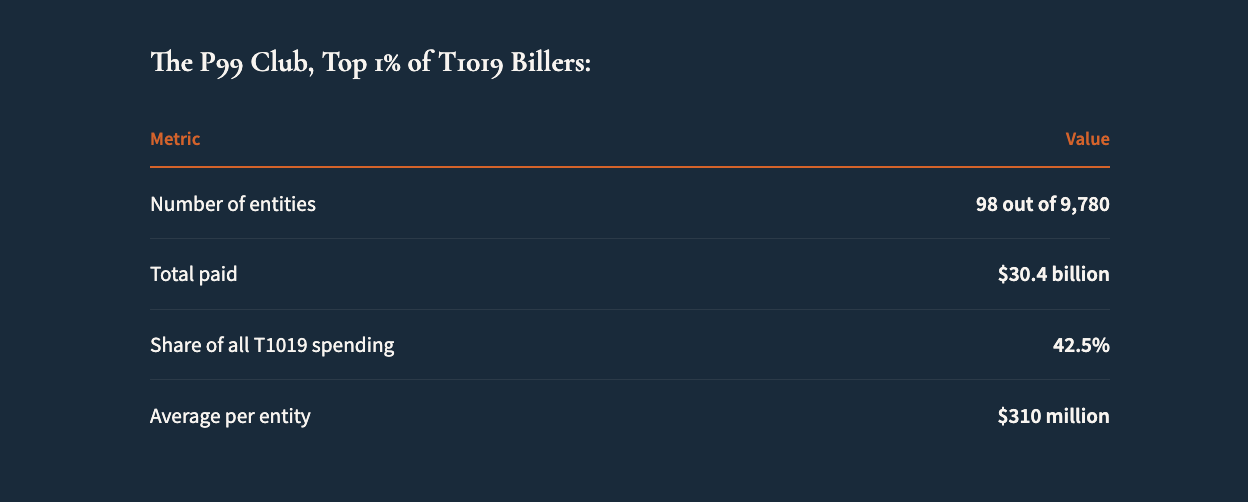
9,780 organizations bill Medicaid for personal care services.
98 of them collected 42.5% of all the money.
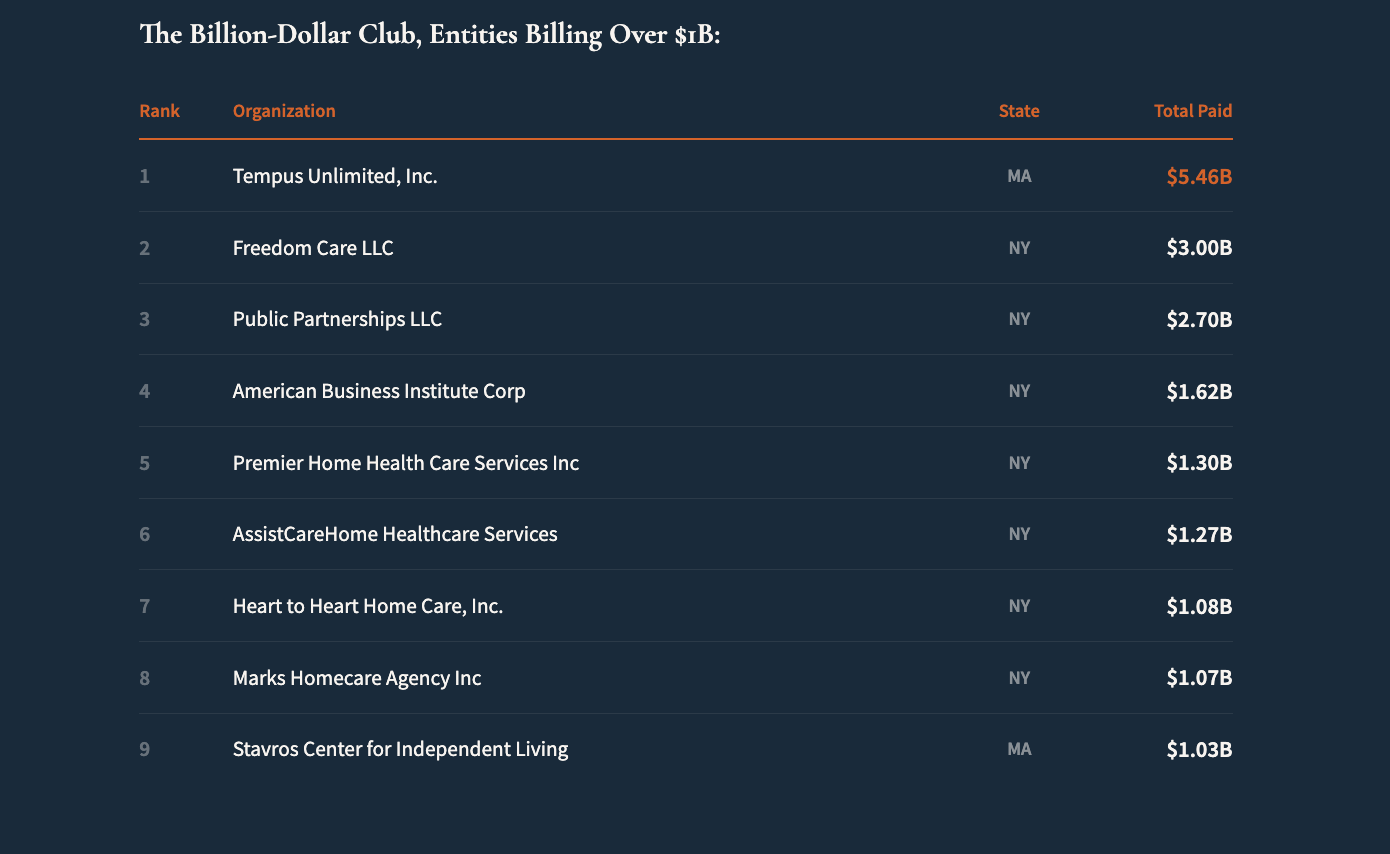
Nine crossed the billion-dollar mark.
Seven are in Brooklyn.
IN TODAY’S ARTICLE:
The newly public HHS Medicaid Provider Spending dataset exposes industrial-scale concentration in personal care payments
Entity proliferation: same names, same addresses, same authorized officials, different NPIs, billions in claims
A 3x cost-per-claim spread across the top 20 billers for an identical service code with no clinical justification
One individual on the OIG exclusion list since 1986 may be the authorized official for $151 million in active Medicaid billing
Glossary at the bottom of today’s article.
There are 9,780 organizations in the United States that bill Medicaid under code T1019, Personal Care Services.
The top 1% of them, just 98 entities, collected $30.4 billion.
That’s 42.5% of all T1019 spending nationally.
Nine of those entities crossed the billion-dollar threshold individually.
The top 20 alone absorbed $28 billion.
And the geographic concentration will stop you cold: 17 of the top 20 are in New York State. Seven of them are in Brooklyn.
This is not a story about healthcare.
This is a story about industrial-scale wealth extraction from a system designed to serve the most vulnerable Americans.
The elderly.
The disabled.
The homebound.
And the almost complete absence of anyone watching the money.
What Is T1019?
Before we follow the money, you need to understand what we’re looking at.
T1019 is a Healthcare Common Procedure Coding System (HCPCS) code for “Personal Care Services, per 15 minutes.” It covers non-medical assistance: bathing, dressing, meal preparation, and light housekeeping. The services are provided to Medicaid beneficiaries in their homes. The services are typically delivered by home health aides rather than by physicians or nurses.
The total national spend on this single code from January 2018
through December 2024: $122.7 billion.
That number comes from the HHS Medicaid Provider Spending dataset, which was recently made publicly available for the first time. What follows is an analysis of who received the money, how concentrated the payments are, and the red flags that emerge when you start cross-referencing the data.
The Concentration Problem
Healthcare is supposed to be distributed. Personal care services are inherently local. Someone comes to your home and helps you get dressed. There is no economy of scale in helping a 78-year-old woman in Flatbush take a bath.
And yet, the payment structure tells a very different story.
Read that list again.
Eight of the nine billion-dollar T1019 billers are in New York or Massachusetts.
Seven are in New York alone.
The only entity outside the Northeast to crack the top 20 is GuardianTrac LLC in Sturgis, Michigan. Population 10,000. It billed $826 million.
The New York Home Health Industrial Complex
Of the 98 entities in the P99, roughly three-quarters are based in New York. Their combined T1019 billing approaches $24.5 billion.
In New York, clustering becomes even more extreme.
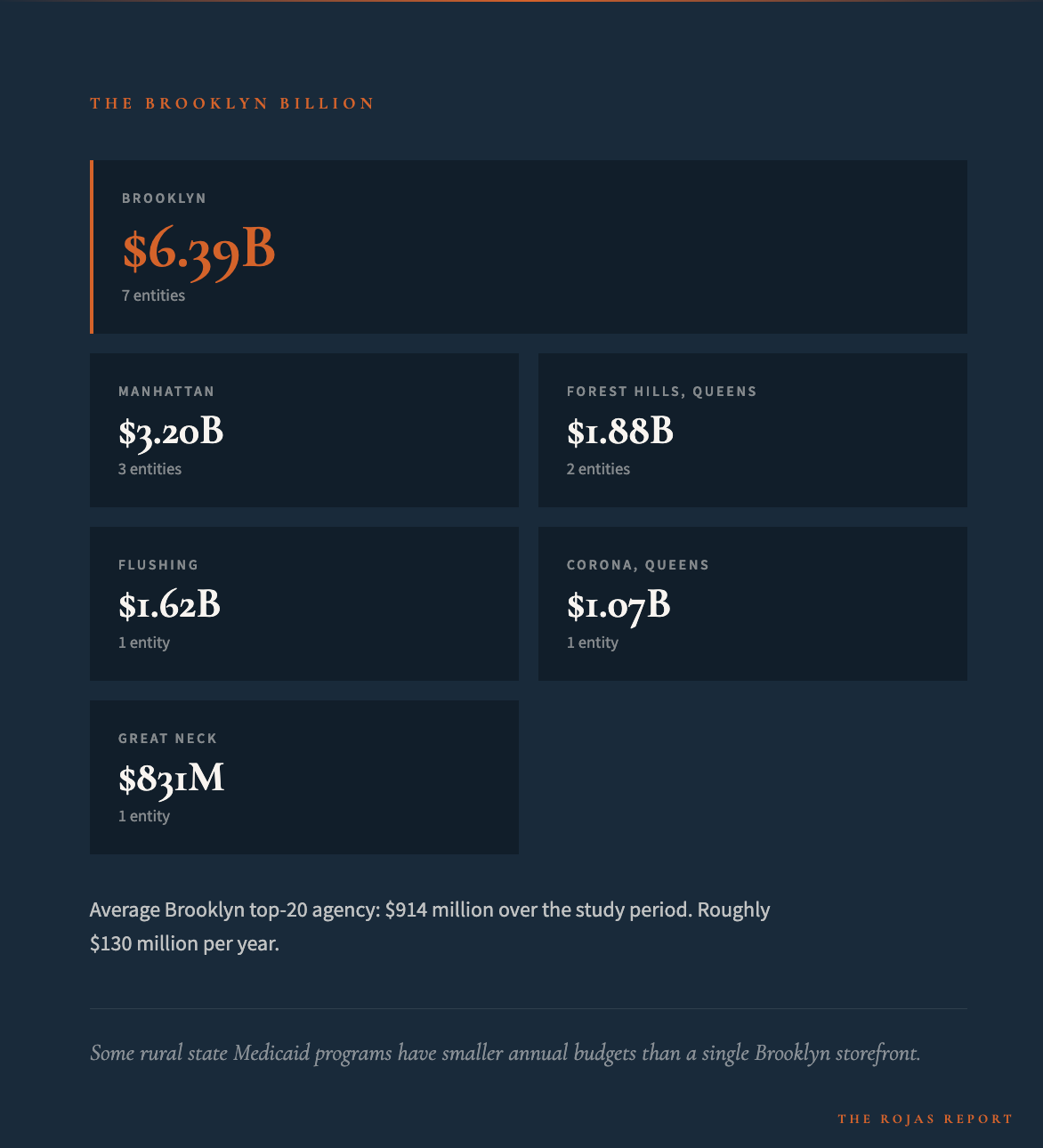
Seven of the top 20 T1019 billers nationwide are in Brooklyn.
Combined, they billed $6.4 billion for personal care services in a single borough.
Seven home health agencies in Brooklyn billed $6.4 billion.
You're not supposed to know that. Now you do.
Only 3, 172 words of this article to go…
Subscribe
Keep reading with a 7-day free trial
Subscribe to The Rojas Report to keep reading this post and get 7 days of free access to the full post archives.