
The Charity That Pays Like Wall Street

There’s a retirement plan you’ve never heard of.
It’s not a 401(k).
It’s not a pension.
It’s not available to you.
It’s called a SERP.
And it’s how nonprofit hospitals pay their executives more than Wall Street pays its bankers.
IN TODAY’S ARTICLE:
How Supplemental Executive Retirement Plans let nonprofits pay executives $30 million while maintaining tax-exempt status
The three consulting firms that benchmark these packages against each other, creating an upward spiral
Why nonprofit hospital CEOs now out-earn their for-profit competitors
The exposed contradiction: $92.7 million in executive compensation at Kaiser, while charity care spending sits at 2.3%
Glossary at the bottom of today’s article.
THE PAYOUT
Howard Kern retired from Sentara Healthcare in 2021.
His final compensation package: $33.2 million.
Sentara is a nonprofit hospital system. Tax-exempt under section 501(c)(3) of the Internal Revenue Code. No federal income tax. No state income tax. No property tax. Donors can deduct their contributions.
$33.2 million.
For running a charity.
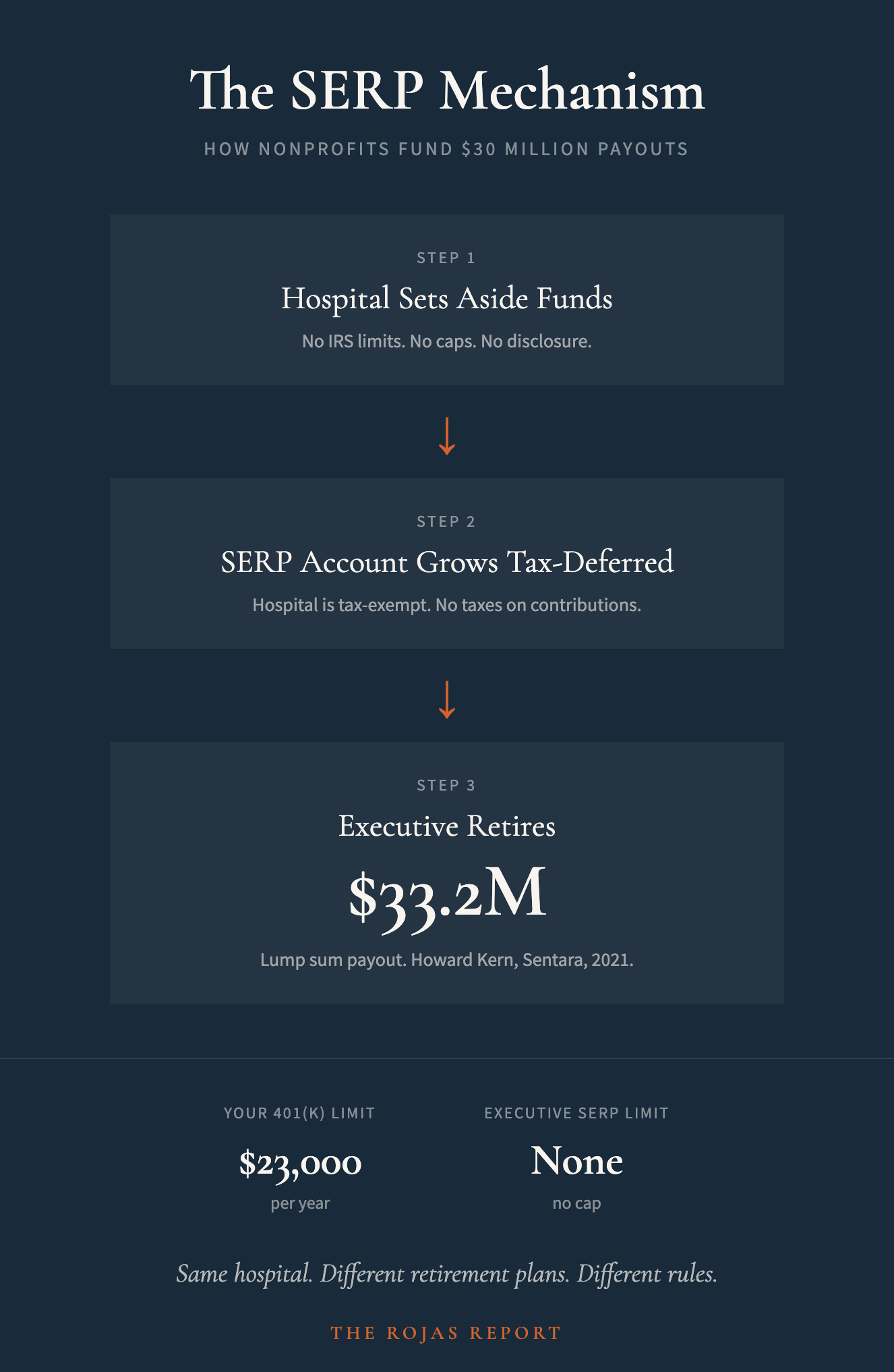
The bulk of that payout came from something called a Supplemental Executive Retirement Plan. A SERP.
THE MECHANISM
A SERP is a non-qualified deferred compensation agreement. Translation: a retirement plan that doesn’t follow the rules.
Regular employees receive 401(k) plans. The IRS caps contributions at $23,000 per year. Executives get SERPs. No caps. No limits. No disclosure until the payout is reported on Form 990.
Here’s how it works.
The health system allocates funds to the executive. Either from general assets or by purchasing a cash-value life insurance policy on the executive’s life. The money grows tax-deferred. Upon retirement, the executive receives the balance. Lump sum or annuity.
Three structures exist:
Defined Benefit: The hospital promises a specific dollar amount at retirement. Hit your tenure, collect your millions.
Defined Contribution: The payout depends on investment performance. The hospital contributes, the market grows, the executive collects.
Hybrid: An account-based plan with guaranteed interest credits. The best of both worlds. For the executive.
The key features:
Not subject to IRS contribution limits. Not available to regular employees. Tax-deferred until distribution. Because the hospital is tax-exempt, the organization pays no tax on the funds it sets aside.
The nonprofit wrapper doesn’t reduce executive pay. It eliminates the tax friction on executive pay.
THE SCALE
Howard Kern isn’t an outlier.
He’s the pattern.
John Murphy, CEO of Nuvance Health, received $30.1 million in 2021. Most of it from his SERP.
Kevin Lofton and Lloyd Dean at CommonSpirit Health split $32 million between them in 2021.
Gene Woods at Advocate Health received $25.8 million in 2024.
A 49% increase from 2023.
At a nonprofit.
The 2024 Form 990 filings reveal the scope:
Kaiser Foundation Health Plan reported $92.7 million in total executive compensation. Gregory Adams, the CEO, received $12.9 million in personal compensation.
Mayo Clinic, with $19.8 billion in consolidated revenue in 2024, paid its CEO, Gianrico Farrugia, $4.89 million. Thirty executives received more than $1 million each. The enterprise’s Group Return 990 reported over $100 million in total executive compensation.
These are charitable organizations.
Tax-exempt entities.
Community servants.
$92.7 million in executive compensation.
2.3% average charity care spending industry-wide.
The math tells the story.
They’re not running charities. They’re running compensation schemes linked to emergency rooms. 60,000+ physicians and healthcare operators are learning how the game works. SUBSCRIBE
