
THE CONCEPT THAT EXPLAINS EVERY REGULATION YOU HATE
Before you can understand why independent medicine is dying, you need to understand how governments see. The answer is a word you’ve never heard.

There’s a word that explains every regulation, every compliance burden, every payment model of the last 30 years.
You’ve probably never heard it.
IN TODAY’S ARTICLE:
The word political scientists use that bureaucrats never say out loud
Why states destroy what they’re trying to manage
The pattern that repeats from forests to surnames to labor
Tomorrow: how this explains the war on independent medicine
Glossary at the bottom of today’s article.
AUDIO VERSION
🎧 Audio version available below.
ARTICLE BODY
THE FOREST THAT DIED OF LEGIBILITY
In 18th century Prussia, the state had a problem.
It needed timber revenue. Forests were valuable. But old-growth forests were chaos. Mixed species. Varied ages. Irregular spacing. Trees tangled together with no logic an accountant could follow.
The state couldn’t measure what it couldn’t see.
And it couldn’t see the forest.
So it fixed the forest.
Foresters cleared the old growth. They replanted in rows.
Single species. Uniform age. Straight lines.
They created what Germans called Normalbaum: the normal tree.
Standardized. Countable. Legible.
For one generation, it worked. Yields were predictable. Timber revenue flowed.
The state could finally see its forests.
Then the forests died.
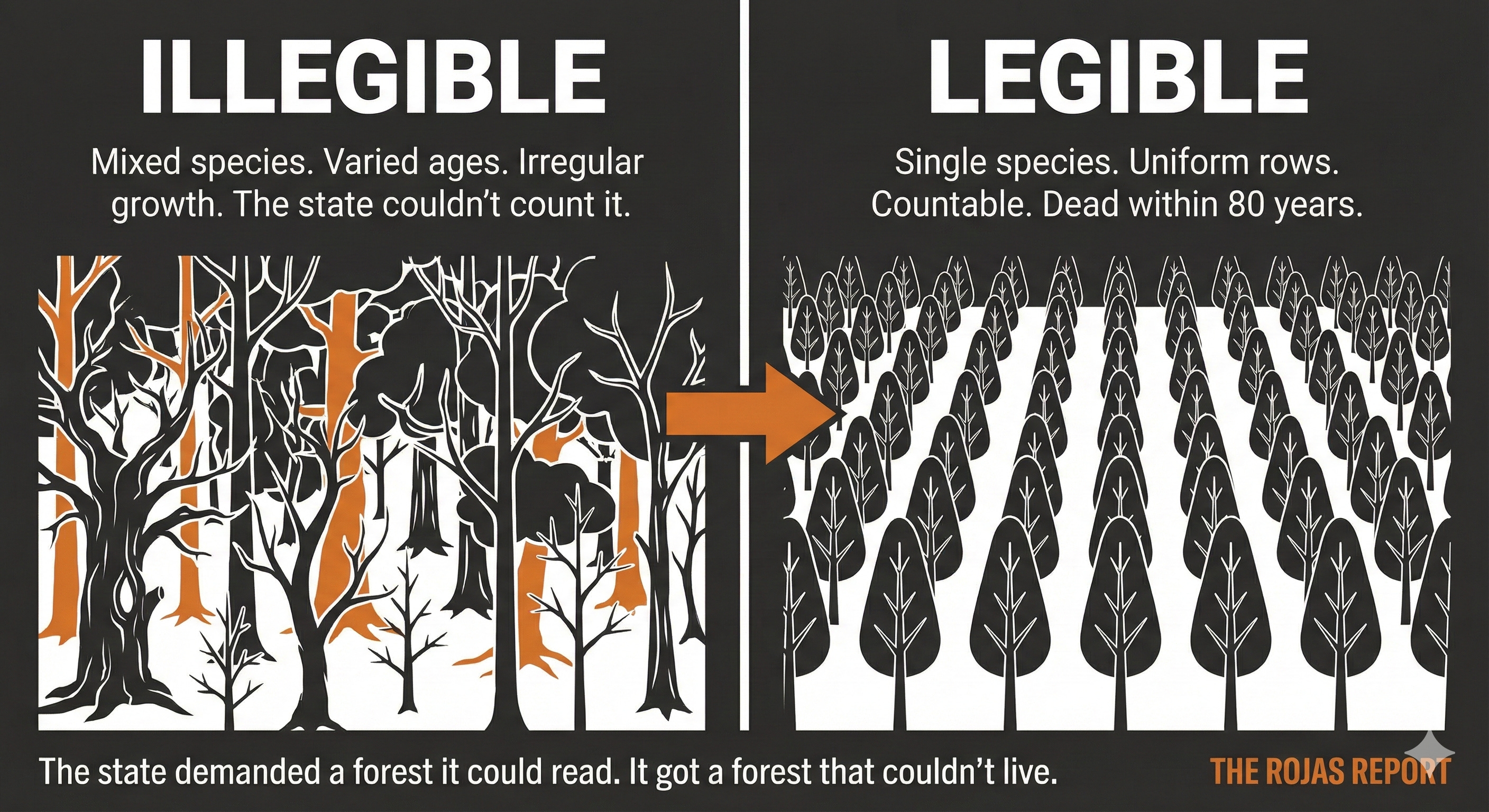
Monocultures have no resilience.
Without species diversity, pests spread unchecked.
Without varied ages, root systems weakened.
Without the chaos of old growth, the soil lost nutrients the bureaucrats never knew existed.
The state optimized for visibility. Nature had optimized for survival.
These were not the same thing.
Within 80 years, the “scientific” forests of Prussia collapsed.
The Germans coined a word for it: Waldsterben. Forest death.
The state had demanded a forest it could read.
It got a forest that couldn’t live.
THE WORD FOR THIS IS LEGIBILITY
In 1998, a political scientist named James C. Scott published a book called Seeing Like a State. It is arguably the most important book for understanding how modern power actually functions.
Scott’s core insight: states do not perceive society the way citizens do.
They see abstractions designed for administration.
He calls this “legibility.”
To govern, a state must render society readable.
What cannot be enumerated cannot be administered.
What cannot be categorized cannot be controlled.
What cannot be standardized cannot be scaled.
The Prussian forest was illegible. So the state made it legible. The resistance wasn’t ideological. It was structural. A central authority cannot act on what it cannot see.
Scott writes:
“If we imagine a state that has no reliable means of enumerating and locating its population, gauging its wealth, and mapping its land, resources, and settlements, we are imagining a state whose interventions in that society are necessarily crude.”
Legibility is not about good intentions or bad intentions. It is about the basic mechanics of administration. A bureaucracy that cannot measure cannot manage. So it demands measurement. Whether or not the measurement captures what matters.
Everyone in healthcare has an opinion. Very few have receipts. This is where the receipts live. Subscribe here.
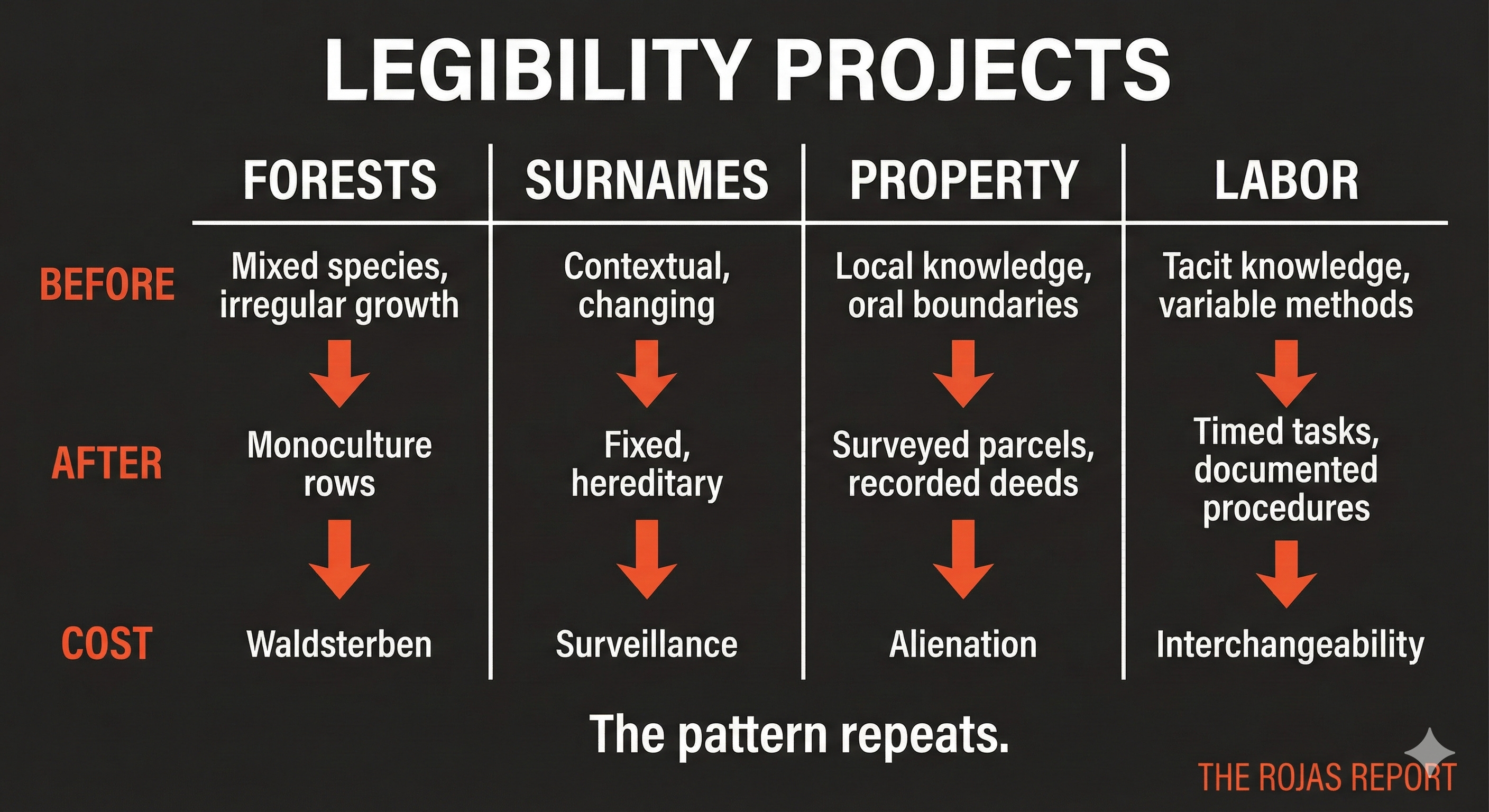
THE PATTERN REPEATS
The Prussian forest was not unique.
The same logic appears everywhere states try to see.
Surnames.
Before the modern state, most people didn’t have fixed last names. You were “John the miller’s son” or “Mary from the hill.” Names changed. Moved. Adapted to context. They meant something to the people who used them.
States couldn’t tax, conscript, or track inheritance without fixed identities. So they mandated surnames. Some countries assigned them arbitrarily. Your grandfather’s profession. Your village. A physical trait. A bureaucrat’s whim.
The population became enumerable.
It also became trackable in ways it never consented to.
Property.
Before standardized surveys, land ownership was local knowledge. Boundaries were trees, streams, oral agreements. Outsiders couldn’t parse who owned what. Locals didn’t need to.
States needed to tax land. So they surveyed it. Drew lines. Created parcels. Assigned values.
Property became visible to central authorities. It also became alienable in ways that destroyed communal arrangements. Land that was “ours” became land that was “mine.” Land that could be sold, seized, or leveraged by people who had never walked it.
Cities.
Medieval cities were illegible. Narrow streets. No grid. Navigation by landmark and memory. Armies couldn’t march through them. Tax collectors couldn’t find anyone.
Baron Haussmann demolished medieval Paris. Built boulevards. Created sight lines. Made the city visible from above.
Paris became administrable. It also became controllable. The same boulevards that let commerce flow let troops suppress uprisings. Legibility serves whoever holds the vantage point.
Labor.
Craft production was illegible. One artisan, variable methods, tacit knowledge, unpredictable output. A master blacksmith was a black box. You knew what went in (iron, coal, time) and what came out (tools). You didn’t know what happened inside. Neither did he, in terms a manager could use.
Frederick Taylor made work legible. Break tasks into measurable units. Time each motion. Standardize the process. Replace tacit knowledge with documented procedure.
Productivity became measurable. The worker became interchangeable. The artisan became an employee.
CTA 2: You can learn how the system works.
Or you can keep being surprised when it works against you.
Subscribe.
THE TRADEOFF
Every legibility project follows the same arc.
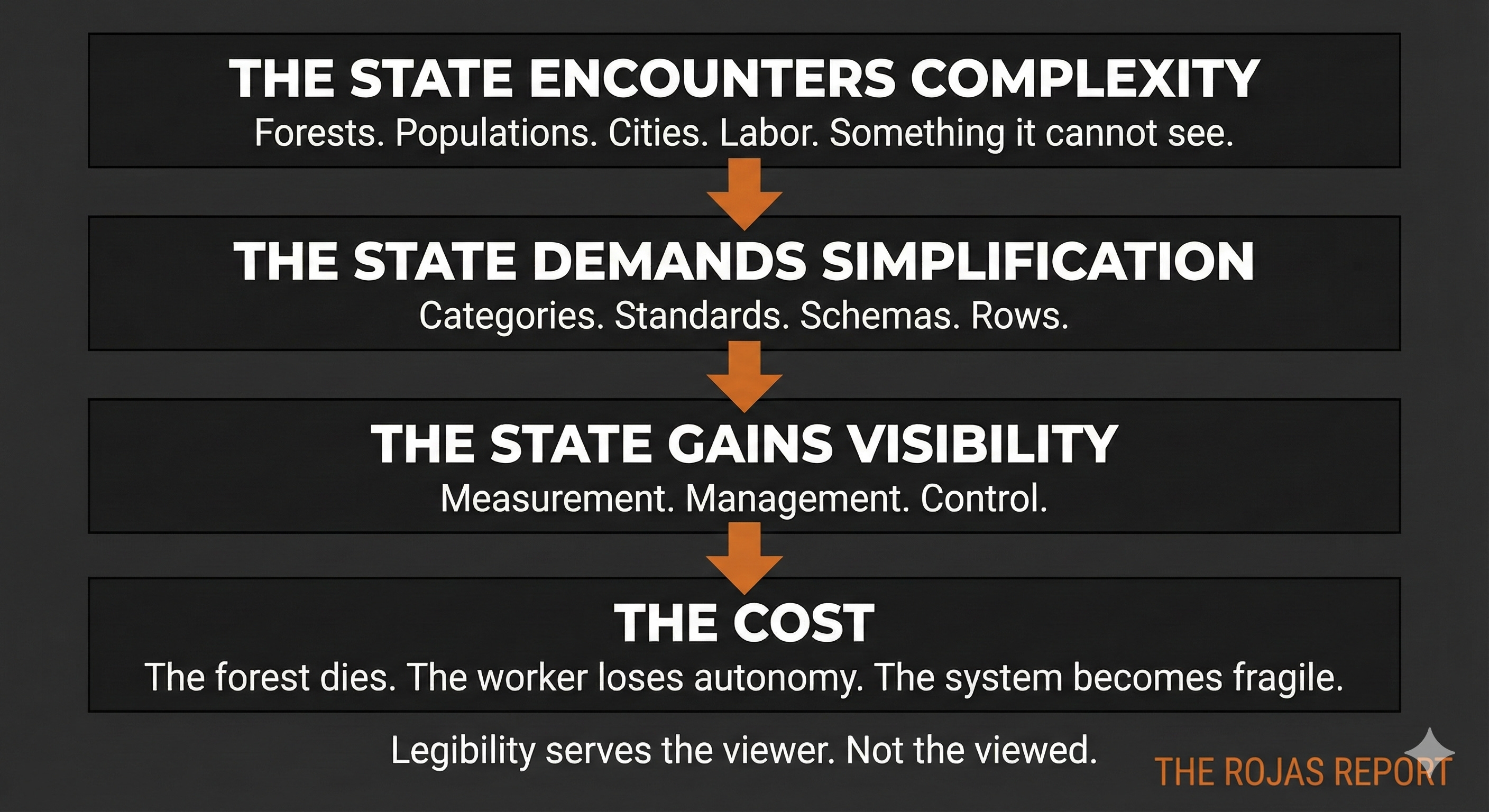
The state encounters something it cannot see. A forest. A population. A city. A craft. The thing is complex, adapted, functional on its own terms. But those terms are local, idiosyncratic, illegible to central authority.
The state simplifies. It creates categories, schemas, standards. It demands that reality conform to its models.
The simplification works. For a while. The state can now see. It can measure, manage, intervene.
Then the costs arrive.
The simplified version lacks the resilience of the original. The standardized forest dies. The fixed surnames enable surveillance. The gridded city enables control. The measured worker loses autonomy.
The state optimizes for administration. The thing being administered optimizes for survival. These are not the same optimization targets.
Scott again:
“Legibility implies a viewer whose place is central and whose vision is synoptic. State simplifications are designed to provide authorities with a schematic view of their society, a view not afforded to those without authority.”
Legibility is not neutral. It serves the one who demands it.
THE QUESTION THIS RAISES
Once you see the pattern, you cannot unsee it.
Every regulation that demands standardization. Every compliance burden that requires reporting in approved formats. Every payment model that rewards measurable metrics over unmeasurable outcomes.
These are not random. They are not even about the stated goals. They are legibility projects.
The state encounters something it cannot see. It demands simplification. The simplification serves administration. Whether it serves the thing being administered is secondary.
This is not conspiracy. It is structure. Bureaucracies do not need to coordinate to produce this outcome. They produce it by existing.
The question is: what happens when the thing being administered is you?
Tomorrow: Legibility and the war on independent medicine.
-Rojas out.
GLOSSARY
Legibility: The process by which states simplify complex social arrangements into standardized categories that can be measured, monitored, and administered from a central vantage point.
High modernism: The belief that scientific knowledge and rational planning can design and operate society according to universal laws. Often leads to schemes that ignore local knowledge and conditions.
Metis: (Greek) Practical knowledge gained through experience and shaped by local context. Cannot be easily codified or transferred. The opposite of standardized, formal knowledge.
Waldsterben: (German) “Forest death.” The collapse of monoculture forests planted under scientific forestry regimes in 18th-19th century Germany.
Normalbaum: (German) “Normal tree.” The standardized, uniform tree species planted in rows under Prussian scientific forestry.
Cadastral survey: A systematic survey of land for the purpose of recording ownership, boundaries, and value for taxation.
SOURCES
Scott, James C. Seeing Like a State: How Certain Schemes to Improve the Human Condition Have Failed. Yale University Press, 1998.
Data Republicans article on legibility

This article was fascinating. If they can measure it, they can regulate it. This pattern now becomes obvious everywhere, including schools (endless reports to the state), medicine (“quality standards”), and likely countless other industries.
Not sure how we strike a balance. For example, state must manage its budget (and measure it) in order to stay accountable to taxpayers (which it rarely does, of course).
Looking forward to more insights from you!