
The End of the Scale Advantage: How AI Agents Will Let Independent Physicians Outmaneuver Health Systems
The consolidation thesis is collapsing. Here's why, and what you should do about it.


For two decades, health systems have sold the same story.
You can’t survive alone. You need our infrastructure. Our IT systems. Our billing departments. Our compliance teams. Our administrative backbone.
It was a compelling argument. A 3-physician practice simply couldn’t match the operational sophistication of a 500-physician employed group. The math didn’t work.
Until now.
Artificial intelligence, specifically, what the industry calls “AI agents”, is about to demolish the scale advantage that justified hospital consolidation and physician employment.
And independent practices that move first will find themselves with capabilities that would have cost millions just three years ago.
Let me explain what’s coming, and what you ought to be doing about it.
What AI Agents Actually Are (And Why They’re Different)
You’ve probably used ChatGPT or one of its competitors. You type something in, you get an answer back. Useful, but limited. You’re still the one doing the work, you’re just getting faster answers to your questions.
AI agents are something else entirely.
An agent doesn’t wait for your prompt. It has a defined role, a set of objectives, and the ability to take action autonomously. It monitors, decides, and executes. Multiple agents can work together, critique each other’s work, and accomplish complex multi-step workflows without human intervention.
Think of the difference this way: ChatGPT is a very smart intern who answers when you ask. An AI agent is an employee who shows up, knows their job, and does it, 24 hours a day, 7 days a week, without benefits, PTO, or HR complaints.
Now imagine deploying dozens of these agents across your practice.

Why This Matters for Independent Practices
Health systems have two structural advantages: capital and bureaucracy.
Capital let them buy expensive infrastructure. Bureaucracy let them process the endless administrative complexity of modern healthcare—prior authorizations, claim submissions, denials management, quality reporting, compliance documentation.
AI agents neutralize both.
Capital becomes less relevant because agent deployment costs a fraction of traditional infrastructure. A comprehensive agent system for a small practice might cost what a health system spends on one FTE administrator.
Bureaucracy becomes a liability because agents favor the nimble. While Ascension runs an 18-month pilot through their IT committee, procurement department, and compliance review, an independent orthopedist can be live next week.
The independent practice that deploys first gains capabilities the health system won’t match for years.
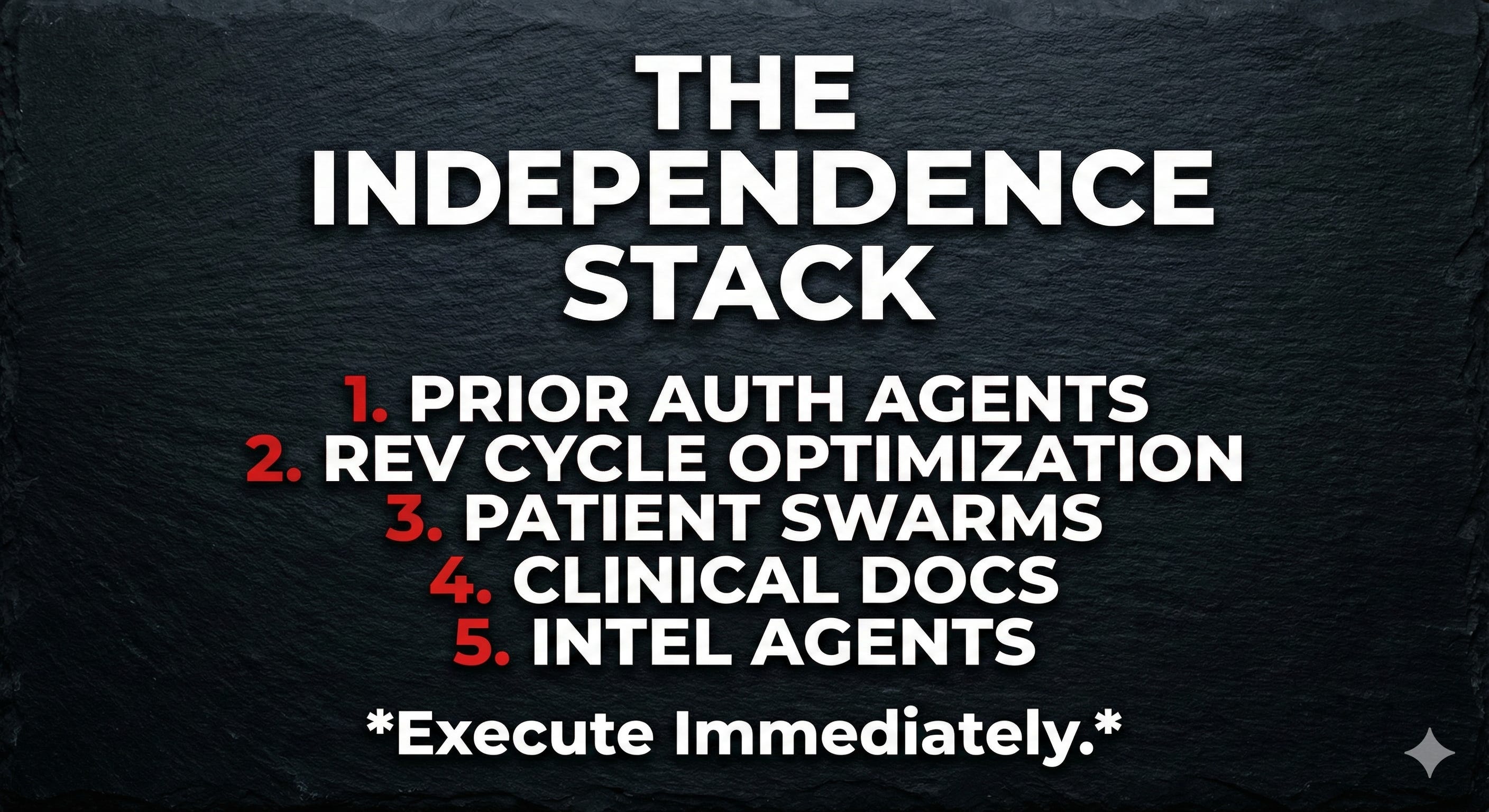
Five Agent Deployments That Change the Competitive Landscape
Here’s where this gets practical. These aren’t theoretical, they’re either available now or will be within 12-18 months.
1. Prior Authorization Agents
You know the drill. Your staff spends hours on hold. Forms get lost. Denials come back for nonsensical reasons. You appeal. You wait. The patient suffers.
A prior authorization agent works differently:
It monitors every order that requires authorization
Submits documentation preemptively, formatted exactly how each payer wants it
Tracks status automatically
Flags delays before they become problems
Drafts appeals within hours of denial, citing the specific clinical criteria and payer’s own policies
The agent doesn’t get frustrated. It doesn’t take lunch. It doesn’t forget to follow up.
A health system with 50 staff members processing prior auths isn’t more efficient than an independent practice with properly deployed agents. It’s less efficient—those 50 people have meetings, turnover, training needs, and varying competency levels.
2. Revenue Cycle Optimization Agents
Every claim your practice submits is a bet. You’re betting you coded correctly, documented sufficiently, and that the payer will process it fairly.
Most practices lose that bet more often than they should.
A revenue cycle agent:
Reviews every claim before submission and predicts denial likelihood
Identifies documentation gaps while the patient is still in the office
Tracks reimbursement patterns by payer, procedure, and diagnosis combination
Automatically initiates appeals with supporting documentation
Learns from every denial to prevent future ones
The health system advantage in revenue cycle has always been data, they see enough volume to identify patterns. Agents democratize that intelligence. Your 3-physician practice can learn from denial patterns across thousands of similar practices, not just your own.
3. Patient Communication Swarms
The phrase sounds aggressive, but it describes something your patients desperately want: proactive, personalized communication that closes loops.
Most practices react. The patient calls, you respond. The patient no-shows, you reschedule. The patient forgets their medication, they end up back in your office with an exacerbated condition.
A patient communication swarm:
Sends pre-visit instructions tailored to the specific appointment type
Confirms appointments through the patient’s preferred channel
Follows up post-visit with care plan reminders
Checks in on medication adherence
Identifies patients who haven’t scheduled needed follow-ups
Escalates concerning responses to clinical staff
This isn’t a chatbot waiting for patients to ask questions. It’s an always-on system that reaches out, follows up, and maintains relationships at a scale no human staff could match.
Health systems have call centers. You’ll have something better.
4. Clinical Documentation Agents
Ambient AI scribes are already here, systems that listen to your patient encounters and generate notes. That’s table stakes.
The next generation does more:
Ensures documentation supports appropriate billing levels (not upcoding, capturing what you actually did)
Flags quality measure gaps in real-time (”You haven’t documented smoking status for this patient”)
Pre-populates referral letters with relevant clinical history
Identifies care gaps based on the patient’s problem list and recent visits
Suggests relevant clinical decision support without interrupting your workflow
The documentation burden is one of the primary drivers of physician burnout. It’s also one of the primary reasons physicians sold to health systems, ”they’ll handle the administrative stuff.”
If agents handle the administrative stuff better than health systems do, that argument collapses.
5. Competitive Intelligence Agents
Independent practices typically operate blind. You don’t know when the local health system loses three surgeons. You don’t know their pricing on shoppable services. You don’t know how patients are reviewing their experience compared to yours.
An intelligence agent continuously monitors:
Public job postings and LinkedIn activity for competitor staffing changes
Patient reviews across platforms, with sentiment analysis
Pricing transparency data (now required by federal law)
New service line announcements
Physician departures and arrivals
The practice that knows the health system just lost its top-rated cardiologist has a recruiting advantage. The practice that knows competitor pricing can position accordingly.
Information asymmetry has always favored the consolidated. Agents flip that.
The Strategic Implications
Let me be direct about what this means.
The consolidation thesis is collapsing.
The entire premise of physician employment was: We offer infrastructure you can’t replicate.
If a solo physician can deploy agent systems that match or exceed health system administrative capabilities, that premise is false. And physicians will start to realize they traded autonomy, income, and clinical independence for something they can now buy for a few hundred dollars a month.
This doesn’t mean independent practice becomes easy. You still need clinical excellence, operational discipline, and business acumen.
But it means the scale barrier that protected health systems is crumbling. The “too small to survive” narrative was always propaganda. It’s about to be provably false.
What You Ought Do Now
If you’re an independent physician, here’s your action plan:
This quarter:
Identify your three biggest administrative time-sinks
Research agent solutions in those specific areas (prior auth, scheduling, documentation, billing)
Run a small pilot—one workflow, one agent system, measured outcomes
This year:
Build relationships with vendors who understand independent practice needs
Document your current operational costs so you can measure ROI
Start thinking about which employed physicians in your market might be recruitable when they realize they don’t need the health system anymore
Ongoing:
Follow the technology closely, this space is moving fast
Connect with other independent physicians testing these tools
Maintain your clinical quality, because technology amplifies excellence but can’t replace it
The Opportunity
I’ve spent 20 years building businesses that help physicians remain independent. I’ve seen every cycle of consolidation pressure and every wave of technology that promised to change everything.
This wave is different.
AI agents don’t just make existing processes faster. They eliminate the structural advantages that justified consolidation in the first place. They turn the health system’s scale into a liability, slower to adopt, harder to customize, more bureaucratic to deploy.
The independents who move first will build capabilities their employed competitors won’t match for years. They’ll recruit the best physicians who are tired of being employees. They’ll capture market share while health systems are still running pilot programs through committee.
The scale advantage is ending.
What you do with that opportunity is up to you.
If you found this valuable, here’s how you can help:
Already a paid subscriber? Give a gift subscription to a physician colleague who needs to see this. Independence is a team sport.
Reading this for free? The Rojas Report is how independent physicians stay ahead of the curve. Become a paid subscriber to get the full analysis, tactical playbooks, and access to a community of physicians who refuse to be employees.
-Rojas out
Dutch Rojas is a healthcare entrepreneur and the publisher of The Rojas Report. He is the author of Too Big To Care: How Nonprofit Health Systems Hijacked Healthcare and advises physicians on practice independence strategies.
Ha just saw this! Ignore previous note asking, gee, where can I learn about this? LOL