
The Great American Healthcare Tax Dodge
How “Nonprofit” Health Systems Perfected Capitalism Without the Consequences

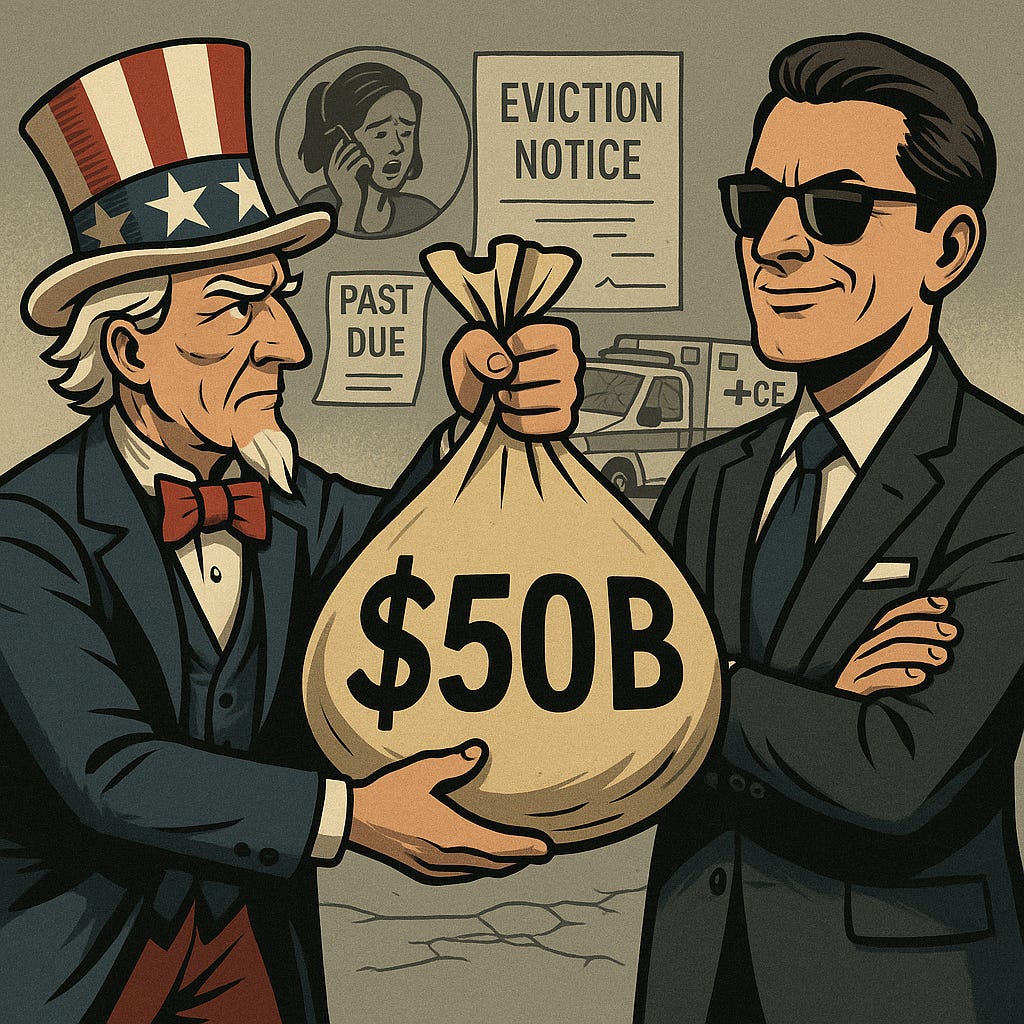
A peculiar species of economic organism has evolved in America’s healthcare landscape, one that enjoys all the privileges of charity while practicing the ruthless pricing of monopoly.
The arithmetic is breathtaking in its brazenness.
A CT scan that costs $150 to produce is billed at $2,500. A colonoscopy with actual costs of $1,200 carries a price tag of $12,000. The markup would make a Parisian art dealer blush, yet these aren’t the practices of some rapacious private equity firm. They’re the standard operating procedures of America’s “nonprofit” health systems—institutions that, by their tax-exempt status, haven’t paid a penny in federal income tax.
This represents perhaps the most audacious feat of regulatory capture in modern American commerce: an entire industry that has convinced regulators it deserves the tax benefits of a soup kitchen while operating with the pricing discipline of a luxury resort.
Consider the perverse incentives at work. Your local nonprofit hospital system, let’s call it St. Extractive Medical Center, enjoys a trifecta of taxpayer subsidies that would make any Fortune 500 CEO weep with envy.
First, complete exemption from federal corporate income taxes on what often amounts to billions in annual revenue.
Second is exemption from local property taxes that fund the schools, roads, and fire departments serving their facilities.
Third, access to tax-exempt municipal bond financing, allowing them to borrow money at rates typically reserved for sovereign governments.
The quid pro quo for these extraordinary privileges?
A vague obligation to provide “community benefit”, a standard so elastic it makes EU budget rules look rigid by comparison. Health systems routinely satisfy this requirement by counting their bad debt as charity care, training programs as community education, and executive salaries as administrative necessity. It’s accounting alchemy that would have impressed the scribes of Enron.
The behavioral economics here are predictable. When you remove the discipline of taxation while maintaining the incentives of profit maximization, you get organizations that behave like hedge funds while dressing like charities. They acquire competitors with the aggression of Amazon, negotiate with insurers like OPEC, and charge patients like they’re running a premium hospitality business.
The historical irony is delicious. America’s nonprofit hospital system emerged from genuine charitable institutions, typically founded by religious orders with authentic service missions to people with low incomes. These organizations operated on donations and charged what patients could afford because they were, quite literally, charities. The modern nonprofit health system bears about as much resemblance to a 19th-century charity hospital as McDonald’s does to a medieval monastery that happened to serve food.
Instead, we have a masterclass in institutional evolution, or perhaps devolution. Organizations that discovered they could maintain tax-exempt status while maximizing revenue extraction have predictably optimized for exactly that outcome. They’ve become profit-maximizing entities that happen to be structured as nonprofits, rather than charitable organizations that incidentally need to cover their costs.
The scale of the public subsidy is staggering. Congressional Budget Office estimates suggest that nonprofit hospitals receive approximately $35 billion annually in federal tax exemptions. Add state and local property tax exemptions, plus the implicit subsidy of below-market borrowing costs, and the total easily exceeds $50 billion per year. This is corporate welfare that dwarfs most targeted industry subsidies, yet it operates with virtually no oversight or accountability.
Meanwhile, the supposed beneficiaries of this largesse, American patients and taxpayers, face medical bills that routinely drive families into bankruptcy. Medical debt is now the leading cause of personal bankruptcy in America, a grotesque outcome in a system subsidized by the very taxpayers it’s impoverishing.
The regulatory capture is complete and sophisticated. Nonprofit health systems employ armies of lobbyists who ensure that “community benefit” standards remain conveniently vague. They fund academic research, emphasizing their charitable contributions while ignoring their pricing practices. They maintain boards populated by local business leaders who benefit from the same tax-avoidance strategies they’re theoretically overseeing.
Perhaps most cleverly, they’ve convinced policymakers that any meaningful reform would threaten healthcare access, a classic hostage-taking strategy that works because healthcare genuinely is a life-or-death issue. It’s regulatory Stockholm syndrome on a national scale.
The solution isn’t complex, merely politically difficult. Either these organizations should face taxation commensurate with their commercial behavior or provide community benefits commensurate with their tax savings. A simple rule would suffice: tax exemptions should be dollar-for-dollar matched by genuinely charitable care supplied at cost.
This would create proper incentives immediately. Organizations that want to maintain nonprofit status must demonstrate charitable behavior through below-cost care for genuinely indigent patients. Those who prefer commercial pricing could pay taxes like any other business. The choice would be theirs, but the current arrangement, privatized profits with socialized costs, would end.
The broader lesson extends beyond healthcare. When the government creates privileged categories without corresponding obligations, those categories inevitably attract actors who game the system rather than serve its intended purpose. America’s nonprofit health systems have become expert at this game, but the final score is tallied in medical bankruptcies and foregone care.
The next time you receive a medical bill that exceeds your mortgage payment, remember: the organization charging you likely paid less in taxes than your corner grocery store. That’s not healthcare policy—it’s elaborate corporate welfare disguised as charity.
In any rational system, institutions claiming charitable status must behave charitably. That we’ve created a parallel universe where the opposite occurs—claiming charity status enables maximum extraction from the community supposedly being served—represents a triumph of lobbying over logic, of political influence over public interest.
The great American healthcare tax dodge continues because we’ve allowed it to be redefined as healthcare policy rather than recognized for what it truly is: the most successful regulatory arbitrage in modern commercial history. Until we restore the connection between charitable benefits and charitable behavior, American patients will continue subsidizing their exploitation.
Health systems, meanwhile, will continue their capitalism cosplay, with all profit motives and no tax consequences, while policymakers congratulate themselves on supporting “nonprofit” healthcare. It’s a performance worthy of Broadway, if Broadway specialized in grand larceny.
