
The Health Plans Aren’t Losing in Court. They’re Losing on Purpose.
Every dismissal is a press release. Every press release is a lobbying document. The courtroom isn’t where this fight ends. It’s where it starts.

Health plans don’t sue to win.
They sue to lose.
A dismissal in court is a citation in Congress.
A judge writing “with prejudice” is a lobbying win.
This is what the No Surprises Act fight actually looks like.
IN TODAY’S ARTICLE:
Three federal courts. Three dismissals. The insurers keep filing the same losing lawsuit anyway.
The misread: why everyone treats these dismissals as plan defeats.
The actual play: lawsuits as advocacy infrastructure, not legal strategy.
The signal: what CMS rulemaking and the Hill have queued up next, written months in advance.
Glossary at the bottom of today’s article.
THE SCOREBOARD
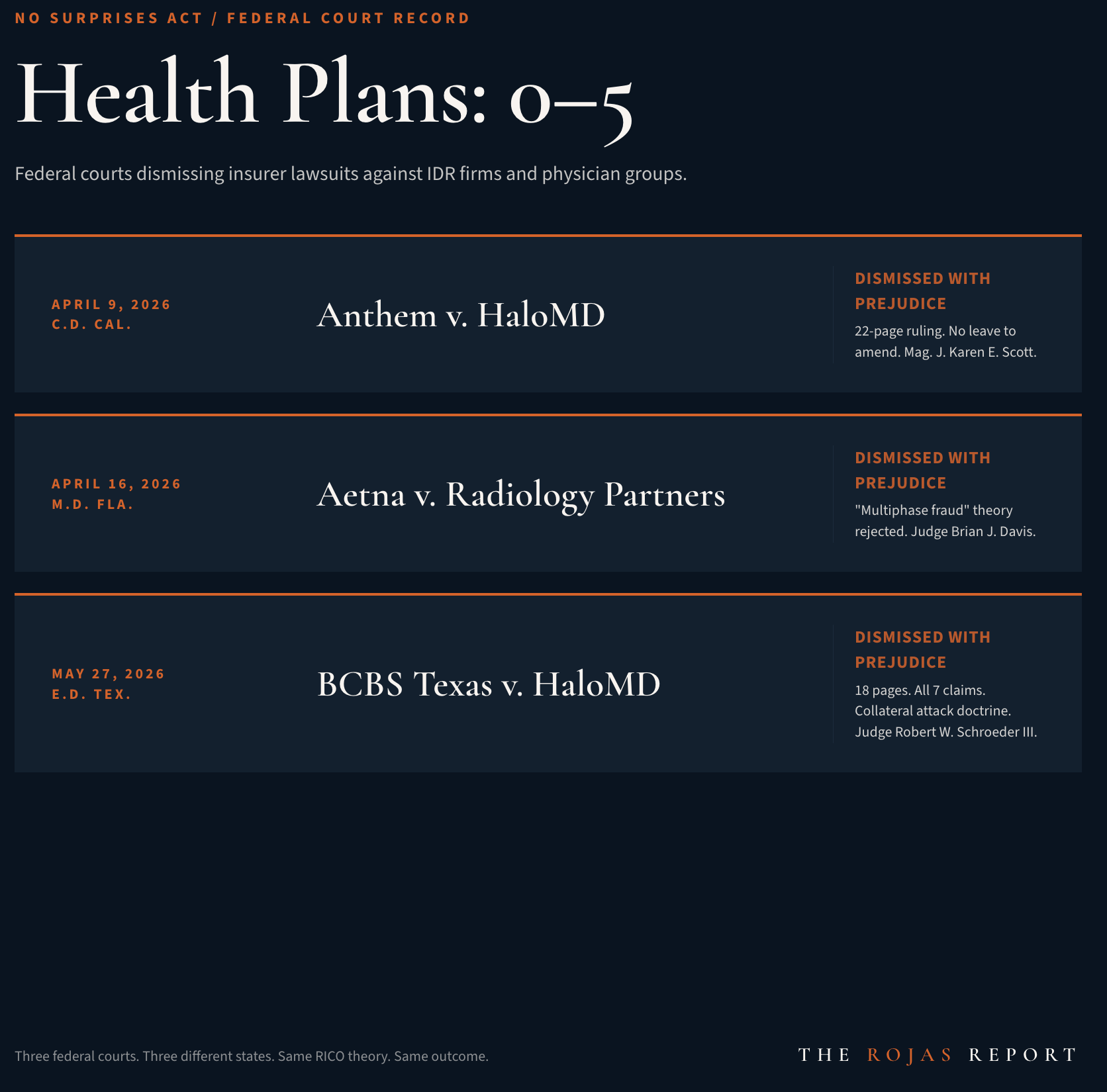
Three federal judges.
Three dismissals.
Three different states.
April 9, 2026. Magistrate Judge Karen E. Scott of the U.S. District Court for the Central District of California dismissed all claims in Anthem Blue Cross of California v. HaloMD with prejudice. Twenty-two pages. No leave to amend. The defendants walk: HaloMD, MPOWERHealth Practice Management, Bruin Neurophysiology, and Sound Physicians Emergency Medicine of Southern California. Anthem files notice of appeal to the Ninth Circuit four days later, docketed as No. 26-2355.
April 16, 2026. U.S. District Judge Brian J. Davis of the Middle District of Florida dismissed Aetna v. Radiology Partners with prejudice. Aetna had alleged a “multiphase healthcare fraud scheme” worth “tens of millions.” Judge Davis writes that Aetna’s allegations fail to establish a sufficient basis to excuse Aetna from raising its eligibility objections through the IDR process itself. The case had been pending since December 2024.
May 27, 2026. District Judge Robert W. Schroeder III of the U.S. District Court for the Eastern District of Texas dismisses BCBS Texas v. HaloMD with prejudice. Eighteen pages. All seven claims are gone. The court applies the “collateral attack doctrine,” writing that the doctrine “is even more clearly applicable where, as here, Plaintiff is attempting to relitigate issues previously decided by the IDR entities.” BCBS Texas is a division of Health Care Service Corporation, the Chicago-based parent. HCSC is also the defendant. Guardian Flight failed to sue all the way to the Supreme Court, which declined certiorari in January 2026.
That is the third consecutive merits dismissal in six weeks. HaloMD’s release the same day cites a fourth, an “additional dismissal in the Eastern District of Pennsylvania.” Industry counsel Ed Gaines, regulatory affairs counsel at Zotec Partners and one of the most cited voices on the No Surprises Act, calls the Texas ruling the fifth consecutive dismissal of an insurer lawsuit against an IDR firm or physician group.
The scoreboard, in Gaines’s words: physicians and IDR firms are undefeated. Health plans are zero and five.
The press takes the dismissals at face value. “Major win for HaloMD.” “Insurers handed another loss.” “Court tosses Aetna fraud suit.”
Read the lawsuits. Read the briefs. Read who showed up to file amicus in support of the losing parties. A different reading is available.
THE LAWSUIT THAT TOLD ON ITSELF
Look at the Anthem California complaint. It runs hundreds of paragraphs. It cites a survey. It quotes industry talking points. It reads less like a federal civil filing and more like a position paper with a case caption stapled to the front.
The judge noticed.
Judge Karen Scott was not persuaded. She found that Anthem did not present convincing evidence of fraud or of the defendants’ disregard for the law. She pointed to a structural issue with Anthem’s approach: insurers can contest a dispute’s eligibility during the IDR process. That is why the courts do not have to weigh in afterward. In other words, Anthem had every chance to object during the arbitration process Congress built. Anthem chose not to. Then Anthem sued.
Anthem’s other problem was the FAA. Federal courts can vacate an arbitration award only in four narrow circumstances. Fraud has to be procured. Undue means has to be shown. The arbitrator has to have exceeded their powers. Anthem could not show any of it. The IDR entities were using the exact fee structure and incentives that Congress wrote into the No Surprises Act. Fee incentives, Judge Scott wrote, are not bribery.
The Aetna ruling lands in the same place. Judge Davis says Aetna had to raise its eligibility objections during IDR. Aetna did not. The courthouse door closes.
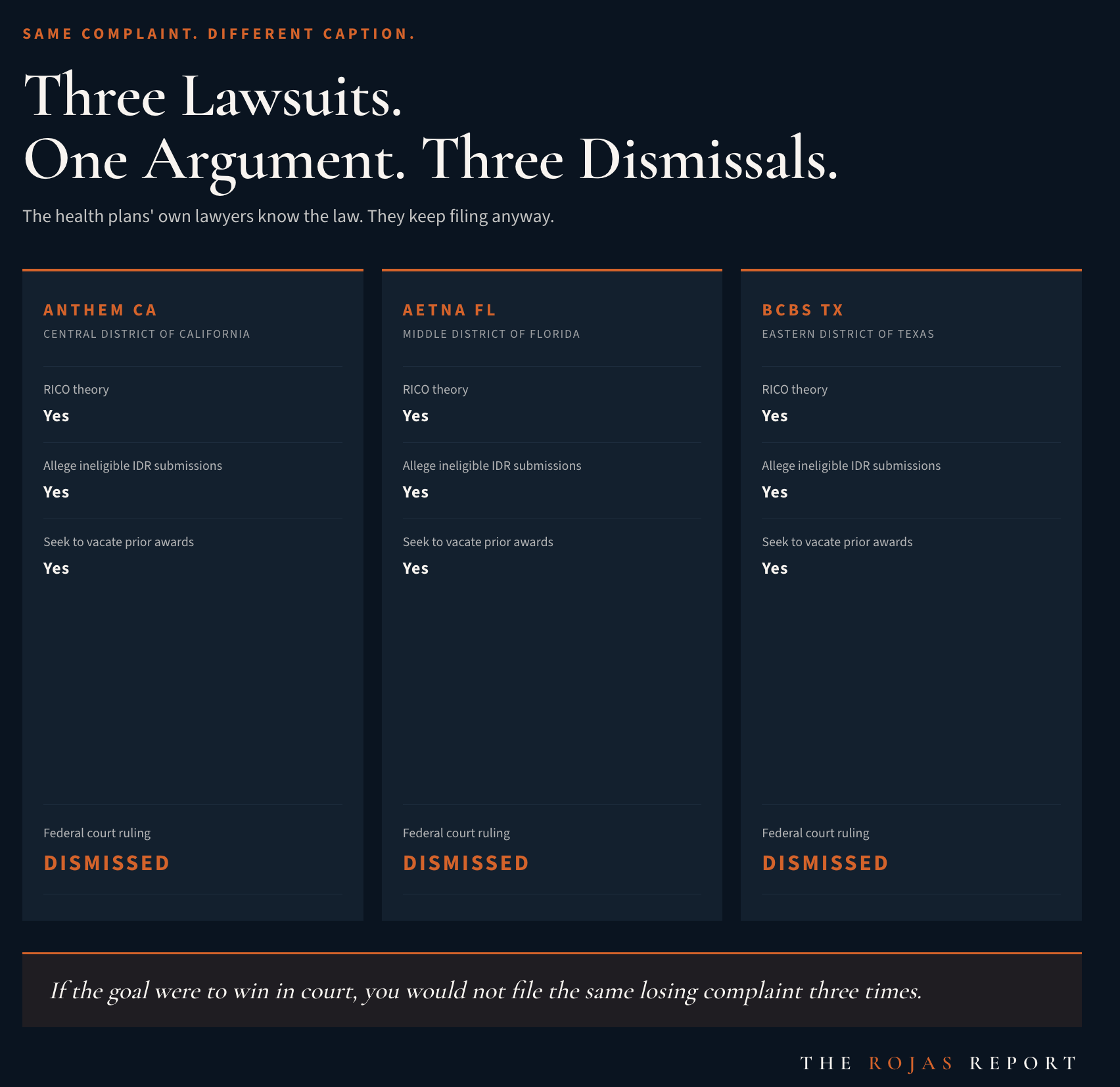
The BCBS Texas case is the same complaint with a different caption. Same RICO theory. Same alleged fraud. Same demand to vacate the awards. Same outcome.
The three rulings agree on a single point: insurers cannot use Article III courts to unwind IDR outcomes they could have challenged during the IDR process itself.
That is the law. The plans’ own lawyers know it is the law. They keep filing anyway.
Misread these dismissals as insurer defeats and you'll be blindsided when the CMS rule lands exactly where the lawsuits pointed.
The people who saw the play coming read this first.
Subscribe.
