
The HHS & CMSAdvisory Committee Didn’t Fail Independent Physicians. Independent Physicians Failed the Advisory Committee.
Rational actors nominated their people, staffed the process, and won. Independent physicians were right on the policy and absent from the room. One of those facts is fixable.

Independent physicians are right on the policy.
They have lost at every turn.
That is not a moral failure. That is a strategic one.
The Healthcare Advisory Committee is the latest example. Eighteen seats. Selected from more than 400 nominations. Advising the federal government on Medicare, Medicaid, physician payment, and claims processing. Announced March 26, 2026.
The roster includes the CEO of Sanford Health, the CFO of Cleveland Clinic, the chief strategy officer of Intermountain Health, the CEO of the country's largest health information network, a venture capitalist, and Tony Robbins.
Zero independent physicians hold a seat.
The question worth asking is not why.
The question worth asking is how, and whether independent physicians are willing to do what it takes to change it.
IN TODAY’S ARTICLE:
How advisory committees become structural advantages for incumbents without anyone doing anything illegal
Who is in the room, what they represent, and why their presence is logical
The open intelligence file at hac.rojasreport.com, every member, every affiliation, every conflict on the record
What independent physicians would need to become to stop losing
Glossary at the bottom of today’s article.
THE MECHANISM
Regulatory capture at its most durable does not require a lobbyist, a check, or a phone call. It requires a nomination window and a Federal Register notice.
The Federal Advisory Committee Act has governed federal advisory bodies since 1972. It mandates balanced viewpoints, geographic representation, demographic diversity, and a transparent process. It is a well-designed law. It does not solve the problem of who has the apparatus to respond to a nomination window at scale.
Sanford Health has a government affairs team. Cleveland Clinic has a government affairs team. Intermountain Health has a government affairs team. The American Hospital Association, whose incoming chair sits on this committee, spent more than $29 million lobbying the federal government in recent years. That infrastructure does not exist to win arguments. It exists to show up first.
The solo physician in Tulsa has a patient at 7 am.
That asymmetry is not corruption.
It is the compounding interest of incumbency.
Every nomination window that incumbents flood and independent physicians miss makes the next one harder.
The infrastructure gap compounds.
The roster gaps compound.
The policy outcomes compound.
This is not new. The ACA’s Independent Payment Advisory Board followed this logic. MedPAC, the commission that advises Congress on Medicare payment rates, follows this logic. Every administration has run some version of this process. The incumbents are simply better at the game than the people they displace.
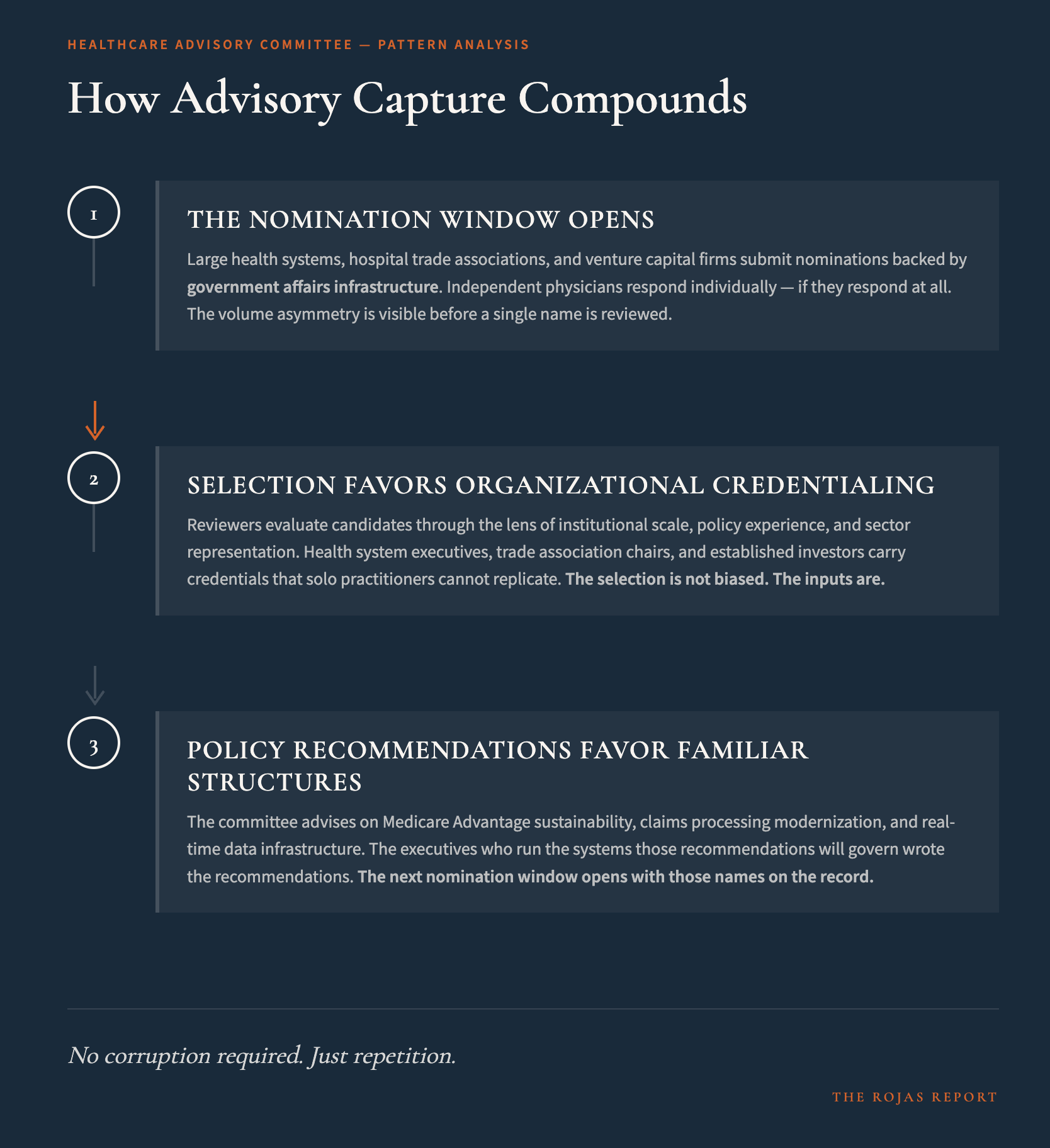
EXHIBIT A
The Healthcare Advisory Committee is not a scandal. It is a case study.
HHS and CMS reviewed more than 400 nominations. The process was transparent, FACA-compliant, and publicly announced. The committee meets in public, consistent with federal transparency requirements.
Here is who the process produced.
William Gassen is the president and CEO of Sanford Health, one of the largest integrated health systems in the Dakotas and upper Midwest. He is also the AHA chair-elect designate. The American Hospital Association has spent more than $29 million lobbying the federal government. Its core policy positions include opposition to physician-owned hospital expansion, defense of facility fee structures, and resistance to CON law reform. The incoming chair now advises the committee that will make recommendations on Medicare physician payment rates.
Dennis Laraway is the CFO of Cleveland Clinic.
Dan Liljenquist is the chief strategy officer of Intermountain Health. A former Bain consultant, he built Civica Rx, a nonprofit generic drug manufacturer, and has shaped how large integrated systems engage federal policy.
Russ Thomas is the CEO of Availity, the largest health information network in the country. Availity processes claims between physicians, hospitals, and insurers. The committee will advise on real-time data infrastructure and claims processing modernization.
Clive Fields, MD, is the co-founder and chief medical officer of VillageMD, a corporate primary care chain backed by Walgreens operating at national scale.
David Carmouche, MD, is the chief clinical transformation officer at Lumeris, a value-based care and managed care infrastructure company.
Sebastian Caliri is a partner at 8VC, a venture capital firm with proximity to the current administration’s healthcare policy orbit. Before 8VC, he led healthcare at Palantir.
Kimberly Brandt and Stephanie Carlton hold ex officio seats as CMS’s deputy administrator and chief of staff respectively. Brandt’s background spans government, lobbying, and private equity. Carlton came from McKinsey.
Tony Robbins co-founded Fountain Life, a longevity diagnostics company charging $21,500 per year for subscription health services, with $108 million raised. He also holds equity in Celularity, a stem cell therapeutics company that has raised $250 million. RFK Jr. approached Robbins twice as a potential VP running mate before this appointment.
If you ran any of the institutions represented above, you would have done exactly what they did. You would have submitted your best candidate, supported the nomination with institutional resources, and made the case. That is not corruption. That is competence.
Sanford Health has a government affairs team.
You have this. The math is not complicated.
THE ABSENCE ARCHITECTURE
The missing seats are not random. They are a map.
No independent physicians in private practice. No physician-owned hospital operators. No rural hospital administrators outside a consolidated system. No direct primary care physicians. No patient advocacy organizations. No healthcare antitrust experts. No independent emergency medicine groups. No physicians have testified against hospital consolidation. No representatives of uninsured or underinsured patients. No medical workforce or student debt specialists.
Read that list against the active legislative calendar.
Section 6001, which restricted physician-owned hospitals, is a live reform fight. No physician-owned hospital operator holds a seat. Hospital consolidation cases are in federal courts. No antitrust expert holds a seat. Alternative payment models for independent practice are in markup. No direct primary care physician holds a seat. Surprise billing implementation remains contested. No independent emergency physician holds a seat.
The absences are not an oversight. They are a diagram of what the current structure benefits from leaving undisturbed.
Here is the harder version of that same fact: independent physicians had the same nomination window. More than 400 nominations came in. The number from the organized independent physician infrastructure is not zero. It is far smaller than the incumbent share, and the selection reflects that.
The question for independent physicians is not why they were excluded. The question is why they are not yet the kind of institutional actor that makes exclusion impossible.
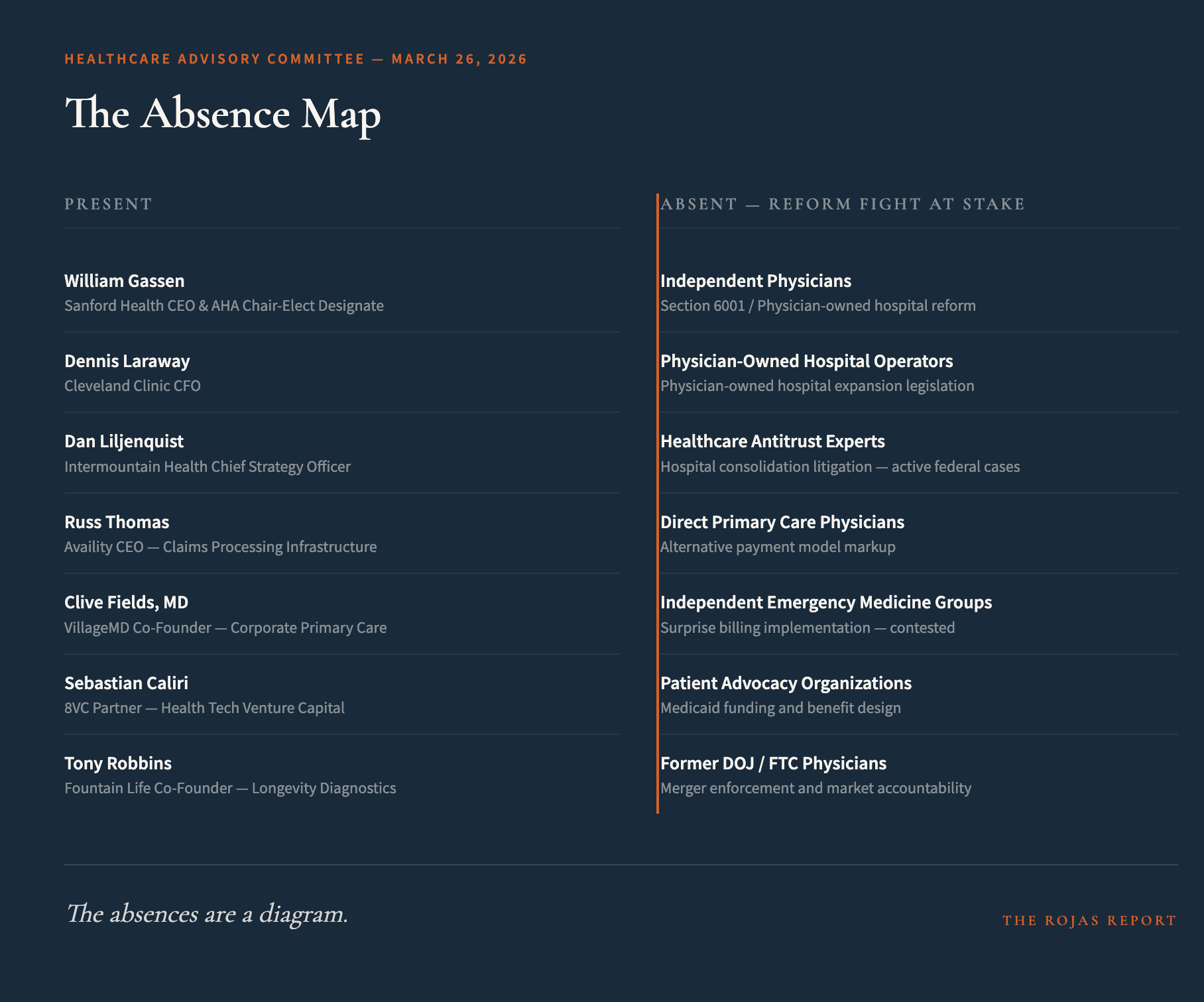
THE NONBINDING ARCHITECTURE
The committee will provide non-binding recommendations.
That phrase appears in the official announcement as a disclosure. It functions as something else.
The architecture is non-binding, not the disclaimer. If the committee recommends policies that align with incumbent interests, those recommendations enter the policy process with the credibility of a federal advisory body. If they do not, HHS declines to act with no consequence. The incumbents seated on this committee cannot lose within this structure.
This is the structural outcome.
Cleveland Clinic has a CFO advising the federal government on Medicare sustainability. You have this publication.
One of those costs $100 a year.
THE TONY ROBBINS QUESTION
An entrepreneur with a $21,500-per-year longevity diagnostics company and $108 million in raised capital sits on a committee advising Medicare and Medicaid policy.
One of the committee’s five stated priorities is the expansion of real-time data and the delivery of precision care. Fountain Life and Celularity operate in diagnostics and regenerative medicine. CMS coverage expansion in those categories affects both companies.
That seat either signals an effort to create outsider optics without changing incumbent composition, or it signals that the committee’s purpose is not structural reform.
Both answers are worse than the other.
THE THIRTY-MINUTE LINE
The team built hac.rojasreport.com in thirty minutes.
It documents every member of the Healthcare Advisory Committee: their role, their employer, their sector affiliation, and the specific committee mandates their background intersects with. The data comes from the CMS press release and publicly available professional records.
HHS reviewed more than 400 nominations over months and produced a committee. The team produced an intelligence layer for that committee in thirty minutes.
That gap is not a criticism of the process. It is a demonstration of what organized, resourced actors do when they decide the game is worth playing.
If a member’s affiliation is incorrect, the record is corrected.
If there is a material conflict that should be on file, it is added.
This is an open intelligence record.
Scrutiny is invited, and corrections will be published.
Independent physicians have been right about the policy for twenty years. Consolidation raises costs. Physician employment reduces competition. Facility fees are an economic fiction. The Avalere data confirms it. The DOJ confirms it. The FTC confirms it.
Being right is not sufficient.
The incumbents on this committee did not earn their seats by being right. They earned them by showing up with infrastructure.
That is fixable.
The site is live.
The record is open.
The game is still being played.
Independent physicians can lose it again.
Or they can decide to start showing up.
The AHA spent $29 million last year making sure the right people were in the right rooms. You can spend $10 a month making sure someone is watching.
-Rojas out.
GLOSSARY
Federal Advisory Committee Act (FACA): The 1972 law governing federal advisory committees. Requires balanced viewpoints, geographic representation, and demographic diversity. Does not require that institutions without nomination infrastructure receive equal representation.
Regulatory capture: The condition in which an advisory or regulatory body advances the interests of the industry it oversees rather than the public interest. Does not require corruption. Requires only that the people with the most to gain are the people in the room.
AHA (American Hospital Association): The primary trade and lobbying organization for U.S. hospitals. William Gassen, its chair-elect designate, holds a voting seat on the Healthcare Advisory Committee.
Availity: The largest health information network in the United States. Processes claims between physicians, hospitals, and insurers. Its CEO, Russ Thomas, holds a voting seat on the committee advising on claims processing modernization.
Non-binding recommendation: A formal advisory output that carries institutional credibility without legal force. Can inform policy when useful to the administering body. Can be set aside when it is not.
Independent practice: A physician practice not owned by, employed by, or contractually controlled by a hospital system, private equity firm, or corporate entity. Approximately 12% of physicians remained in independent practice as of the Avalere/AIMPA whitepaper, September 2024.
Fountain Life: A longevity diagnostics company co-founded by Tony Robbins and Peter Diamandis. Annual subscription priced at $21,500. Has raised $108 million across Series A and B rounds.
SOURCES
“HHS and CMS Announce Healthcare Advisory Committee Members.” CMS.gov, March 26, 2026.
“Kennedy, Oz announce Healthcare Advisory Committee members.” STAT News, March 26, 2026.
“HHS announces members of Healthcare Advisory Committee.” AHA News, March 26, 2026.
hac.rojasreport.com. Member profiles accessed March 30, 2026.
Avalere Health / AIMPA. Medicare Service Use and Expenditures Across Physician Practice Affiliation Models. September 2024.
When does the window to submit nominations open?
This independent physician wants nothing to do with CMS or Medicare. But I’m happy to nominate you Dutch.
We totally understand the concern about lack of independent voices on the Healthcare Advisory Committee, whose job is to advise federal government on Medicare, Medicaid, physician payment, and claims processing.
Given what happened to a more independent ACIP committee on immunization practices reconstituted by HHS Secretary RFK Jr., it’s no wonder independent doctors don’t waste their time joining yet another “advisory” committee that has no real power, no pay, and likely would be overridden by the captured deep state of CDC and US courts.
Example: U.S. District Judge Brian E. Murphy, with the stroke of a pen and an activist judicial opinion, unwound all progress made to rein in childhood vaccines since ACIP was reconstituted.
FACA literally is a joke — it’s performance theater at best.
Heartbreaking to admit that we the people have NO voice in America, no matter how loudly we shout (figuratively speaking). But it’s true.
In a related example, we just spent three miserable months working full-time (as an unpaid citizen volunteer) assessing the lion’s share of ~1000 pieces of legislation introduced in our state since January 2026.
We analyzed hundreds of opaque unreadable bills, prepared summaries, offered our written recommendations, called legislators, and asked others to do so.
The result? Some very good bills passed (likely would have passed anyway). Unfortunately, many new taxes, regulations, liberty stealing surveillance laws, and spending bills also passed. And many good bills sat in committee chairmen’s drawers, never to be seen again. The legislative session, mercifully, ends this week.
So to say we’re jaded and cynical is an understatement. Our sympathies are with the independents who want to stay independent, including from government committees where they work like dogs for little to no reward (often at their own expense), only to get the old heave ho from those behind the scenes or in the courts.
In an election year, the current administration — which started off so promising with its “Make America Healthy Again” noises — no longer wants to rock the boat with “controversial” issues that matter most to so many Americans.
We hope independents will thrive as more Americans start looking carefully at medical systems in our own country as well as Canada and Europe (whose captive medical systems are collapsing in parallel with our own). Americans now crave honest, awake (not woke), patient centered medicine and are looking to independents for that.
You can find some independent medical resources here: https://eolson47.substack.com/i/136557135/independent-medical-resources
Long live independence and independents! And thank you, Dutch, for supporting them.