
The House Goes Home on October 1. The Fee Schedule Comment Deadline Is September 14. Do the Math.
The official calendar is the most honest document Congress publishes. Almost nobody reads it.

Rojas Actual.
Twenty days.
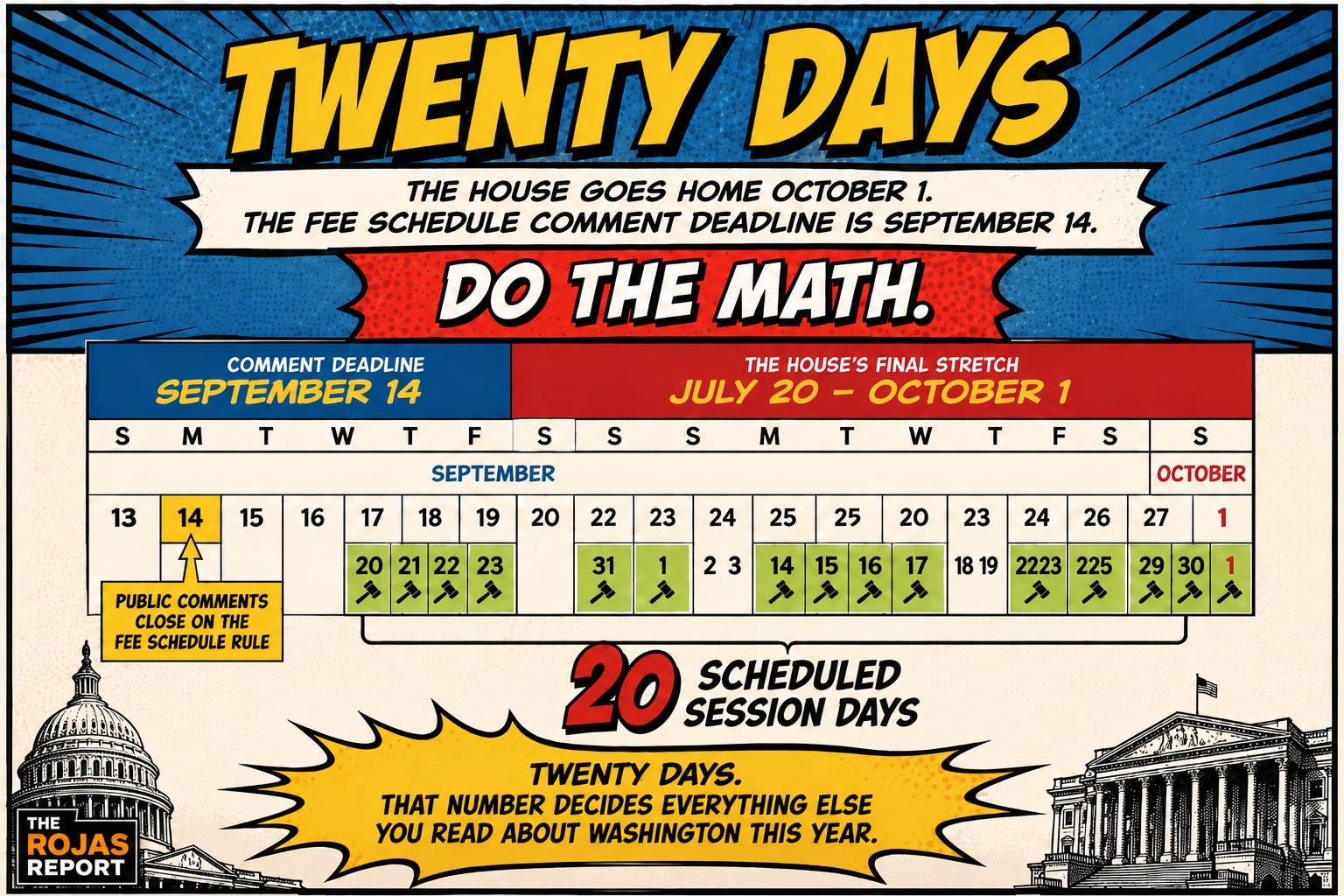
The House convenes July 20 through July 23.
Then it leaves.It returns August 31 through September 3. September 14 through 17. September 22 through 25. September 28 through October 1.
Then it goes home to campaign.
No scheduled session until November 9.Count it.
Twenty scheduled session days between now and the election.
Twelve annual spending bills remain unfinished through both chambers. Nine have never passed the House floor. The Senate Appropriations Committee has not begun formal consideration of bills.
Current discretionary funding expires on September 30.
And on September 14, the same day the House gavels back in, public comments close on the proposed rule that sets Medicare’s payment policies for physician services next year.
The rule closes for comments the same day the House opens its second September work period, deep in the final sprint before the election. Both clocks run at once, and only one side is watching both.
Twenty days.
That number decides everything else you read about Washington this year.
IN TODAY’S ARTICLE:
Congress announced its 2026 work schedule in November 2025. It is a confession, and almost nobody treats it like one.
The House has 20 scheduled session days left before Election Day. Twelve spending bills, a defense authorization, and every healthcare priority you care about compete for those days.
The large-system lobby shops I watched built their 2026 strategy around this calendar when it was posted. Physicians meet the fee schedule at the comment deadline, between patients.
This is Part One of How a Bill Really Dies. The first cause of death is the simplest: the bill runs out of days.
Glossary at the bottom of today’s article.
THE MOST HONEST DOCUMENT IN WASHINGTON
The House Majority Leader announced the 2026 calendar on November 18, 2025, revised since, most recently in March. The Senate posted its schedule the same week. Anyone can download them. They are public, free, and ignored.
They are also confessions.
The calendar tells you, months in advance, which promises the floor time cannot keep. A five-year highway bill needs a bicameral agreement that takes longer than the days available. The calendar knew in November. A full farm bill needs an introduced Senate bill, and none exists. The calendar knew. Twelve appropriations bills through both chambers before September 30, with a five-week August recess in the middle. The calendar answered that question in November.
Schoolhouse Rock taught you that a bill becomes a law through committees, floor votes, and a signature. The cartoon left out the part where the bill sits in a queue behind thousands of other bills, and the queue only moves 20 more days this year.
Most legislation dies of nothing.
No dramatic vote.
No veto.
No headline.
It waits in line, and the line closes.
WHAT THE QUEUE LOOKS LIKE RIGHT NOW
Twenty days is not twenty opportunities. Leadership already knows which bills control the floor. The lobby shops already know which deadlines create vehicles. Everyone else is still writing stand-alone legislation for a calendar that has no room for it.
Bills do not merely compete for votes. They compete for vehicles, deadlines, and leadership time. The interests that read the calendar first enter that competition months ahead.
Here is what is lined up for those 20 House days.
All twelve FY2027 appropriations bills cleared the House Appropriations Committee. Three have passed the House floor. The Senate Appropriations Committee has not begun. Absent new appropriations or a stopgap, agencies without other funding authority begin shutdown procedures on October 1.
The FY2027 defense authorization failed a Senate procedural vote, 50-46, on July 14. A setback, and a preview of Part Five of this series.
Highway and transit authority expires September 30. The replacement bill cleared committee in May and has never seen the House floor.
The farm bill passed the House in April. The Senate has a discussion draft and no bill.
A budget blueprint cleared the House Budget Committee on July 16, permitting four committees to write legislation adding up to $95 billion to deficits. It has not passed either chamber.
Each of these collects leadership floor time ahead of any stand-alone Medicare bill.
So when the funding cliff arrives, the likeliest outcome is the one the calendar predicted in November: a stopgap, with the expiring transportation and farm programs among the natural candidates for a tow, and the real decisions pushed past the election. The House-introduced proposal already runs through December 4.
Which brings us to the part of the calendar nobody talks about.
Congress posted its 2026 calendar last November.
One side of the healthcare economy planned its year around it.
Read what the other side reads.
