
The Most Consequential Session of Congress Begins After Voters Have Spoken
After the election, before the new Congress: the six weeks where healthcare payment policy gets finished. The CR already scheduled the meeting.

Rojas Actual.
Remember that December 4 date from Part Two?
The one written into the House’s own stopgap proposal, back in July.
It wasn’t a funding deadline.
It was an appointment.Leadership scheduled December’s negotiation in the summer, the way you’d book a conference room. The election happens November 3. The House returns November 9. The proposed stopgap expires December 4.
The major items Part Two put on the tracks arrive in the same six weeks, competing for space in the same year-end negotiation, in front of a Congress that includes members who will never face voters again.
There is a name for that session.
And once you see what it produces, you’ll understand why sophisticated government affairs offices across healthcare treat it as the real legislative year.
IN TODAY’S ARTICLE:
The lame duck is the session between the election and the new Congress. Reelected members vote. Defeated members vote. Retiring members vote. Only some of them ever face voters again.
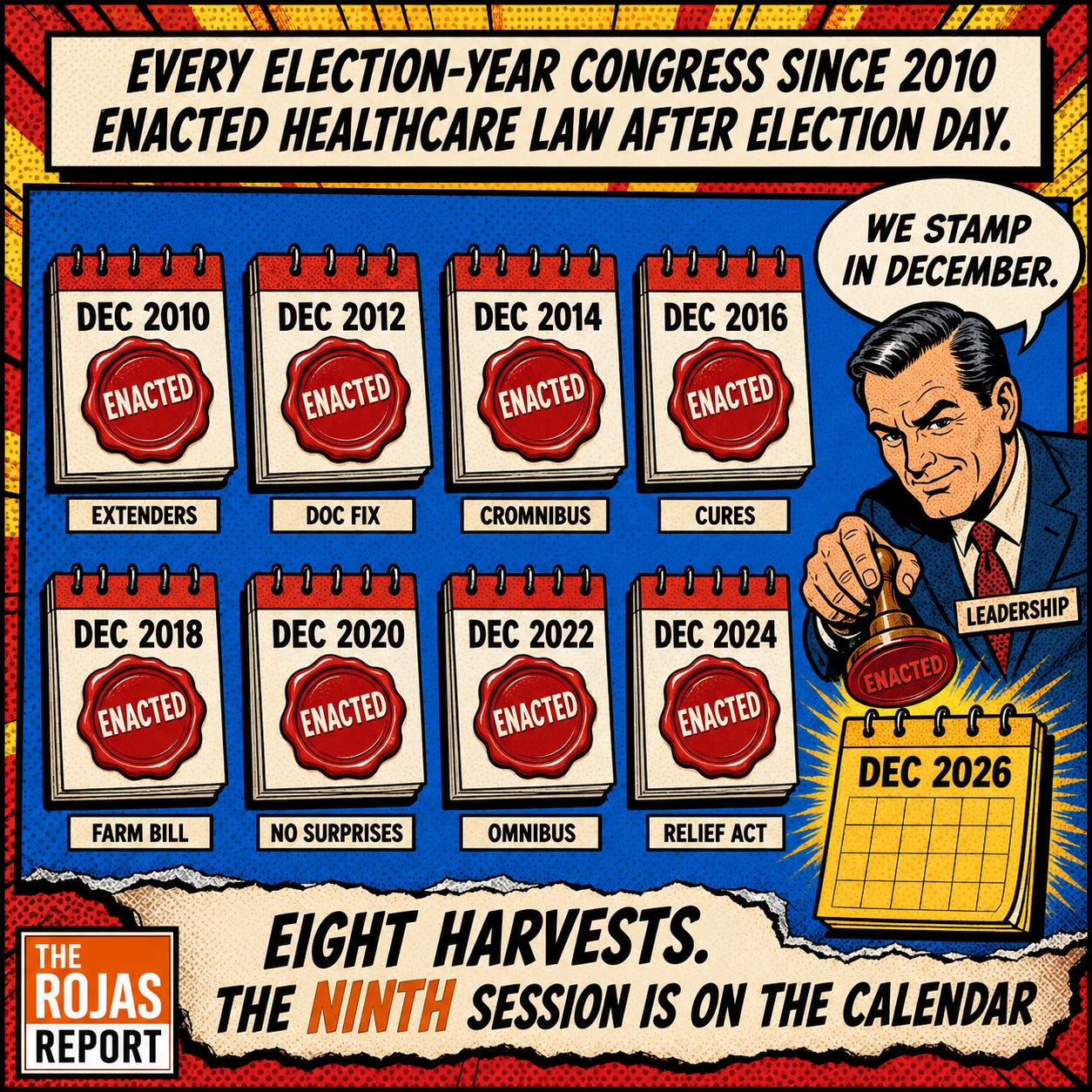
Every election-year Congress since 2010, eight in a row, has enacted healthcare legislation after Election Day. The No Surprises Act, the 21st Century Cures Act, the doc fix, and the 2024 extender stack all passed after voters had spoken.
On four major year-end packages, the maximum window between the official text anchor and the first House vote ran from 4 hours 4 minutes to 30 hours 38 minutes.
Part Three of How a Bill Really Dies: the bills that survive the calendar and catch the vehicle get finished here, in the session conducted after the electoral verdict, partly by members who will never face voters again.
Glossary at the bottom of today’s article.
THE SESSION AFTER THE VERDICT
A lame-duck session is the period after the November election and before the new Congress convenes on January 3.
Everyone still votes.
The members who won reelection vote.
The members who lost vote.
The members who retired vote.
The chamber looks identical to the one voters just judged, except the judgment hasn’t taken effect, and for some of the people on the floor, it never will.
This year, the House returns November 9.
The new Congress arrives January 3, 2027. Between those dates sits the most consequential working period of the cycle, conducted entirely after the electoral verdict has been delivered.
The arithmetic alone makes the point. A member who lost in November casts December votes with no election ever ahead of them. A member who won casts December votes two years from the next judgment, when no voter will remember a package vote buried in a holiday week. For defeated and retiring members, the electoral feedback loop is gone. For reelected members, the next judgment is two years away.
Leadership knows this. Which is why leadership, given the choice in July of when the money runs out, chose December 4.
EIGHT FOR EIGHT
Here is the post-election healthcare ledger since 2010.
Every entry became law after voters had spoken.
Every election-year Congress since 2010 has enacted healthcare legislation after Election Day. In several cycles, the post-election package carried some of the decade’s most consequential healthcare policy.
2010: the Medicare and Medicaid extenders package carrying the physician payment update, the Zadroga Act establishing the World Trade Center Health Program, and the FDA food safety overhaul that granted recall authority. Three major health laws, one post-election December.
2012: the American Taxpayer Relief Act, carrying a one-year doc fix, a stack of Medicare and Medicaid extenders, and the repeal of an entire ACA program. The Senate passed it January 1. The House concurred January 1. The President signed it January 2, one day before the new Congress arrived.
2014: the cromnibus, 219 to 206, carrying Ebola response funding and ACA modifications.
2016: the 21st Century Cures Act, 392 to 26, with $4.8 billion for NIH, $1 billion in opioid grants, FDA reform, and a restructured federal mental health apparatus.
2018: the farm bill’s nutrition and rural health provisions, plus a dozen standalone health laws, maternal mortality, sickle cell, rural health offices, cleared by voice vote in three December weeks.
2020: the Consolidated Appropriations Act, 327 to 85, carrying the No Surprises Act, one of the most consequential healthcare laws of the decade, plus mental health telehealth expansion and the full extender stack.
2022: the year-end omnibus, 225 to 201, making 12-month postpartum coverage permanent, rewriting Medicaid eligibility rules for children, and extending CHIP.
2024: the American Relief Act, 366 to 34 with one voting present, under suspension, carrying community health center funding, the National Health Service Corps, telehealth, hospital-at-home, DSH relief, the entire life-support apparatus Part Two cataloged.
Eight lame ducks.
Eight harvests.
This is the operating rhythm of American healthcare law, and the people who write the December packages plan for it the way farmers plan for October.
When December’s package posts, history says you may have hours before the vote. Readers of this series will have had months.
