

UNC.
Iowa.
Wisconsin.
Colorado.
Virginia.
Texas.
Ohio State.
Michigan.Eight of the most powerful hospital systems in America.
Not one of them files a Form 990.
IN TODAY’S ARTICLE:
Why eight of the country’s flagship academic medical centers file no Form 990, and why it is legal
The three pieces of tax code that erase a hospital from the public record
The full list, with the basis for each system’s invisibility
The back door: how to find the affiliates that do file, even when the flagship does not
Glossary at the bottom of today’s article.
THE BLIND SPOT
In Module 0, you watched the biggest hospital system in Michigan vanish from the public record. Eight point seven billion dollars a year, and no Form 990, because the University of Michigan is legally a state government.
If you walked away thinking Michigan was a quirk, walk back.
It is a national pattern, and it concentrates exactly where you would least want it to: at the most prestigious, most dominant academic medical centers in the country. The systems that train the doctors, set the prices, and absorb the most public subsidy are the ones you can see the least.
This installment is the field guide. The law that makes it possible, the full list of systems it covers, and the technique for getting inside them anyway.
Keep it. The day one of these names lands in your inbox, in a contract, or across a negotiating table, you will need to know in ten seconds that no 990 is coming and where to look instead.
THE THREE LINES OF CODE THAT ERASE A HOSPITAL
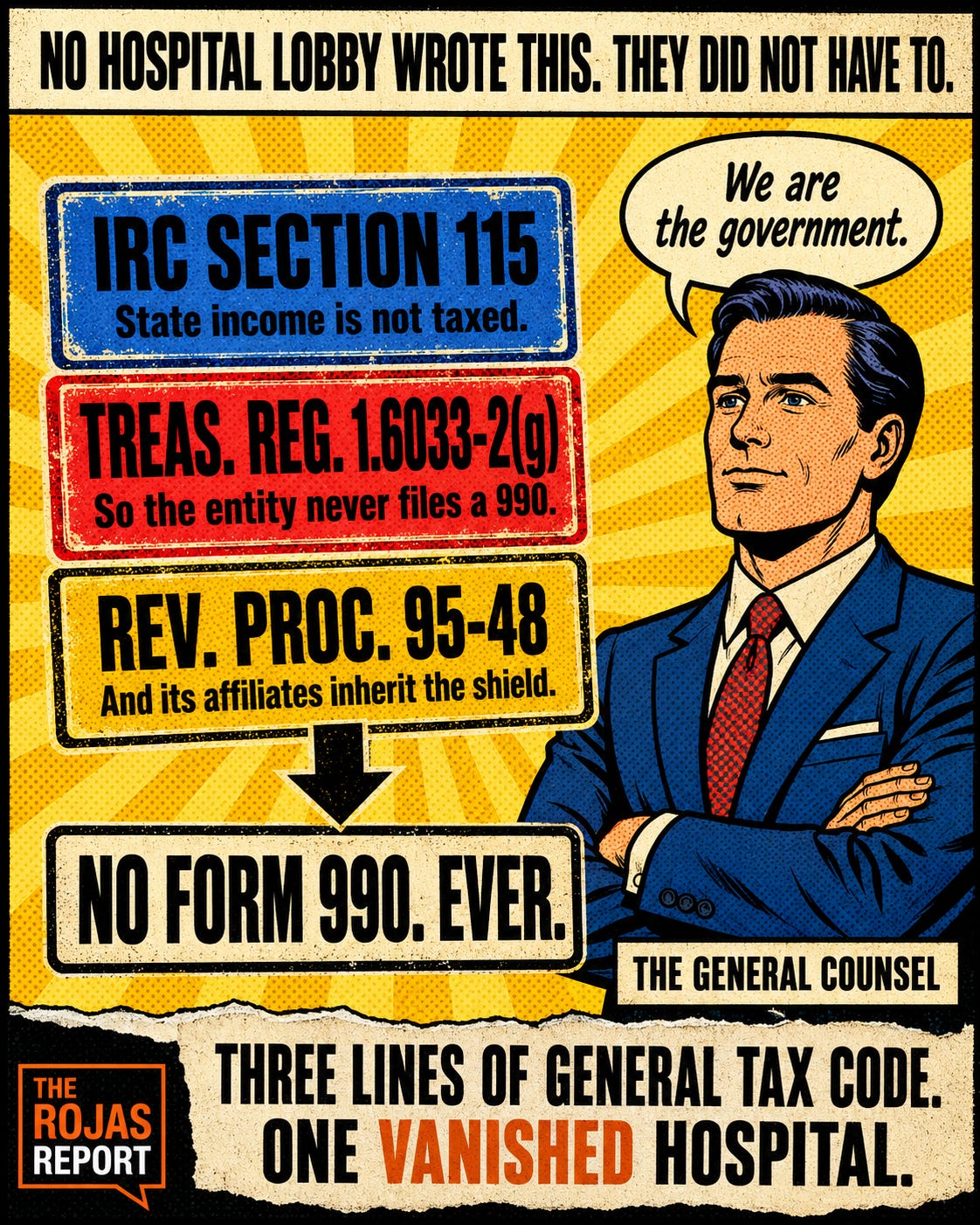
There is no healthcare carve-out. No hospital lobby wrote a special exemption into the 990 rules. The invisibility stems from three general tax laws that have nothing to do with medicine.
One. IRC Section 115. This section excludes from federal gross income the money a state earns performing an essential governmental function. A public university is an arm of the state. Its income falls under Section 115. The income is not taxed, and that is the hinge on which everything else swings.
Two. Treasury Regulation 1.6033-2(g). This regulation lists who does not have to file Form 990. State institutions whose income is excluded under Section 115 are on that list. So the same status that exempts the income from tax also exempts the entity from the disclosure return. The hospital is not hiding. The law simply never asks it to show.
Three. Revenue Procedure 95-48. This extends the filing exemption to governmental units and their affiliates. It is the provision that lets a hospital authority or a controlled affiliate claim the same governmental shield as the parent.
Put the three together, and the machinery is complete. The income is untaxed, the entity is not required to file, and the affiliates can inherit the same treatment. A hundred-page disclosure that a private competitor must publish every year simply does not exist for these systems.
This is the part to sit with. The exemption is not a reward for charity. It is a function of being the government. The most subsidized hospitals in the country disclose the least, and the reason is structural, not accidental.
100,000 physicians, healthcare executives, and lawmakers keep this list. Lose it, and you burn an afternoon hunting a filing that was never going to load. Keep it, and you know in ten seconds.
👉 Subscribe to The Rojas Report.
