
The NON-PROFIT Disguise...
How Blue Cross Blue Shield Giants Operate Like For-Profit Titans...

How Blue Cross Blue Shield Giants Operate Like For-Profit Titans
$62.8 billion in revenue.
$18.9 million CEO pay.
$3.6 billion in tax refunds.
One in three Americans is insured.
Zero accountability.
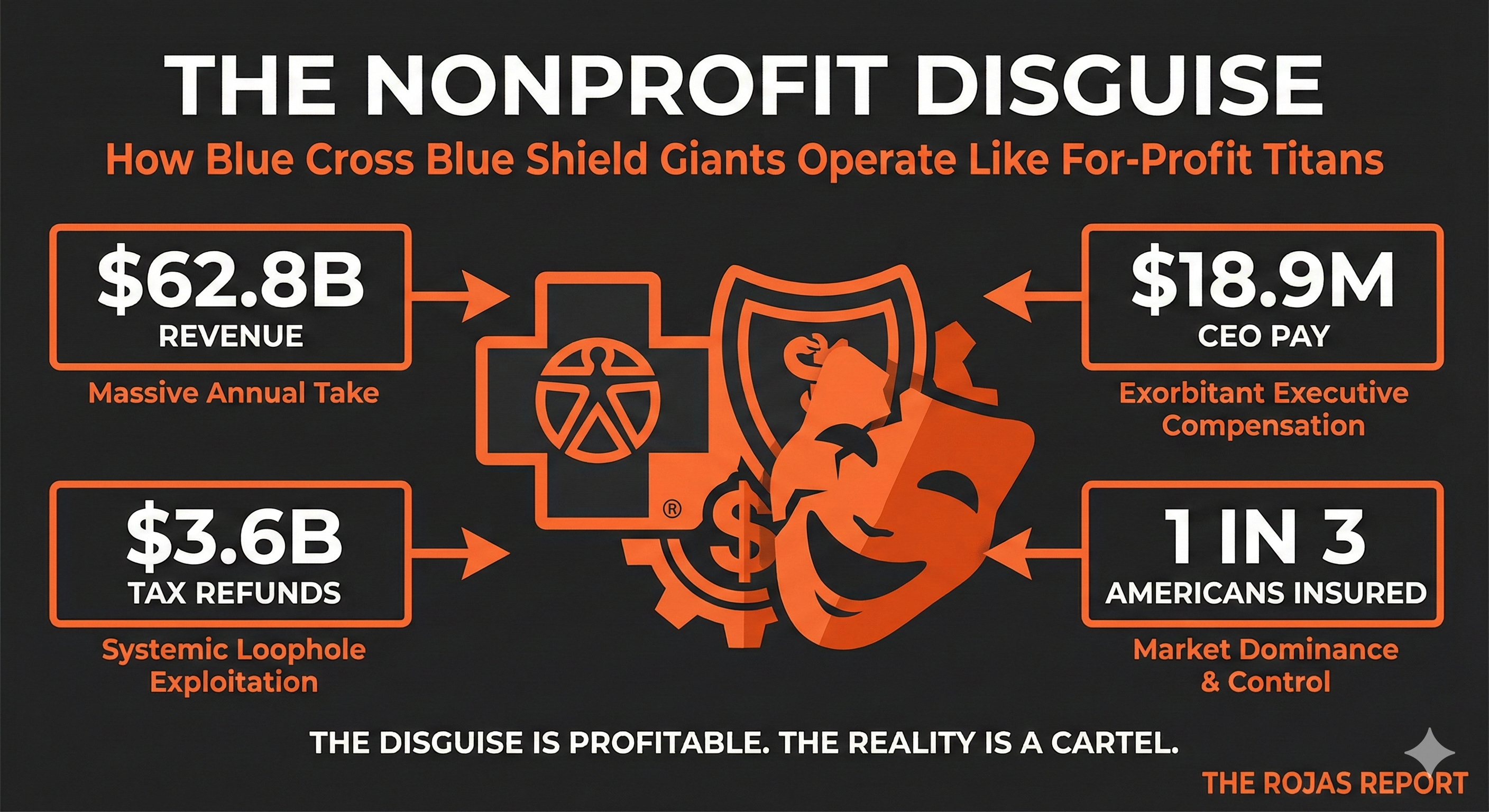
$3.6 billion. That’s how much one “nonprofit” health insurer received in federal tax refunds since 2018, not paid. Received.
Health Care Service Corporation.
HCSC.
Blue Cross Blue Shield parent in five states.
They collected $3.6 billion from the federal government while raising your premium every single year.
This is what “nonprofit” looks like in American healthcare.
In today’s article:
The scale of BCBS “nonprofit” operations ($62.8 billion and counting)
Executive compensation that rivals Wall Street ($18.9 million and climbing)
The $32 billion surplus is sitting in their vault while your rates rise.
The $3.6 billion tax refund proves the system is rigged.
What California did about it (and why 49 states haven’t followed)
Glossary of key terms at the bottom of this article.
The Scale
Blue Cross Blue Shield covers one in three Americans.
33 independent companies. A federation built on a foundation of nonprofit and mutual organizations. Their stated mission: community service and affordable access to healthcare.
Their actual operation: for-profit extraction with a nonprofit wrapper.
Let’s skip the sugarcoating.
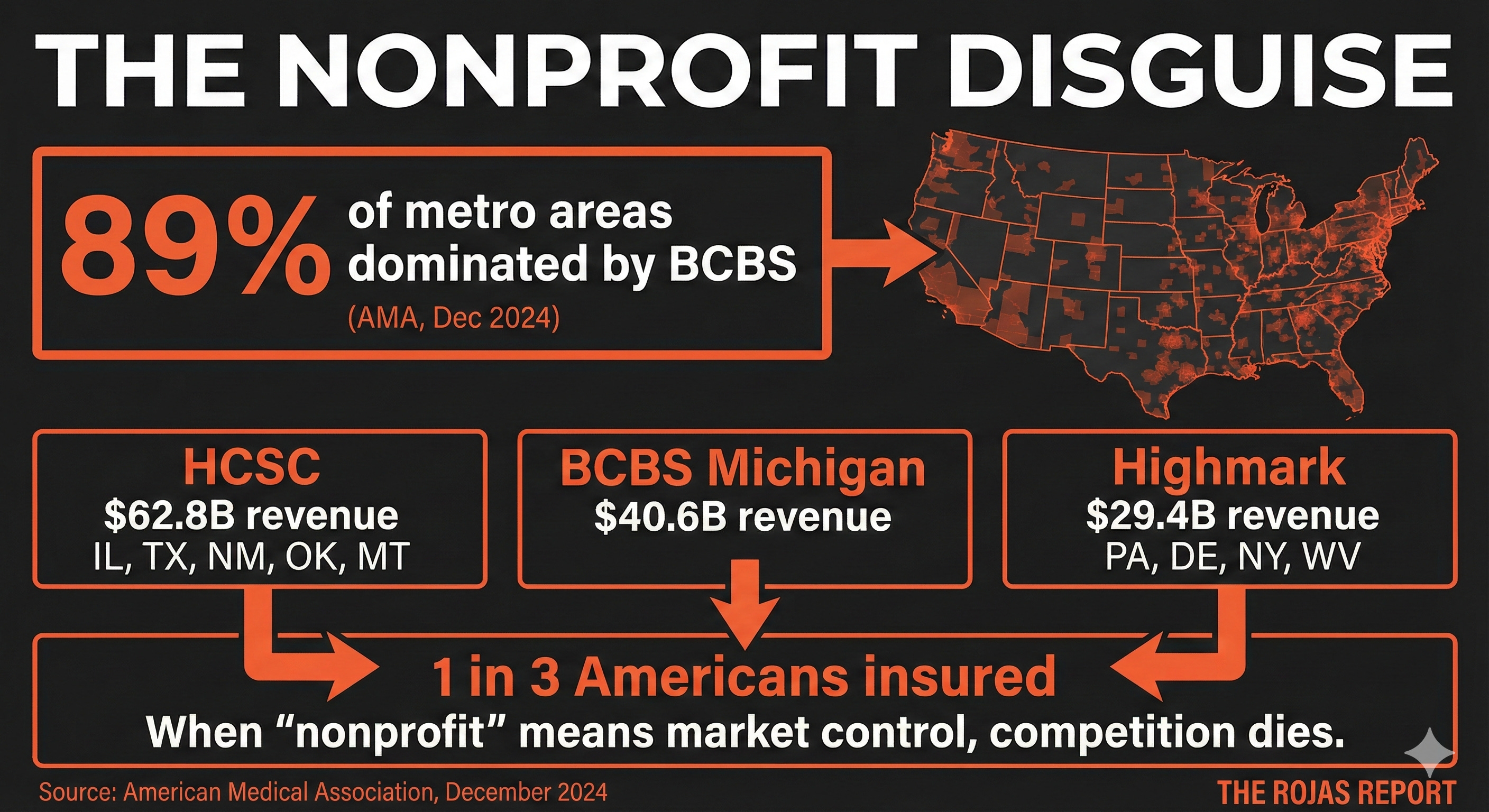
Health Care Service Corporation. HCSC. The parent of Blue Cross Blue Shield plans in Illinois, Texas, New Mexico, Oklahoma, and Montana.
2024 revenue: $62.8 billion.
Not million. Billion.
That figure dwarfs most publicly traded corporations.
1. HCSC covers 26 million Americans.
2. Blue Cross Blue Shield of Michigan pulls in $40.6 billion.
3. Highmark Health, covering Pennsylvania, Delaware, New York, and West Virginia, reports $29.4 billion.
These are not scrappy community nonprofits.
These are titans.
And they dominate.
The American Medical Association’s December 2024 report found that BCBS-affiliated insurers hold the largest market share in 89% of metropolitan areas across the United States.
89%.
In most American cities, Blue Cross Blue Shield isn’t just a choice. It’s THE choice. The only choice.
The Executive Pay Paradox
Nonprofits have no shareholders. No stock price to inflate. No quarterly earnings calls.
So who benefits from $62.8 billion in revenue?
The executives.
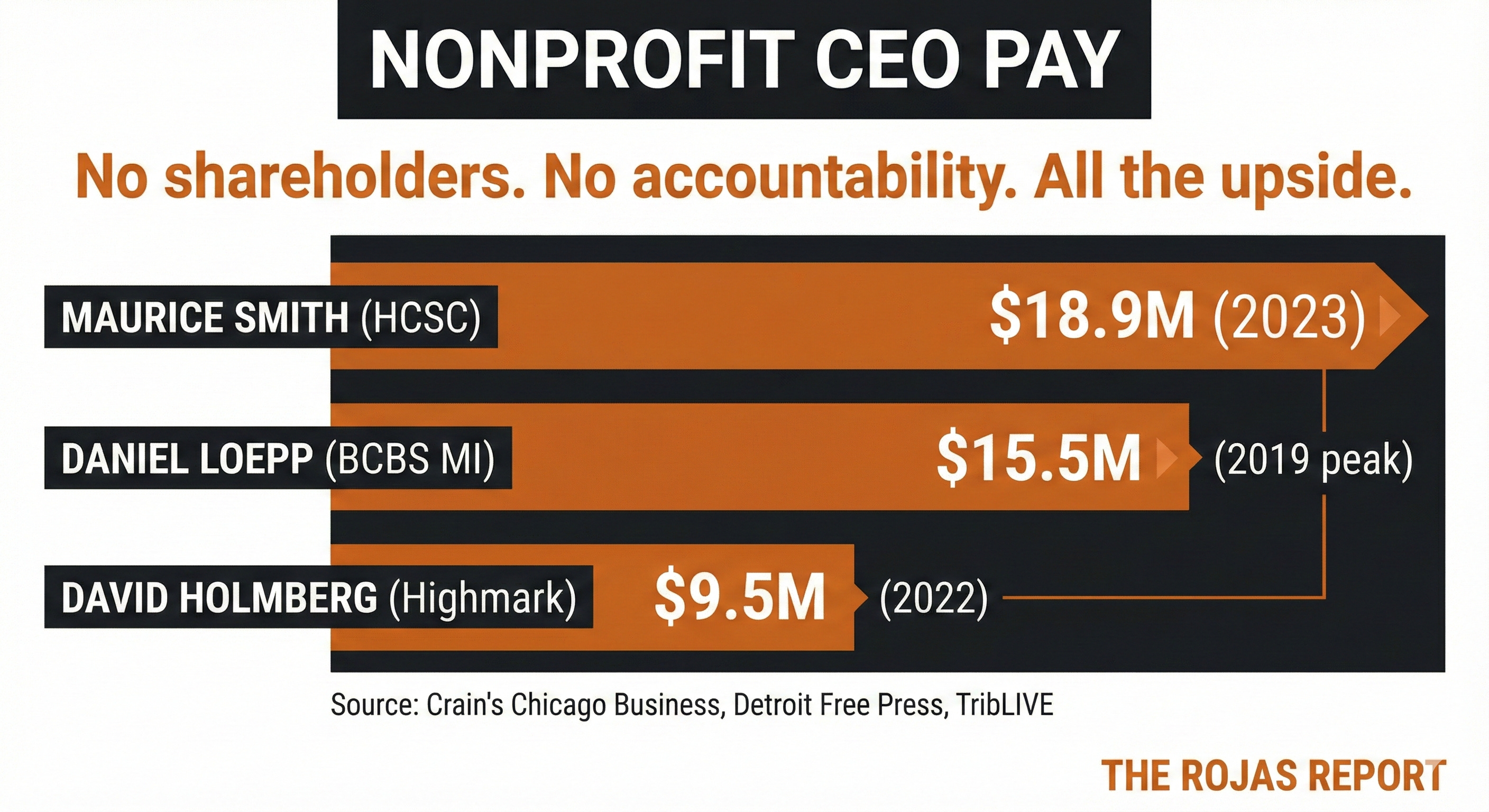
Maurice Smith. CEO of HCSC.
A nonprofit entity.
2023 compensation: $18.9 million.
Estimated 2024 compensation: $40 million or higher.
Read that again. The CEO of a nonprofit health insurer made $18.9 million in a single year. And that number is climbing.
He’s not alone.
Daniel J. Loepp. Former CEO of nonprofit Blue Cross Blue Shield of Michigan. Compensation in 2020: $11.5 million.
His pay reached $15.5 million in 2019 and $13.5 million in 2021.
David Holmberg. CEO of Highmark Health.
$9.5 million in 2022.
These compensation packages are heavily weighted toward bonuses and incentives. The exact structure you’d find at United Healthcare or Cigna.
The same playbook.
The same extraction.
The Blue Cross Blue Shield Association’s own tax filings reveal first-class and charter travel for executives, along with reported conflicts of interest.
This is what “nonprofit” looks like in American healthcare.
Most newsletters tell you what to think.
This one tells you what they’re hiding.
Billions in Surplus: Profits by Another Name
Nonprofits don’t report “profit.” They report “surplus.”
Same thing.
Different word.
This surplus comes from premiums.
Your premiums.
Built up over the years and held in reserve.
A reasonable surplus protects solvency.
An excessive surplus is a slush fund.
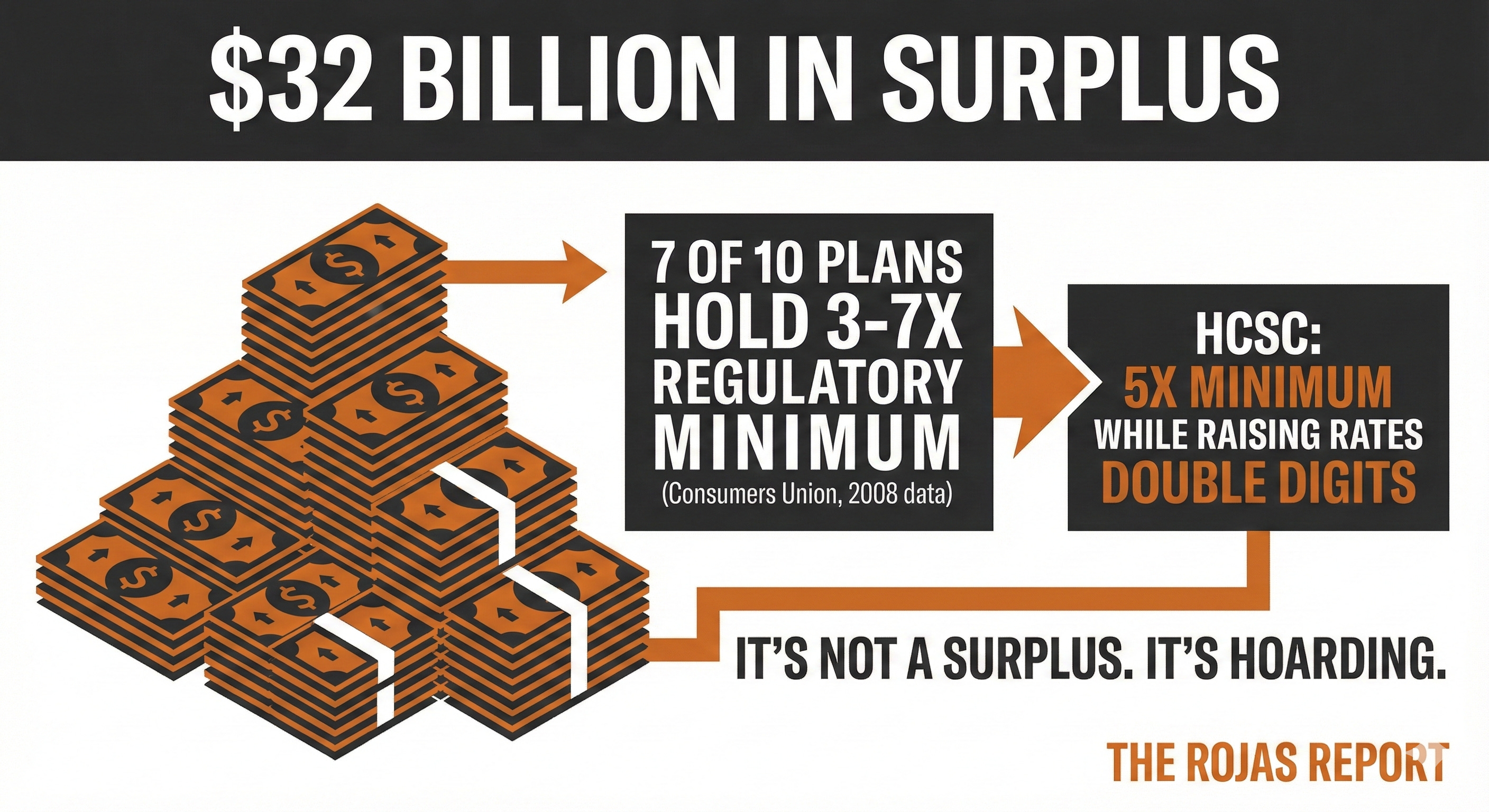
A 2010 Consumers Union investigation (using 2008 data) found that nonprofit Blue Cross Blue Shield plans held over $32 billion in surplus. Many held reserves three to seven times the regulatory minimum required for solvency.
HCSC held five times the regulatory minimum.
Meanwhile, both HCSC and Blue Cross Blue Shield of North Carolina continued to impose double-digit rate increases on customers.
Your premiums went up.
Their vault got fuller.
This is an extraction.
The Tax Scam
The Tax Reform Act of 1986 revoked the blanket federal tax exemption for Blue Cross Blue Shield plans selling commercial insurance.
But they found workarounds.
Special tax deductions under Internal Revenue Code Section 833. State and local tax exemptions. Property tax breaks. Sales tax exemptions.
The result?
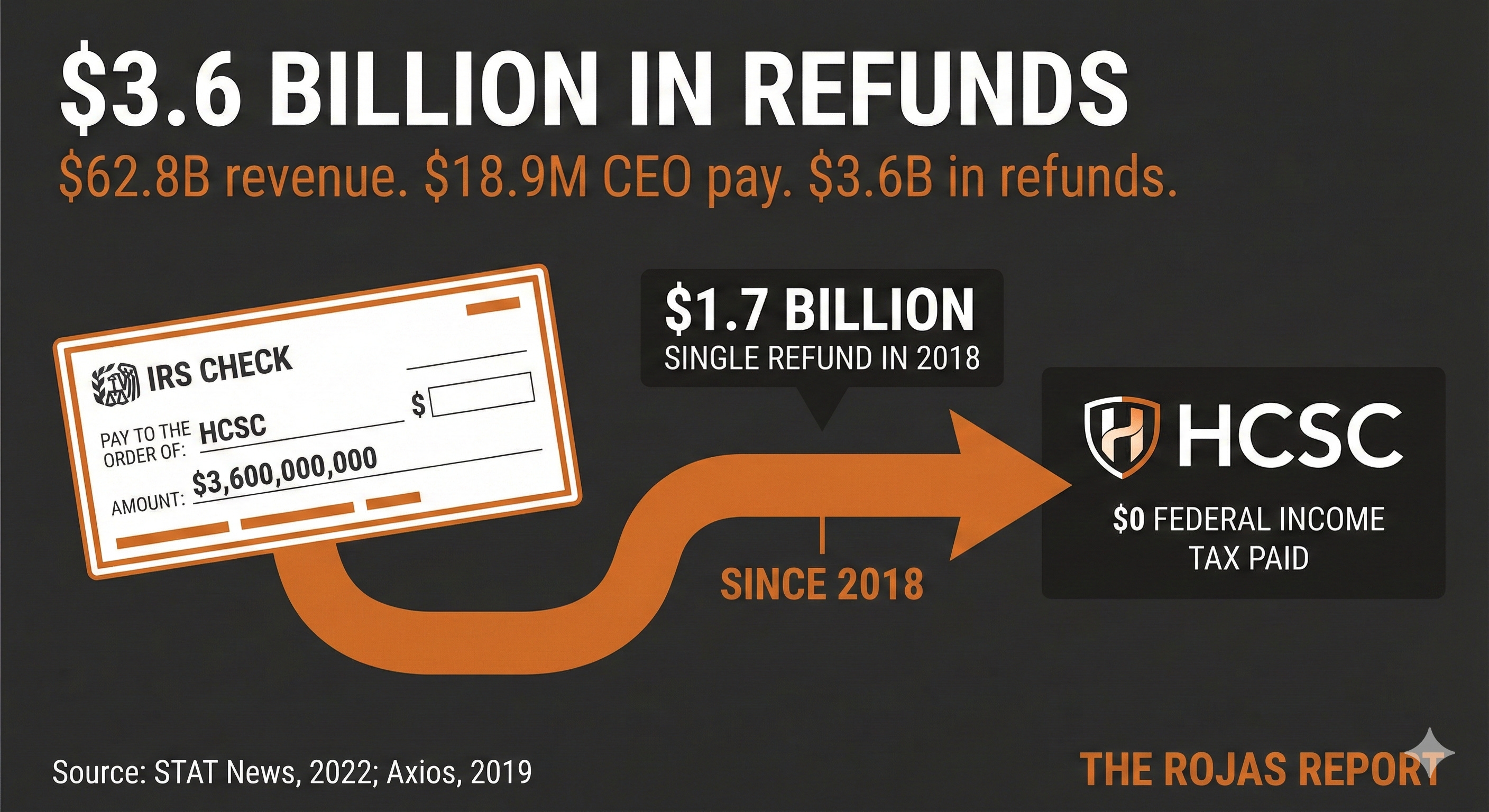
A 2022 STAT News investigation found that HCSC received $3.6 billion in federal tax refunds since 2018.
$3.6 billion.
Not paid!
Received.
A company with $62.8 billion in revenue.
A CEO making $18.9 million.
And the federal government sent them a check.
Multiple checks. Totaling $3.6 billion.
Axios reported that in 2018 alone,
HCSC pocketed a single $1.7 billion refund.
California eventually caught on. In August 2014, the Franchise Tax Board revoked Blue Shield of California’s state tax exemption. Forced them to pay millions in back taxes. The state found that massive reserves and high premium increases didn’t align with community benefit.
One state. One action.
Eleven years ago. 49 more are still waiting.
The Question
Blue Cross Blue Shield plans look like for-profit companies.
They act like for-profit companies.
They pay their executives like for-profit companies.
But they don’t pay taxes like for-profit companies.
They get the benefits of nonprofit status without the accountability.
The best of both worlds.
The responsibilities of neither.
Is this charity?
Or is this market capture with a 501©(3) wrapper?
You already know the answer.
-Rojas out.
60,000+ physicians and healthcare operators read The Rojas Report across platforms. Not because it’s comfortable.
Because it’s true.
Glossary
Mutual Insurer: An insurance company owned by its policyholders rather than shareholders. In theory, policyholders share in profits and have voting rights. In practice, policyholders rarely exercise control.
Surplus: The nonprofit equivalent of profit. The amount by which assets exceed liabilities. Accumulated from premiums paid by members.
Solvency Minimum: The minimum amount of reserves that regulators require an insurer to hold to ensure it can pay claims. Typically set by state insurance departments.
501©(3): IRS designation for tax-exempt nonprofit organizations. Requires the organization to operate for charitable, educational, or other specified purposes.
IRC Section 833: Internal Revenue Code section providing special tax treatment for Blue Cross Blue Shield organizations, including certain deductions not available to other insurers.
Form 990: Annual tax filing required of nonprofit organizations, disclosing executive compensation, financial information, and governance details. Available to the public.
Community Benefit: The services and activities nonprofit organizations provide to justify their tax-exempt status. It can include charity care, health education, and community health improvement.
Sources
S&P Global. “Health Care Service Corp. And Subsidiaries.” March 2025.
Asplund, J. “HCSC top execs got big raises in 2023 despite income drop.” Crain’s Chicago Business. December 2024.
American Medical Association. “Health insurance market concentration grows deeper: AMA report.” December 2024.
BCBS. “Blue Cross and Blue Shield System – Health Care Coverage.” Retrieved January 2026.
Reindl, J.C. “Blue Cross CEO earned $15.5M cash in 2019 during pandemic.” Detroit Free Press. March 2020.
Reindl, J.C. “Blue Cross CEO Daniel Loepp saw pay cut to $11.5M in 2020.” Detroit Free Press. March 2021.
Napsha, J. “Highmark CEO’s pay tops $9.5 million in 2022.” TribLIVE. November 2023.
ProPublica Nonprofit Explorer. “Blue Cross Blue Shield Association.” Retrieved January 2026.
Consumers Union. “How Much Is Too Much: Have Nonprofit Blue Cross Blue Shield Plans Amassed Excessive Amounts of Surplus?” July 2010. (Using 2008 data)
STAT News. “Can you guess which health insurer has a history of tax breaks?” June 2022.
Herman, B. “Large Blues health insurer pockets $1.7 billion tax refund.” Axios. March 2019.
Gold, J. “Blue Shield Of California Loses Exemption From State Taxes.” NPR. March 2015.