
The QPA Isn't a Calculation. It's a Confession.
They gave insurers the pen, the paper, and the right to grade their own work. Then called it patient protection.

The QPA is a number.
One number.
The carrier calculates it.
The carrier submits it.
The carrier does not have to show their work.
Every out-of-network arbitration in America starts with that number.
Four federal courts have now ruled it was calculated illegally.
Regardless, physicians win 80 to 88 percent of IDR cases.
At 2.5 to 4.5 times the QPA.
That’s not a win rate. That’s a verdict on the number itself.
IN TODAY’S ARTICLE:
The QPA: how insurers calculate a number they never have to explain
Ghost rates: the AMA found 57% of primary care physicians had services they never perform included in their network contracts. The raw material for rate manipulation.
Four district court rulings called the QPA unlawful. The Fifth Circuit split the difference. The full court is still deciding.
Why physicians win 80-88% of IDR cases at 3-4x the QPA. And why that gap is the story.
Glossary at the bottom of today’s article.
WHAT THE QPA IS
The No Surprises Act created an arbitration process for out-of-network billing disputes.
Before arbitration begins, each side submits an offer.
The arbitrator picks one.
To guide that choice, the law required a benchmark rate. A reference point the arbitrator could use to evaluate which offer was reasonable.
Congress called it the Qualifying Payment Amount.
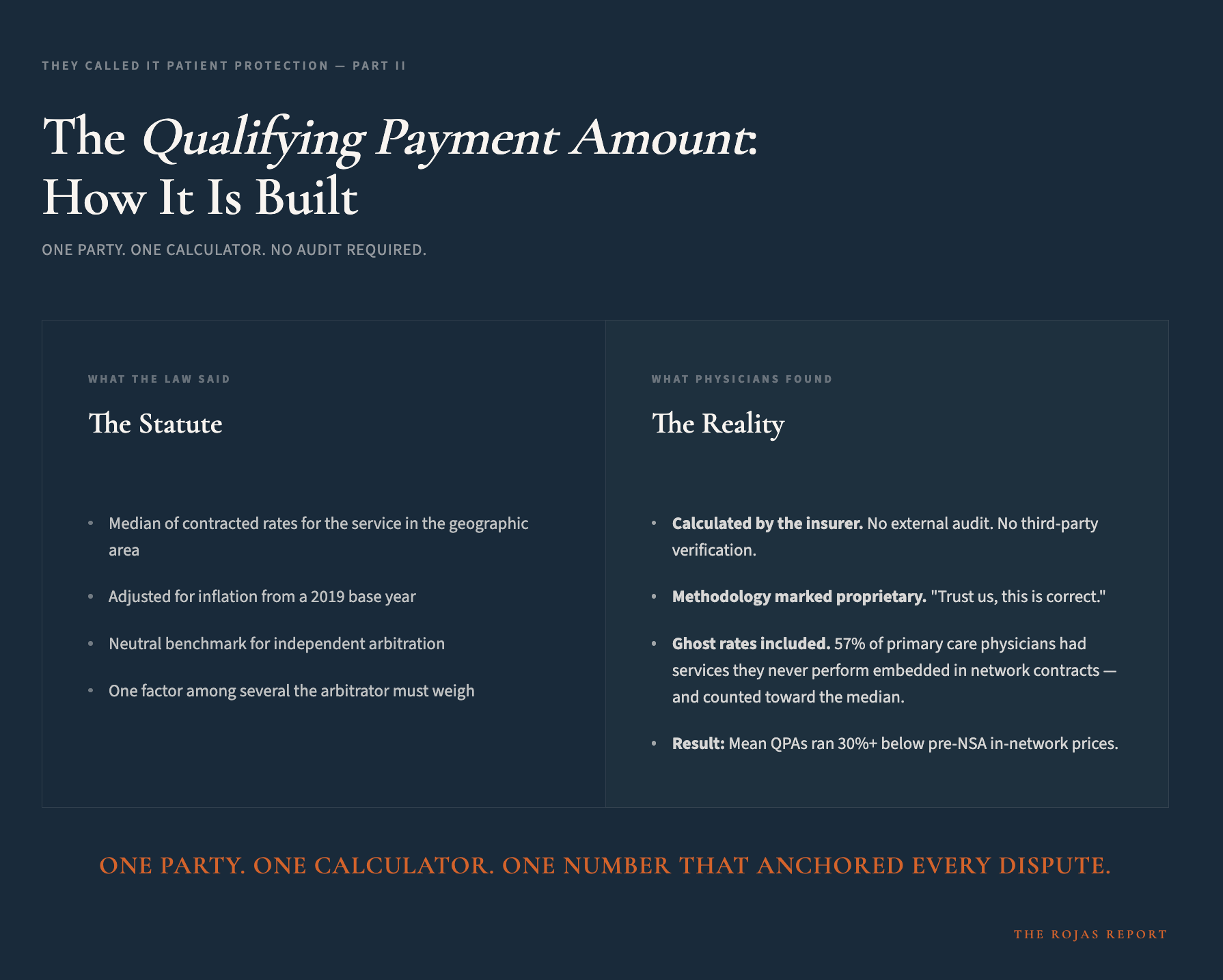
The insurer runs the calculation. No external audit. No real-time verification. No requirement to show the underlying rate pool.
The ASPE/HHS/RAND stakeholder report documented what physicians discovered when they tried to examine QPA calculations: “Hey, show me your QPA calculations. They’re like, No, it’s all proprietary, but trust us, this is correct.”
Trust us, this is correct.
That was the benchmark.
GHOST RATES
The QPA’s accuracy depends on the quality of the contracted rates that go into the calculation.
The AMA surveyed primary care physicians and found that 57% had services they never perform included in their network contracts.
Read that again.
More than half of primary care respondents were contracted for services that fall outside their scope of practice.
Those rates exist on paper. They count toward the median calculation. They suppress the QPA for the services physicians actually perform.
The industry term is “ghost rates.”
Contracted rates for procedures no one in the network will ever bill. Included in the rate pool. Pulling the median down.
This is not a simple accounting error.
A rate that drags the median toward zero has to come from somewhere.
It was placed there.
The QPA is a number the insurer calculates and refuses to explain.
100,000+ physicians decided they'd rather know how it works than keep being surprised by its cost.
