
The Report Found 93 Percent Compliance. The Ban Was Built on the Other Seven.
The investigators led with the compliance rate. Everyone since has quoted the exceptions.

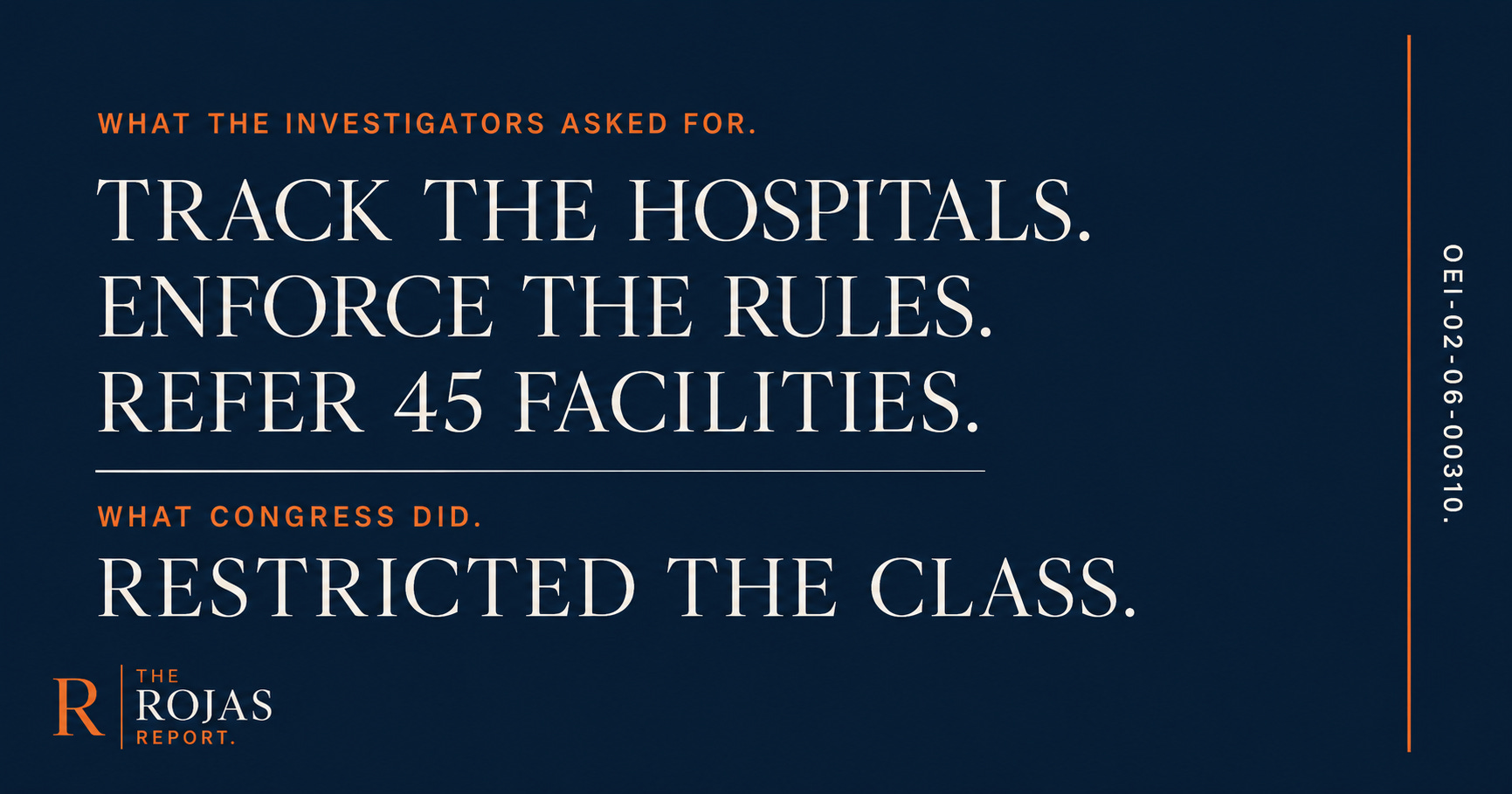
Rojas Actual.
Every account of the 2008 Inspector General report leads with the failures.
Here is the sentence the investigators wrote first.93% of physician-owned specialty hospitals met both staffing requirements across the eight sampled days.
7% did not.
That’s 8 hospitals.The report named them and sent them to CMS for enforcement.
Congress restricted an entire class.
IN TODAY’S ARTICLE:
The compliance rate the investigators reported first, and the eight hospitals behind the failure figure
The 45 facilities the Inspector General referred to CMS for enforcement action
What the report found that was genuinely alarming, stated without softening
Why the four recommendations never reached ownership
Glossary at the bottom of today’s article.
THE STUDY EVERYONE CITES
The Senate Finance Committee asked the HHS Office of Inspector General to evaluate patient care and safety in physician-owned specialty hospitals. Inspector General Daniel Levinson published the result in January 2008 as OEI-02-06-00310.
The team worked from a CMS list of 130 facilities and contacted every one between December 2006 and March 2007 to confirm the definition applied.
Twenty-one dropped out.
Fourteen had no physician owner.
Three no longer met the cardiac, orthopedic, or surgical threshold.
CMS had already terminated three.
One had converted to a critical access hospital.
That left 109 hospitals in 20 states, heavily concentrated: 33 in Texas, 15 in Louisiana, 9 each in Oklahoma and Kansas, 8 in South Dakota. Sixty-six surgical, 23 orthopedic, 20 cardiac.
The investigators reviewed staffing schedules for eight sampled days between July and December 2006, read every hospital’s written emergency policies, read the staffing policies from all but two, and conducted structured telephone interviews with an administrator at each facility.
This became the central federal safety document in the case for Section 6001. Almost nobody who cites it has read past the executive summary.
WHAT IT FOUND THAT ALARMS ME
Start with the findings that hold up, because they are real and this series does not soften them.
Twenty-two percent of these hospitals had written emergency policies that failed to address the appraisal of emergencies, the initial treatment of emergencies, or the referral and transfer of patients. That is nearly a quarter of the class missing at least one of the three basics.
Twenty-four percent had policies that never mentioned emergency response equipment such as a defibrillator. Fifteen percent never mentioned CPR or Advanced Cardiac Life Support. Six percent did not indicate who responds to a medical emergency. Among hospitals whose administrators reported no physician on duty at all times, twenty one percent had no written guidance for handling an emergency when no physician was there.
Thirty-four percent used 911 to obtain medical assistance in stabilizing a patient. CMS has already stated that relying on 911 for appraisal or initial treatment in place of a hospital’s own capability violates the conditions of participation.
The report quotes the policies. One instructed staff to call 911 to the scene to attempt resuscitation. Another told staff to call 911 for a code blue after hours and hand responsibility to county EMS on arrival.
Those are indefensible, and nobody in this series will defend them.
Now read what the report says next to them.
THE SENTENCE THAT COMES FIRST
On staffing, the investigators wrote the compliance rate before the failure rate.
Ninety-three percent of physician-owned specialty hospitals met both Medicare staffing requirements across the eight sampled days: a registered nurse on duty around the clock, and a physician on call when none was onsite.
Seven percent did not. In raw numbers, eight hospitals. Seven failed the nurse requirement on at least one sampled day. One failed the physician requirement. Three had no registered nurse on any shift during one sampled day, and one had none across three sampled days plus a night shift on a fourth.
Eight facilities out of 109, and the report says the failures clustered on weekends.
Read the census data alongside it. The median patient count ran four to nine on weekdays and one to two on weekends. Forty-six percent of these hospitals had no patients at all on one of the sampled weekend days. Twenty-five percent had none on the holiday.
That context belongs in the record. It does not excuse a hospital operating without a nurse. It does explain why the gaps landed where they did, and no account of this report has ever mentioned it.
Your hospital association’s policy team read all twenty-three pages in 2008. Check how often they quote page 11.
Paid subscribers get the pages the lobby leaves out, and every article in this twelve-part investigation.
