
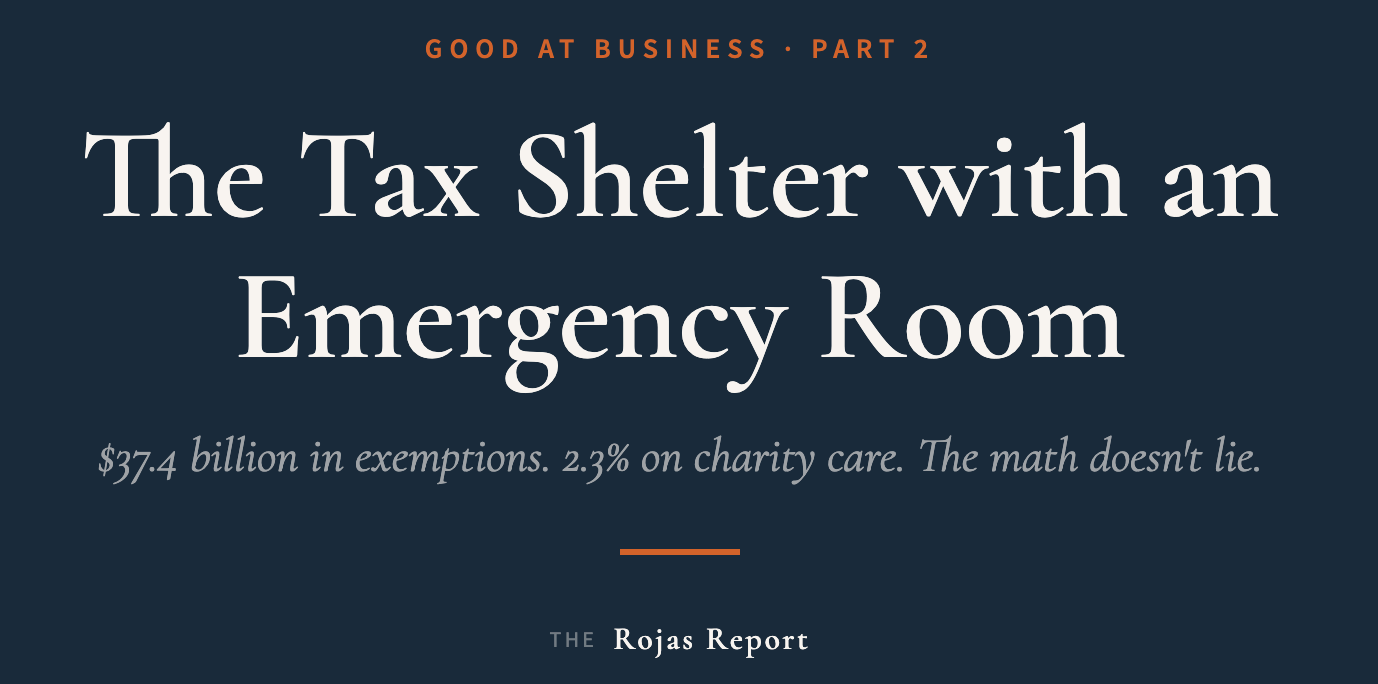
The Tax Shelter with an Emergency Room
What does "Good at Business" mean? Part 2.

Nonprofit doesn’t mean no profit.
It means no shareholders.
The executives still get paid.
The empire still expands.
The collections calls still go out.
The only difference is the tax bill.
Or rather, your tax bill. Because when they don’t pay, you do.
IN TODAY’S ARTICLE:
Why “nonprofit” is a tax classification, not a mission statement
The 212 hospitals that capture 50% of $37.4 billion in tax exemptions
How hospitals count Medicaid reimbursement as “charity” on their tax forms
The lawsuits that caught Providence and Mayo billing patients who qualified for free care
Glossary at the bottom of today’s article.
THE DEAL
Here’s how tax exemption is supposed to work.
A hospital incorporates as a nonprofit. It promises to serve its community. In exchange, it pays no federal income tax. No state income tax. No property tax. No sales tax. It can issue tax-exempt bonds. Donors can deduct their contributions.
The deal was simple.
Except that the deal is broken.
In September 2024, researchers at Johns Hopkins published a study in JAMA quantifying what nonprofit hospitals actually receive in tax exemptions. The number: $37.4 billion annually.
That’s $6.1 billion in federal income tax exemptions.
$8.3 billion in state sales tax exemptions.
$5.3 billion in property tax exemptions.
Plus the value of tax-exempt bonds and tax-deductible donations.
$37.4 billion. Every year. Extracted from your tax base.
THE CONCENTRATION
The exemptions don’t spread evenly.
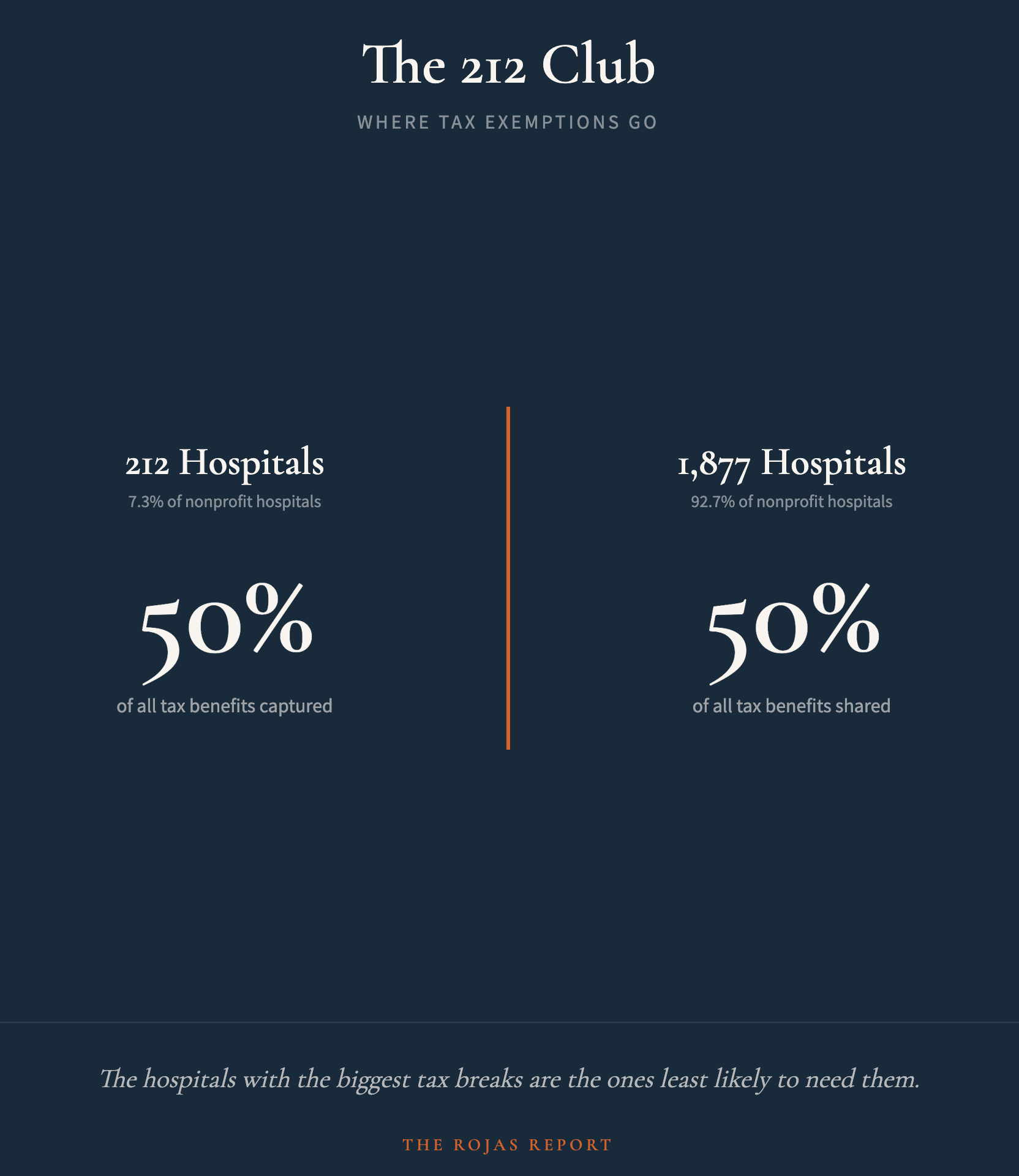
The JAMA study found that 7.3% of nonprofit hospitals, just 212 facilities, capture 50% of all tax benefits.
These aren’t struggling community hospitals in underserved areas.
They’re the flagship institutions of the largest, most profitable systems in the country.
Kaiser Permanente. Providence. CommonSpirit. UPMC. Mass General Brigham.
The health systems with the largest tax breaks are the ones least likely to need them.
State variation compounds the concentration.
Massachusetts hospitals average $541,000 in tax benefit per bed.
Delaware: $21,000 per bed.
Same nonprofit status.
Different extraction rates.
55% of nonprofit hospital tax benefits come from state and local sources, not federal. Your property taxes and sales taxes subsidize systems that may spend less than 2% on charity care.
THE RETURN
What do communities get in exchange for $37.4 billion?
The national average for charity care spending is 2.3% of operating expenses. The median is 1.4%.
Half of all nonprofit hospitals in America spend 1.4% or less on charity care.
The Lown Institute, a nonpartisan healthcare think tank, takes a stricter approach. They compare estimated tax-exempt values to meaningful community investments, excluding categories such as Medicaid shortfalls and research that don’t directly benefit patients.
Their 2024 report analyzed 2,089 nonprofit hospitals nationwide.
77% spend less on community benefit than the value of their tax breaks.
The total combined deficit: $14.2 billion.
THE ACCOUNTING TRICK
Hospitals don’t report charity care on their tax filings.
They report “community benefit.”
The difference is everything.
According to a 2024 Johns Hopkins analysis, nonprofit hospitals reported $95 billion in community benefits. The breakdown reveals the trick:
Medicaid shortfall: $41 billion. That’s 43% of total “community benefit” spending.
Medicaid shortfall is the difference between what Medicaid pays and what hospitals claim the actual costs are. Hospitals are already being paid for these services. Counting the gap as charity is like a grocery store counting expired milk as a donation.
The actual patient-directed services, the financial assistance most people think of as charity care, represent less than 25% of reported community benefit.
“There’s no standardized definition, which means hospitals can report large figures without necessarily showing how these services directly benefit the communities they’re meant to serve.”
— Dr. Hossein Zare, Johns Hopkins
The IRS lets hospitals define their own generosity.
The hospitals have been generous in their definitions.
When is the last time the IRS audited a non-profit health system?
You will not like the answer…
Nonprofit hospitals aren’t bad at charity. They’re good at business. Very good. The question is whether you understand the business they’re in.
