
VERMONT’S PRICE BOARD HAS REAL TEETH. THAT’S THE MOST DAMNING THING ABOUT IT.
The board has the authority, and in 2025, it used it all. What it cannot do is build the second hospital that would make the cutting unnecessary.

The easy story is that Vermont’s price board is toothless.
In September 2025,, it cut $88.5 million off the state’s largest hospital in one order.
It even clawed back one executive’s raise.
IN TODAY’S ARTICLE:
What the board actually did to UVM Medical Center in 2025, by the numbers
What it took to make a price board finally bite: a near-insolvent insurer, a new statute, and a public scandal
Why running a monopoly’s budget line by line is not the same as a market
The second hospital the board can never build, and the option nobody in the room will name
Glossary at the bottom of today’s article.
THE EASY STORY IS WRONG
The easy story about Vermont is that the state built a price board with no power to use.
It is wrong, and the people who repeat it have not read a budget order.
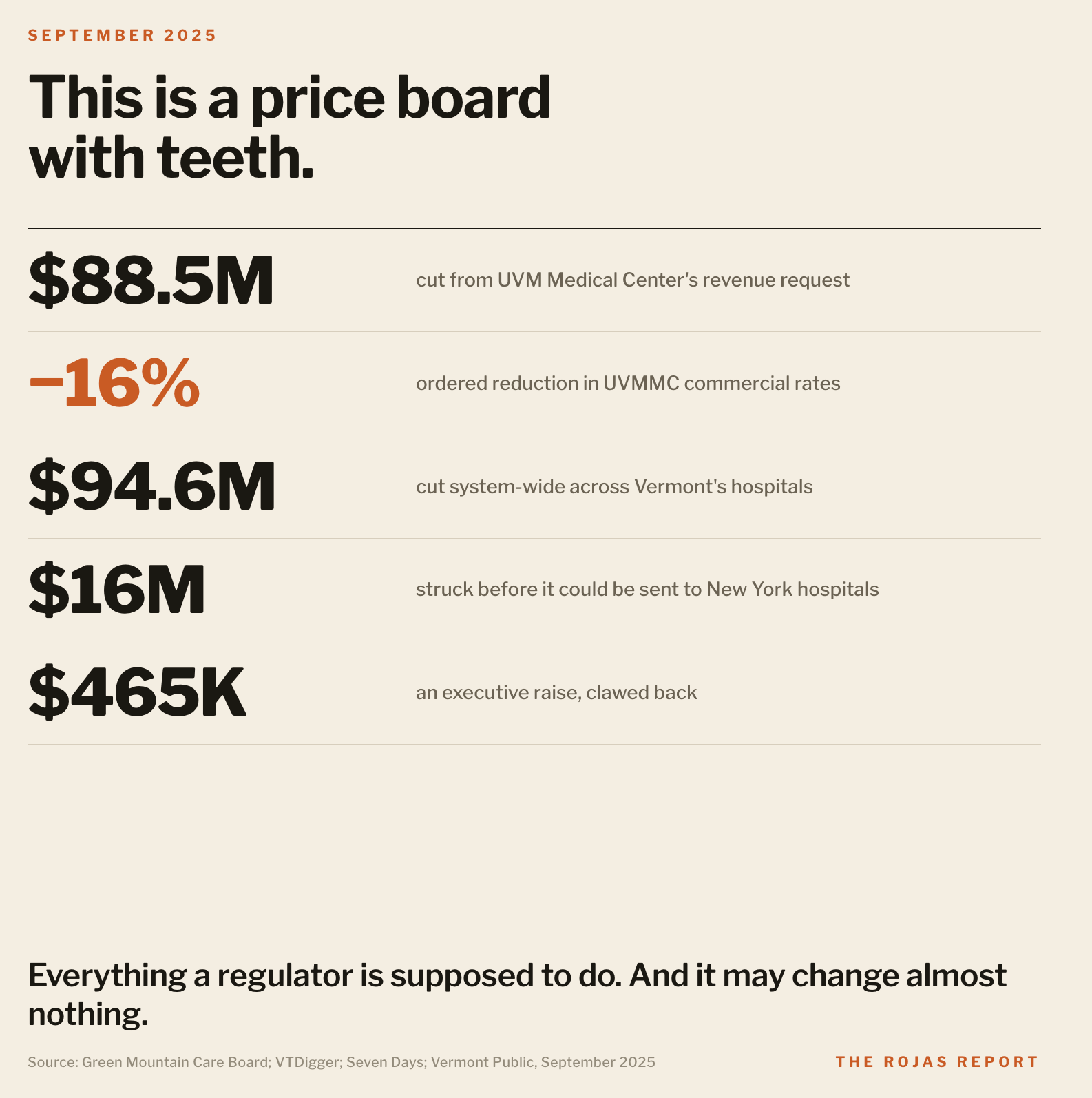
In September 2025, the Green Mountain Care Board cut eighty-eight and a half million dollars off the budget of the University of Vermont Medical Center, the state’s largest hospital, in a single decision.
It ordered the hospital to hold its revenue flat and cut its commercial insurance rates by 16%. It went line by line. It struck the sixteen million dollars the hospital’s parent network planned to ship to its hospitals in New York.
It deleted $465,000 set aside for a 9% raise for the network’s top executives. The hospital’s own chief executive said it was the first time in his career he had watched a commercial rate go down.
That is not a toothless board.
That is a board with teeth, biting hard, in public.
And it is the most damning thing about it.
Because once you accept that the board can do all of that, the comfortable explanation falls apart. The problem in Vermont was never that the regulator lacked power. The regulator has enormous power and proved it.
The problem is what that power actually is, what it took to make the board use it, and what it leaves standing when the cutting is done. All three answers are worse than a weak board would have been.
WHAT THE BOARD DID IN 2025
Start with the receipts, because they decide the argument.
On September 12, 2025, the board cut UVM Medical Center’s net patient revenue request by $88.5 million, a 4.5 percent reduction. Across all fourteen of Vermont’s community hospitals, it cut $94.6 million. The vast majority of that came from one hospital. The board approved eight other hospital budgets exactly as submitted. It aimed the knife at UVMMC on purpose.
On the commercial side, where the money that drives your premium lives, the board ordered UVMMC to hold net patient revenue flat and to lower its commercial insurance rate by 16%. UVMMC’s allowed charges to commercial insurers fell from a proposed $1.16 billion to an approved $1.07 billion.
Then the board did the thing regulators almost never do. It managed the hospital. It removed $16 million the UVM Health Network intended to move out of Vermont to its hospitals in New York. It removed $465,000 from the budget for a 9% raise for top network executives, in a year when the network was cutting frontline positions. The board’s chair, Owen Foster, said the network had become “physically and spiritually distant” from its mission and accused it of using inflated commercial rates in Vermont to subsidize its operations across the state line.
The rate side tells the same story. For 2026 marketplace plans, Blue Cross and Blue Shield of Vermont requested an average increase of 23.3 percent for individual plans and 13.7 percent for small-group plans. The board approved 9.6 percent and 4.4 percent. It cut the request roughly in half.
This is a regulator doing everything its defenders say a regulator should.
It named the monopoly.
It cut the budget.
It capped the rate.
It clawed back an executive raise.
It blocked money from leaving the state.
If administrative price regulation works anywhere, it should work right here.
You can watch a state cut a hospital’s budget and call it a win or you can ask why it had to? Only one of those is reporting. Subscribe.
