
Wall Street Bought a Hedge. It Was a Mirror.
UnitedHealth stacked four businesses on one Medicare dollar and called it diversification. 2025 found the correlation.

Rojas Actual.
Wall Street treated the architecture as a hedge.
When the insurer suffers, the care platform profits.
The pieces offset each other.2025 ran the experiment.
The insurer’s earnings collapsed.
The care platform fell into a loss.The promise was never tested until it failed.
IN TODAY’S ARTICLE:
The thesis: Wall Street priced in owning the insurer, the physicians, the facilities, and the claims infrastructure, and rising care costs shift earnings across the stack instead of leaving the company.
Both sides of the care hedge deteriorated together. UnitedHealthcare’s operating earnings fell 40 percent in 2025. Optum Health swung from $7.77 billion in earnings to a $278 million loss.
The reason: CMS premiums supplied 44 percent of consolidated revenue, and every floor of the structure eats the same dollar. Four businesses, one government-priced payment.
The recovery plan confirms the diagnosis. It reduced exposure across the same stack: fewer Medicare Advantage members, tighter physician relationships, and higher pricing on the business that remained.
Glossary at the bottom of today’s article.
THE PITCH
The architecture took two decades to assemble and one sentence to sell.
Own the insurance company that collects the premium. Own the physicians who direct the care. Own the surgery centers and home-health agencies where the care happens. Own the claims rails the money moves across. Then tell Wall Street the pieces hedge each other: in a year when medical costs spike, the insurance segment suffers, but every dollar of that extra care flows into facilities and physician groups the same company owns. Heads, the insurer wins. Tails, the care platform catches the coin.
The market priced the architecture as a diversified earnings machine.
Diversification works only when risks do not move together under stress. Nobody ran that test on UnitedHealth’s stack, because through 2024, every segment went up. A hedge that has never been stressed is indistinguishable from a pile.
Then 2025 stressed it.
THE EXPERIMENT
The collapse arrived on a schedule.
April 17, 2025: UnitedHealth reports its first earnings miss since 2008, and cuts adjusted EPS guidance from a range of $29.50 to $30.00 down to $26.00 to $26.50. Medicare Advantage utilization is running hotter than the bids assumed.
May 13, 2025: CEO Andrew Witty resigns. Stephen Hemsley returns to the top job. Guidance is withdrawn entirely.
July 29, 2025: the reset. Adjusted EPS of at least $16, nearly half the original number. The company discloses that expected company-wide medical expense for 2025 sits $6.5 billion above its original assumption.
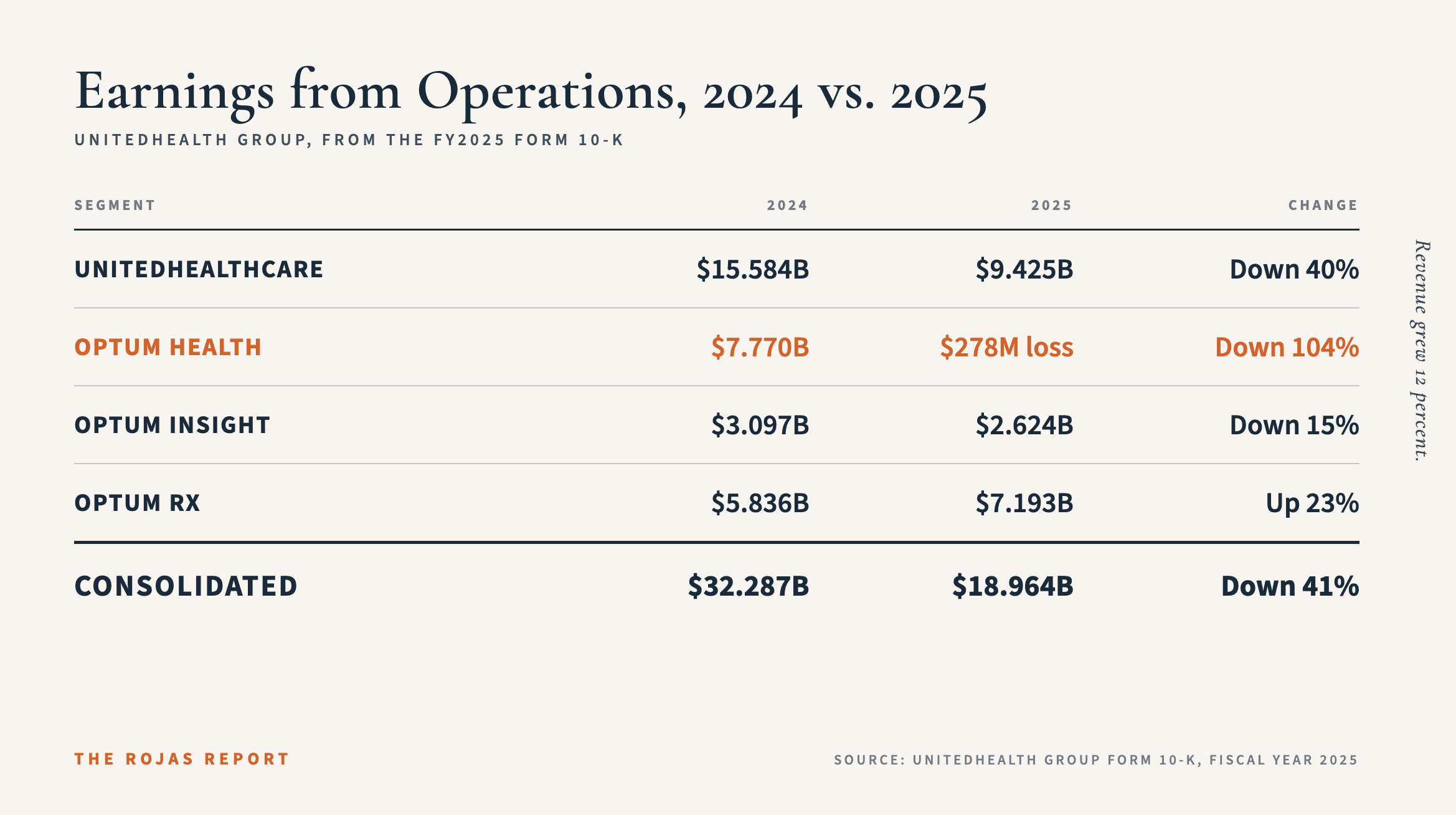
Read the table the way an underwriter reads a loss run.
The insurer kept its profit and lost 40 percent of it. The care-delivery platform, the segment built to profit when the insurer bleeds, did not catch the coin. It swung from $7.77 billion in earnings to a loss. The claims-infrastructure segment fell 15 percent. Consolidated operating earnings dropped 41 percent in a year when revenue grew 12 percent. The company sold more of everything and kept less of all of it.
One segment grew. Optum Rx, the pharmacy business, rose 23 percent. It carried a broader external customer base and different earnings drivers than the insurer and the delegated-risk physician platform. The exception defines the rule: the only major segment that grew was also the one least dependent on the insurer-care loop this article examines.
The hedge Wall Street bought, an insurer against care platform, deteriorated on both sides in the same twelve months. That is not what a hedge does under stress. That is what a mirror does.
THE CORRELATION
Here is the correlation the diversification story concealed.
At year-end 2025, CMS premiums generated 44 percent of UnitedHealth’s consolidated revenue. UnitedHealthcare carried 8.4 million Medicare Advantage members and priced the benefit. Optum Health accepted delegated risk on the medical costs of many of those same members.
Optum-owned physicians and facilities delivered care to that population in the geographies where the insurer concentrated its operations, as the first article documented. Optum Insight processed part of the transaction flow. And roughly a quarter of consolidated revenue is intercompany, eliminated in the financial statements. The insurer pays Optum. Optum bills the insurer.
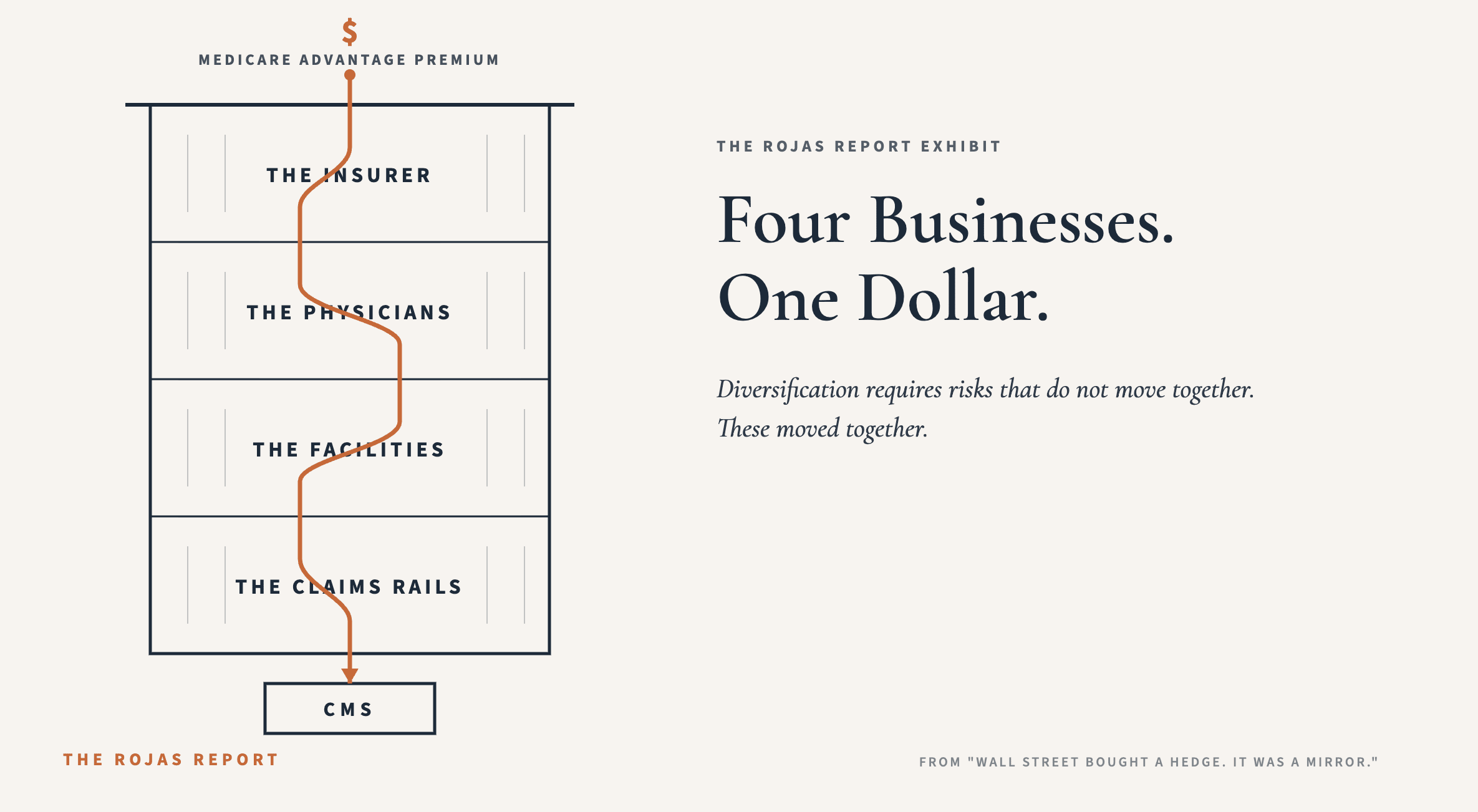
Stack the floors.
The premium floor collects the government-priced Medicare Advantage dollar. The physician floor takes delegated risk on that same dollar. The facilities floor treats the members that dollar covers. The claims floor processes the transactions that dollar generates. Four floors, one dollar, one landlord in Washington.
Then the assumptions failed from two directions at once. CMS changed how payments were calculated, completing the phase-in of its revised risk-adjustment model, which the industry calls V28. And utilization ran past the assumptions built into the bids and the risk contracts. One pressure was payment methodology. The other was medical-cost experience. Both traveled through businesses tied to the same members and the same dollar, because every floor had priced the same set of revenue and cost assumptions.
The four businesses did different jobs. Too many of them depended on the same federal payment, the same members, and the same utilization forecast. They were never four exposures. They were one exposure wearing four uniforms.
The internal customer looked like a hedge on an investor slide. Under stress, it behaved like a mirror: whatever happened to the insurer happened to its reflection, at the same time, for the same reason.
Wall Street found the correlation after the earnings collapsed.
Supporters receive the recovery plan that confirms it.
